
The best science experiment sets for high school students turn abstract lessons into practical investigations. Whether a student is exploring chemical reactions, building circuits, studying DNA, or testing mechanical principles, the right kit can make independent learning more structured and engaging.
This roundup compares 10 options across chemistry, physics, biology, microbiology, and STEM. We focus on experiment variety, instructional support, included equipment, safety considerations, and the type of learner each set suits best.
Best 10 Science Experiment Sets for High School Students Picks for 2026
Advanced Chemistry Pick

- 333+ experiments across major chemistry fields
- Real lab equipment and selected chemicals
- 192-page manual with integrated safety guidance
Best For: Aspiring chemists and advanced, supervised home study
Hands-On Physics Pick
EUDAX Electricity and Magnetism Lab
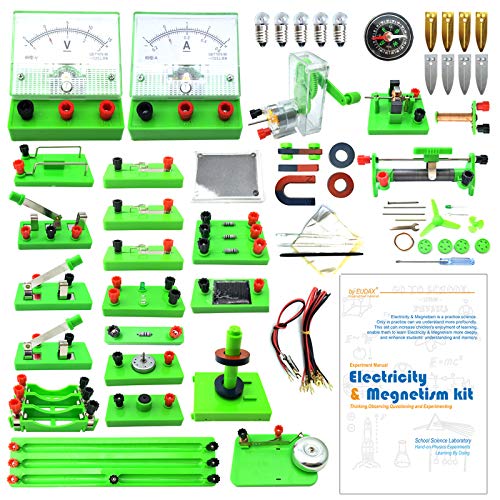
- Build circuits, electromagnets, and generators
- Includes 79 listed items and a color manual
- Batteries are required but not included
Best For: Grades 9–11 exploring basic electricity and magnetism
Intermediate Chemistry Pick

- 250 experiments in 18 themed chapters
- Includes alcohol burner and real lab equipment
- Full-color manual supports progressive learning
Best For: Students moving from beginner kits into high school chemistry
Microbiology Project Pick
Evviva Sciences Agar Plate Kit

- Includes 10 pre-poured nutrient agar plates
- Designed for hands-on microbiology projects
- Includes swabs, pipette, vial, and eBook guide
Best For: Students 15+ exploring microbiology or science-fair projects
Biology Deep Dive

- 20 guided genetics and DNA experiments
- Includes DNA model and chromosome puzzle
- Full-color 48-page instructional manual
Best For: Ages 10–16 exploring genetics and introductory biology
Optics Exploration
Physics Optical Experiment Set

- Demonstrates refraction and reflection
- Includes lenses, prism, mirrors, and light source
- Recommended for ages 14 and up
Best For: Students studying hands-on physical optics
Broad STEM Starter

- Includes up to 150 varied experiments
- Covers chemistry, physics, and earth science
- Step-by-step illustrated manual included
Best For: Younger learners and families exploring many STEM topics
Hands-On Mechanics Lab

- 26 experiments covering core mechanics concepts
- Includes pulleys, force gauge, balance, trolley, and ramp
- Manual and storage box support organized learning
Best For: High school physics mechanics practice
Build-and-Test Circuits
EUDAX Electricity Experiment Set

- Projects include series, parallel, and switch circuits
- Explores electromagnets, generators, LEDs, and wind power
- Color manual and transparent storage box included
Best For: Introductory electricity and magnetism projects
Expanded Electromagnetism Lab
Physics Electricity & Magnetism Kit

- Includes 55 electrical and 22 magnetism components
- Covers Ohm’s law, circuits, electromagnets, and generators
- Double-layer case and detailed manual included
Best For: High school electricity and electromagnetism study
Advanced Chemistry Pick – Thames & Kosmos CHEM C3000
For students seeking science experiment sets for high school students with substantial chemistry depth, the Thames & Kosmos CHEM C3000 offers more than 333 hands-on experiments across inorganic, organic, and electrochemistry topics. Its extensive equipment selection and detailed manual make it better suited to serious, supervised study than casual play.
Best For: Aspiring chemists, homeschool students, and high school learners ready for advanced, hands-on chemistry.
Pros:
- Includes more than 333 experiments organized into 27 chapters.
- Covers advanced topics including chemical bonding, electrolysis, redox reactions, and organic chemistry.
- Provides real lab equipment, chemicals, safety goggles, and a 192-page full-color manual.
- Includes safety, first-aid, labeling, and waste-disposal guidance.
Cons:
- Adult supervision is required throughout.
- Some experiments require common household additions.
- The advanced scope may be more than beginners need.
CHEM C3000 is the most comprehensive option in this group for students who want a broad home chemistry curriculum. Its 12+ recommendation and extensive safety guidance make supervision and careful preparation essential.
Hands-On Physics Pick – EUDAX Electricity and Magnetism Lab
Among science experiment sets for high school students, the EUDAX School Physics Labs kit focuses on practical electricity and magnetism projects. It gives students components for building circuits, investigating electromagnetism, and exploring basic electronic principles with guidance from a color manual.
Best For: Students in grades 9–11 who want an accessible introduction to electricity, magnetism, and circuit building.
Pros:
- Supports projects involving series and parallel circuits, fruit batteries, and Ohm’s law.
- Includes electromagnetism activities such as an electromagnet, electric bell, and hand-crank generator.
- Provides 79 listed items, repair tools, a storage bag, and a color-page manual.
- Offers a hands-on way to build simple electrical and magnetic models.
Cons:
- Three AA batteries are required but not included.
- The kit is focused on basic electricity and magnetism rather than a broad physics curriculum.
- The supplied age range spans younger learners as well as high school students.
This is a practical choice for learners who prefer constructing and testing models over reading through a large collection of experiments. Plan to supply the required batteries before starting.
Intermediate Chemistry Pick – Thames & Kosmos CHEM C2000
The Thames & Kosmos CHEM C2000 is a strong middle-ground choice among science experiment sets for high school students. It provides 250 real chemistry experiments, an intermediate progression, and equipment such as an alcohol burner for heat-based investigations.
Best For: Students building a foundation in high school chemistry and learners moving beyond beginner-level experiments.
Pros:
- Offers 250 experiments across 18 themed chapters.
- Covers acids and bases, gases, food chemistry, chromatography, electrolysis, and more.
- Includes an alcohol burner, glass equipment, goggles, and selected chemicals.
- Provides a 128-page full-color manual with step-by-step explanations.
Cons:
- Adult supervision is required, especially for heat-based experiments.
- Some experiments require careful handling, labeling, and waste disposal.
- Its recommended age range is narrower than the C3000’s and may not suit every high school student.
CHEM C2000 balances breadth and approachability well. It is less extensive than the C3000 but still provides genuine lab-style activities and a logical route into high school chemistry.
Microbiology Project Pick – Evviva Sciences Agar Plate Kit
For older students interested in biology, this Evviva Sciences kit is a focused alternative to broader science experiment sets for high school students. Pre-poured nutrient agar plates let learners begin microbiology activities without melting or preparing agar themselves.
Best For: Students age 15 and older working on introductory microbiology or science-fair projects.
Pros:
- Includes 10 pre-poured agar Petri dishes ready for experiments.
- Comes with cotton-tipped swabs, a pipette, a plastic vial, instructions, and an experiment eBook.
- Eliminates the need to technically melt and pour agar.
- Targets hands-on biology and microbiology learning.
Cons:
- Its subject area is narrower than chemistry or physics kits.
- The manufacturer recommends it for ages 15 and older.
- The supplied components are limited to the listed microbiology materials.
This kit is convenient when the project goal is specifically microbiology rather than a general STEM survey. Its ready-to-use plates reduce setup, while the included guide provides a starting point for classroom or science-fair exploration.
Biology Deep Dive – Genetics & DNA Lab
For students interested in science experiment sets for high school students, the Thames & Kosmos Genetics & DNA Lab provides a focused introduction to genetics through 20 guided experiments. It combines hands-on activities, including plant DNA isolation, with models and worksheets that help connect the experiments to core biology concepts.
Best For: Learners ages 10–16 who want a structured, biology-focused lab experience covering DNA, cells, chromosomes, and inheritance.
Pros:
- Includes 20 experiments supported by a 48-page, full-color manual.
- Explores plant DNA isolation, biological inheritance, cells, and chromosomes.
- Includes a DNA model, chromosome puzzle, worksheet, test tubes, filter paper, and other lab components.
Cons:
- The theme is specialized around genetics and DNA rather than covering a broad range of science topics.
- Some activities use included consumable materials such as filter paper and agar.
This is a strong choice when the goal is an organized introduction to molecular biology rather than a general experiment assortment. The manual and included models make it especially suitable for guided learning at home or as a supplement to biology coursework.
Optics Exploration – Physics Optical Experiment Set
This physics optical experiment set is a practical option among science experiment sets for high school students who want hands-on demonstrations of light. Its acrylic lenses, triangular prism, mirrors, reflector, and adjustable three-way light source support experiments involving refraction, reflection, and lens behavior.
Best For: Students ages 14 and up studying physical optics and looking for compact, demonstration-style equipment.
Pros:
- Supports experiments with refraction, reflection, convex and concave lenses, mirrors, and a prism.
- Includes three biconvex lenses, concave and convex lenses, a triangular prism, reflector, and light source.
- Comes with an English color-page manual and a compact storage box.
Cons:
- Requires two AAA batteries, which are not included.
- The light source may require screwdriver adjustment to change the light direction.
- It focuses specifically on optics rather than providing experiments across multiple science disciplines.
Choose this set when optics is the priority and you want visible demonstrations of how light behaves through lenses, mirrors, and a prism. Its compact size suits indoor study, classroom demonstrations, or focused physics practice.
Broad STEM Starter – 150 Experiments Science Kit
The UNGLINGA 150 Experiments kit offers broad variety for families comparing science experiment sets for high school students, although its recommended age starts at 8 years. Projects span earth science, surface tension, chemistry, physics, crystals, and more, with a step-by-step manual and many tools and materials included.
Best For: Younger learners and families seeking a wide-ranging, activity-based STEM kit for guided experiments at home.
Pros:
- Offers up to 150 experiments across chemistry, physics, earth science, and other topics.
- Includes kid-friendly science tools and materials, including goggles.
- Illustrated, step-by-step instructions make activities easier to follow.
Cons:
- Some projects require ordinary household items in addition to the included materials.
- Its recommended age of 8 and up may make it less advanced than a specialized high-school lab set.
- The broad selection provides less depth in any single science subject.
This kit is best viewed as a high-volume exploration set rather than a formal high-school laboratory course. It can work well for introductory practice, family science time, or students who prefer trying many short projects across different STEM topics.
Hands-On Mechanics Lab – Physics Mechanics Kit
For shoppers comparing science experiment sets for high school students, this mechanics kit offers a broad selection of hands-on equipment for exploring classical physics. Its 26 experiments use tools such as pulleys, a balance, force gauge, trolley, ramp, and pressure gauge to connect classroom concepts with practical demonstrations.
Best For: High school students, physics classrooms, and independent learners studying mechanics, Newton’s laws, kinematics, gravity, pressure, buoyancy, pulleys, and levers.
Pros:
- Includes equipment for 26 mechanics experiments.
- Covers force, friction, pressure, buoyancy, simple machines, and related concepts.
- Comes with a detailed manual and organized storage box.
- Designed for ages 14 and up with metal and plastic components.
Cons:
- Focused on mechanics rather than electricity, magnetism, or other physics areas.
- The product dimensions and collection of components may require dedicated storage space.
This is a strong choice when the goal is structured, equipment-based mechanics practice rather than a general-purpose science kit. The included manual and portable storage support repeated classroom or home use.
Build-and-Test Circuits – EUDAX Electricity Experiment Set
Among science experiment sets for high school students, this EUDAX kit is centered on building basic electrical and magnetic models. It includes switches, wires, bulbs, LEDs, and other components for guided projects such as series and parallel circuits, electromagnets, a hand-crank generator, and a wind-powered car.
Best For: Students in grades 7–11 and teachers introducing electricity, magnetism, circuit construction, and beginner STEM projects.
Pros:
- Supports multiple projects, including traffic lights, electromagnets, and generators.
- Includes a full-color manual for learning principles and following experiments.
- Parts are stored in a transparent box for easier organization.
- Ready to use out of the box apart from the required two AA batteries.
Cons:
- Two AA batteries are required but not included.
- Its recommended age range and project scope are geared toward introductory work rather than advanced electronics.
This kit works well for learners who benefit from assembling circuits instead of only reading about them. The variety of guided builds makes it a practical starting point for classroom demonstrations or supervised home projects.
Expanded Electromagnetism Lab – Physics Electricity & Magnetism Kit
For students seeking science experiment sets for high school students with broader component coverage, this electricity and magnetism kit combines 55 electrical components with 22 magnetism components. Its manual guides projects involving circuits, Ohm’s law, fruit batteries, electromagnets, magnetic fields, electric bells, and hand-crank generators.
Best For: Junior and senior high school students, physics coursework, and independent STEM exploration in electricity, electromagnetism, and basic electronics.
Pros:
- Provides 77 components across electricity and magnetism activities.
- Includes specialized items such as a sensitive ammeter and magnetically controlled switch.
- Supports guided experiments and creative projects beyond the manual.
- Uses a sturdy double-layer storage box for transport and organization.
Cons:
- Three AA batteries are required and not included.
- The larger component set may be more involved for beginners seeking only simple circuit activities.
This is the most extensive option of the three for electricity and magnetism, especially if students need equipment that extends beyond basic circuit building. Its component variety supports both curriculum-aligned experiments and more independent investigation.
How We Picked These Science Experiment Sets for High School Students
We looked for kits that support meaningful, repeatable experiments rather than relying only on demonstrations or novelty activities. Selection criteria included the range and educational value of the experiments, clarity of the lab manual or instructions, the quality and usefulness of included components, and how well each kit fits high-school-level study.
We also considered subject coverage. The selection includes advanced chemistry sets, electricity and magnetism kits, optics and mechanics equipment, microbiology supplies, genetics activities, and broader introductory STEM options. Because contents can vary by seller and package version, check the current listing for exact component and refill details before buying.
Quick Comparison
- Chemistry: Thames & Kosmos Chem C2000 and C3000 provide structured chemistry experiments with laboratory-style equipment.
- Electricity and magnetism: EUDAX circuit kits and the physics electricity-and-magnetism set suit learners who prefer hands-on wiring and electromagnetism.
- Biology: The microbiology and Genetics & DNA kits focus on specific life-science topics.
- Optics and mechanics: The optical and mechanics sets are useful for studying light, force, motion, pulleys, lenses, and mirrors.
- Broad activity range: The UNGLINGA set offers many introductory experiments, though buyers should verify whether its depth matches high-school coursework.
Key Buying Factors
Subject and Difficulty
Start with the student’s current course and goals. A chemistry student may benefit more from a focused intermediate or advanced chemistry set than from a general kit. Physics learners should choose among circuits, optics, mechanics, or a combination based on the concepts they need to practice.
Experiment Quality and Instructions
A high experiment count is not automatically better. Look for clear procedures, explanations of the underlying concepts, suggested observations, and opportunities to record results. A well-written manual can make the difference between guided learning and trial-and-error assembly.
Equipment, Consumables, and Refills
Check whether the kit includes genuine measuring tools, wires, lenses, sensors, chemicals, prepared plates, or other specialized components. Identify which materials are used up and whether replacements are easy to obtain. Some kits may require household items, extra batteries, protective equipment, or a separate microscope.
Safety and Supervision
Review the age guidance, chemical warnings, sterilization instructions, and required protective equipment. Chemistry and microbiology activities deserve particular attention, and experiments involving heat, glass, electricity, or biological samples should be performed with suitable adult or teacher supervision.
Who Should Buy Which Science Experiment Sets for High School Students?
Choose the Thames & Kosmos Chem C2000 or C3000 for a student who wants a substantial chemistry-focused lab experience. Select an EUDAX circuit kit or the broader electricity-and-magnetism set for practical electronics and electromagnetism work. The microbiology kit is a good fit for learners interested in culturing and observing microorganisms, while the Genetics & DNA Lab is better for biology projects centered on heredity and molecular concepts.
For physics coursework, choose the optical experiment set for lenses, mirrors, and light; the mechanics kit for forces and motion; or combine a specialized set with a circuit kit for wider coverage. The UNGLINGA 150-experiment kit makes the most sense for families seeking variety and introductory STEM activities, provided its instructions and included materials meet the student’s academic needs.