
The best solar system models for children turn abstract astronomy lessons into hands-on activities. These picks range from simple wooden puzzles and ceiling displays to buildable, gear-driven, and talking planetarium kits.
Use the guide below to match a model with a child’s age, patience, space, and interest in crafting, science, or imaginative play.
Best 10 Solar System Models for Children Picks for 2026
Best Glow-and-Build Pick
National Geographic Solar System Model

- Paintable 3D planets and Sun
- Glow-in-the-dark display accents
- Movable arms for rearranging planets
Best For: Creative learners ages 8 and up
Best Interactive Building Set
LEGO Planet Earth and Moon in Orbit
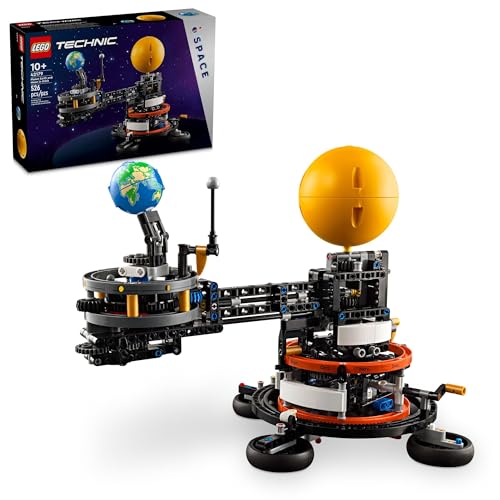
- 526-piece LEGO Technic build
- Crank-operated orbital movement
- Shows months and moon phases
Best For: Builders ages 10 and up who enjoy hands-on astronomy
Best Projector Model
Talking Solar System Planetarium

- Projects 24 space images
- English and Spanish planet facts
- Doubles as a night light
Best For: Young visual learners ages 3 to 12
Best Preschool Puzzle

- Eight smooth wooden planet balls
- Includes planet explanation flashcards
- Hands-on tabletop puzzle play
Best For: Preschool learners ages 3 to 7
Glow-In-The-Dark Favorite
3D Glow Solar System Ceiling Kit

- Nine glow-in-the-dark planets plus 200+ stars
- Removable adhesive stars are designed not to damage walls
- Includes planetary facts and needs no batteries
Best For: Ages 5+ and space-themed bedroom decor
Preschool Hands-On Pick

- Includes 10 photographed wooden planet pieces
- Smooth, easy-grip pieces support fine-motor practice
- Lightweight design works well for travel or tabletop play
Best For: Preschoolers ages 3–5 learning planet basics
Creative Project Choice
64-Piece Solar System Model Kit

- Includes foam pieces, paints, brushes, sticks, and flags
- Lets kids color and build their own planetary model
- Designed for school projects and family activities
Best For: Ages 6–12 and hands-on astronomy projects
Glow-and-Learn Pick
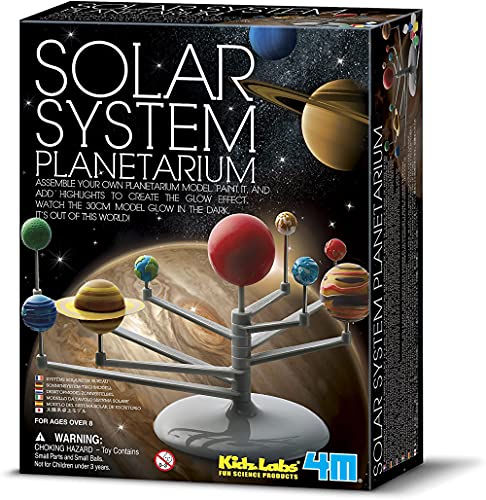
- Paint-and-assemble astronomy activity
- Includes glow paint, chart, and quiz questions
- Battery-free kit for ages 8 and up
Best For: Creative STEM learners who want a glow-in-the-dark display
Science Fair Craft Pick
Nine Planets DIY Solar System Model

- Wood model, puzzle, paint, and brushes included
- Fact cards support astronomy learning
- Designed for ages 8 to 12
Best For: Hands-on projects, classroom displays, and science fairs
Interactive Builder Pick
Smartivity Gear-Driven Solar System Model

- Builds into a rotating planetary model
- Introduces orbits, day, and night
- Eco-friendly MDF design for ages 8 to 14
Best For: Kids who enjoy construction and interactive mechanisms
Best Glow-and-Build Pick – National Geographic Solar System Model
For children who enjoy hands-on solar system models for children, this National Geographic kit combines construction, painting, and display. Kids ages 8 and up build and customize all eight planets and the Sun, then arrange them on movable arms for a flexible space-themed decoration.
Best For: Creative learners ages 8 and up who want a glowing, paintable astronomy project.
Pros:
- Includes planets, Sun, paints, brush, palette, decals, and a facts poster.
- Glow-in-the-dark accents make the finished model suitable for bedroom display.
- Movable arms allow children to adjust the planet positions.
- Supports construction, creativity, hand-eye coordination, and problem-solving skills.
Cons:
- Requires painting and assembly, so it may need adult help for younger users.
- Recommended for ages 8 and up rather than preschool children.
This is a strong choice when the building and decorating process matters as much as the finished model. It offers a creative introduction to the planets while adding glow-in-the-dark room decor.
Best Interactive Building Set – LEGO Planet Earth and Moon in Orbit
LEGO Technic Planet Earth and Moon in Orbit is one of the more interactive solar system models for children, combining a 526-piece build with a working orbital display. Designed for ages 10 and up, it lets children turn a crank to observe the Earth and Moon moving around the Sun.
Best For: Older children who enjoy detailed LEGO construction and learning about orbital movement, months, and moon phases.
Pros:
- Crank-operated design demonstrates Earth and Moon orbits.
- Printed details show months and moon phases.
- LEGO Builder app offers 3D viewing, progress tracking, and building guidance.
- Finished model works as space-themed room decor.
Cons:
- The 526-piece build may be demanding for children unfamiliar with LEGO Technic sets.
- Recommended for ages 10 and up, limiting its suitability for younger children.
Choose this set for a child who prefers engineering-style building and an interactive result. Its moving mechanism provides a particularly clear way to connect construction play with basic astronomy concepts.
Best Projector Model – Talking Solar System Planetarium
This talking solar system model is a versatile option among solar system models for children, combining an eight-planet display with a projector, bilingual facts, and a night-light function. It is designed for children from 3 years old through age 12 and includes 24 images across three projection discs.
Best For: Younger children who benefit from visual, audio, and bilingual English-Spanish astronomy activities.
Pros:
- Projects planets, spacecraft, astronauts, and other space images onto a wall or ceiling.
- Provides astronomy facts in both English and Spanish.
- Includes 24 HD images on three slide discs.
- Can serve as a night light or flashlight as well as a learning toy.
Cons:
- Requires three AA batteries, which are not included.
- The projector adds electronic features beyond a traditional physical model.
- Projection quality depends on positioning and adjusting the focus knob.
This model suits families looking for more than a tabletop display. Its projector and talking features encourage exploration before bedtime, while the bilingual option can support shared learning in English and Spanish.
Best Preschool Puzzle – Wooden 3D Planet Puzzle
For preschoolers seeking tactile solar system models for children, this wooden puzzle offers a simple tabletop introduction to the planets. The set includes eight smooth wooden planet balls, eight explanatory flashcards, and three puzzle pieces that form a cartoon solar system.
Best For: Children ages 3 to 7 who are beginning to learn planet names, positions, and basic space concepts through play.
Pros:
- Includes eight wooden 3D planet models and eight planet flashcards.
- Smooth, rounded wooden spheres are easy for small hands to grasp.
- Three puzzle pieces assemble into a tabletop solar system.
- Supports observation, imagination, exploratory skills, and STEM learning.
Cons:
- Manual puzzle play does not provide moving or electronic features.
- The compact tabletop format may offer less display impact than larger models.
This is a practical starter set for younger children who learn best by handling and matching pieces. The flashcards add context to the puzzle, while the wooden construction keeps the activity straightforward and screen-free.
Glow-In-The-Dark Favorite – 3D Glow Solar System Ceiling Kit
For children who enjoy space-themed room decor, this glow-in-the-dark kit offers a simple, display-focused option among solar system models for children. It includes nine planets, more than 200 adhesive stars, and a guide with planetary facts, with no batteries required.
Best For: Kids ages 5 and up who want a glowing solar system display and an introduction to planetary facts.
Pros:
- Includes nine glow-in-the-dark planets and over 200 adhesive stars.
- Stars come in different sizes and are designed to be easy to remove without damaging walls.
- Can function as night-light-style room decor and includes a solar system guide.
Cons:
- It is primarily a ceiling or wall display rather than a hands-on building model.
- The manufacturer-recommended age is listed as 5 years, so older children may want a more advanced project.
This is a strong pick when visual appeal and easy installation matter most. Choose it for bedroom decor and casual STEM exposure rather than detailed model construction.
Preschool Hands-On Pick – Wooden Solar System Puzzle
This compact wooden puzzle is a practical choice for younger children comparing solar system models for children. It uses 10 easy-grip planet pieces with actual planet photographs, giving preschoolers a tabletop way to practice matching, placement, and basic space recognition.
Best For: Preschoolers ages 3 to 5 who need a quiet, portable activity that supports fine-motor practice and introductory astronomy.
Pros:
- Features 10 wooden planet pieces with realistic planet photographs.
- Sanded, burr-free edges and toddler-sized pieces support comfortable handling.
- Lightweight, thin design makes it suitable for travel, classrooms, or homeschool activities.
Cons:
- It is a flat assembly puzzle, not a three-dimensional planetary model.
- The set is intended for indoor, tabletop play and has only one included puzzle board.
Its strongest advantage is accessibility: children can handle, place, and identify pieces without paints or complicated assembly. It is best suited to foundational learning rather than detailed scale or orbit demonstrations.
Creative Project Choice – 64-Piece Solar System Model Kit
For children who learn best by making things, this 64-piece kit is an activity-centered option among solar system models for children. It supplies foam components, paints, brushes, sticks, flags, and an instruction guide so kids can color and assemble a model for a school project or family activity.
Best For: Children ages 6 to 12 completing a classroom assignment or exploring astronomy through painting and construction.
Pros:
- Includes foam discs, a sun, 12 foam balls, stars, bamboo sticks, flags, paints, brushes, and a palette.
- Coloring and assembly encourage hands-on creativity, focus, and hand-eye coordination.
- Suitable for school solar system projects, classroom activities, or family crafting.
Cons:
- Because children paint the pieces themselves, setup and adult guidance may be helpful.
- The product is made from foam, so it may be less suitable for children seeking a rigid display model.
This kit offers more active involvement than a ready-made display or puzzle. It is the better fit when the goal is a creative science project, though the finished result will depend on the child’s assembly and painting.
Glow-and-Learn Pick – 4M Solar System Planetarium
For families comparing solar system models for children, the 4M Solar System Planetarium combines assembly, painting, and basic astronomy learning in one hands-on kit. It includes planets, stencils, glow paint, rods, string, a fact-filled wall chart, and quiz questions, with instructions for assembly.
Best For: Children ages 8 and up who enjoy creative STEM projects and want a glow-in-the-dark display.
Pros:
- Combines model building, painting, and astronomy lessons.
- Includes a glow paint pen for a display that can glow in the dark.
- Comes with a wall chart and 10 sets of Kidz Quiz questions.
- Does not require batteries.
Cons:
- Assembly and painting require time and adult guidance may be useful.
- Pluto is not included.
- Recommended for ages 8 and up, so it may be too advanced for younger children.
This is a creative option for children who learn best by making and decorating. Choose it when the glow-in-the-dark feature and included learning materials are more important than an interactive rotating mechanism.
Science Fair Craft Pick – Nine Planets DIY Solar System Model
Among solar system models for children, this Nine Planets kit stands out as a craft-focused project with a wood model, puzzle, paint, brushes, and fact cards. It is designed for children ages 8 to 12 and can be displayed in a bedroom, classroom, or science fair.
Best For: Ages 8 to 12 working on a hands-on astronomy project or science fair display.
Pros:
- Includes a wood model, puzzle, paint, and brushes.
- Fact cards provide quick solar system information.
- Designed to be completed in approximately 1 to 2 hours.
- Can be used for bedroom, classroom, or science fair display.
Cons:
- The project requires painting and assembly.
- Its recommended age range is limited to ages 8 to 12.
- The listed manufacturer warranty is 30 days.
This kit is a practical choice when the goal is a contained craft project with supporting fact cards. It suits children who want to build and paint a model rather than operate a moving planetary display.
Interactive Builder Pick – Smartivity Gear-Driven Solar System Model
For children who prefer moving builds, this Smartivity kit offers a gear-driven solar system model that rotates after assembly. It uses construction and basic astronomy concepts to introduce planets, orbits, day, night, and the solar system’s structure.
Best For: Children ages 8 to 14 who enjoy building mechanisms and exploring how planets move around the Sun.
Pros:
- Creates a rotating model through a gear-driven design.
- Teaches planets, orbits, day and night through hands-on play.
- Combines construction, creativity, and basic astronomy.
- Uses eco-friendly, child-safe MDF materials.
Cons:
- The kit requires assembly before the model can be used.
- It does not list paint, fact cards, or quiz materials among the included components.
- Its recommended age range begins at 8, making it less suitable for younger children.
This is the strongest fit for children who want an interactive building challenge rather than a primarily decorative model. The rotating mechanism adds play value while reinforcing introductory space and motion concepts.
How We Picked These Solar System Models for Children
We focused on models that offer a clear way to explore planets, orbits, scale concepts, or basic astronomy through building, arranging, observing, or interactive play. The selection includes options for preschoolers, elementary-age children, tweens, and teens, with different levels of adult involvement.
We also considered activity type, durability, display value, educational usefulness, and whether the kit is best suited to open-ended play, a guided project, a classroom assignment, or a bedroom decoration. Always check the recommended age and included materials before buying, since some kits may require batteries, glue, paint, or extra tools.
Quick Comparison
| Best For | Look For |
|---|---|
| Preschool learning | Large pieces, simple puzzles, and minimal small parts |
| Hands-on STEM | Buildable parts, moving mechanisms, or guided experiments |
| Independent projects | Clear instructions and age-appropriate assembly |
| Bedroom displays | Glow features, ceiling mounting, or attractive finished models |
| Older children | More complex construction, facts, and orbit demonstrations |
Key Buying Factors for Solar System Models for Children
Age and Complexity
Age guidance is one of the most useful filters. Younger children generally benefit from chunky wooden puzzles and straightforward matching activities, while older children may enjoy kits with multiple construction steps, moving planets, or astronomy facts. A project that is too difficult can quickly become an adult-led craft rather than an engaging learning activity.
Learning Style
Choose a format that fits the child. Visual learners may prefer a glow-in-the-dark ceiling kit or a finished display. Children who enjoy making things may prefer a DIY planetarium, wood model, or gear-driven system. Talking and fact-based kits can support questions and discussion, while puzzles reinforce recognition and sequencing.
Materials and Safety
Check whether the model uses wood, plastic, foam, paper, or a combination of materials. Look for sturdy construction and clearly labeled small parts. Younger children should use models with age-appropriate pieces under supervision, especially when kits include magnets, batteries, paint, glue, or tiny accessories.
Space and Presentation
Consider where the finished model will go and how much room assembly requires. A tabletop model suits desks and shelves, while a ceiling kit works better as a decorative learning display. Some orbital models need extra clearance for moving parts, so measure the intended area first.
Who Should Buy Which Solar System Models for Children?
For ages three to five, a wooden planet puzzle is usually the easiest starting point. Families seeking a decorative learning tool should consider a glow-in-the-dark display. Children who like construction may prefer LEGO, a gear-driven kit, or a traditional DIY planetarium.
For a classroom project or structured homeschool activity, choose a kit with facts, instructions, and enough components to explain the planets and their relationships. Older children who already know the basics may get more value from a detailed model or project kit that adds assembly challenge rather than another simple matching exercise.
Finally, decide whether the goal is independent play or family participation. Simpler puzzles can be used with little help, while complex Solar System Models for Children are often most rewarding when an adult helps with setup and uses the building process to discuss orbits, rotation, planets, and the limits of model scale.