
Teaching planetary science is easier when students can see—and manipulate—the relationships between planets, orbits, scale, and motion. The best solar system models for science lessons turn abstract astronomy concepts into hands-on demonstrations and projects.
This roundup includes magnetic displays, DIY construction kits, glow-in-the-dark planetariums, talking models, and orbital demonstrations for different ages, budgets, and teaching styles.
Best 10 Solar System Models for Science Lessons Picks for 2026
Classroom Demonstrator

- Large magnetic pieces for whiteboards
- Supports order and size comparisons
- Includes planets, moon, Pluto, and asteroid belt
Best For: Group demonstrations for ages 4–10
DIY Display Project

- 63-piece craft-oriented project kit
- Includes paints, brushes, labels, and backdrop
- Finished model can hang on a wall
Best For: School projects for ages 8–17
Creative Builder
64-Piece Foam Solar System Kit

- Includes foam pieces, paints, and tools
- Combines astronomy with art activities
- Instructions support guided model building
Best For: Hands-on projects for ages 6–12
Glow-and-Move Model
National Geographic Glow Solar System

- Builds and paints eight planets plus the sun
- Movable arms allow position adjustments
- Glow paint and fact poster add engagement
Best For: Interactive astronomy projects for ages 8+
Best Hands-On Build
Smartivity DIY Solar System Kit

- Gear-driven rotating model
- Builds basic astronomy concepts
- Eco-friendly MDF for ages 8–14
Best For: Interactive STEM activities and young builders
Best Collaborative Project

- Includes foam planets and felt board
- Movable pieces simulate trajectories
- Paints, labels, and instructions included
Best For: Creative school projects and group learning
Best Glow-in-the-Dark Display
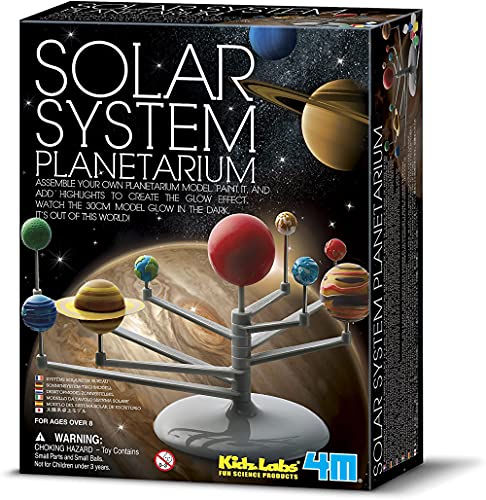
- Assemble and paint the planets
- Glows in the dark without batteries
- Includes chart and quiz questions
Best For: Display-focused astronomy activities for ages 8+
Hands-On Builder

- Wood model with paint, brushes, puzzle, and fact cards
- Designed for ages 8–12 and approximately 1–2 hours of building
- Useful for classroom displays, home projects, and science fairs
Best For: Hands-on elementary science projects
Interactive Explorer
Talking Projector Solar System

- Includes eight planets, bilingual English/Spanish facts, and a projector
- Three slides provide 24 space images for wall or ceiling viewing
- Doubles as a night light or flashlight; requires 3 AA batteries
Best For: Interactive STEM activities for younger children
Orbit Demonstrator

- Shows Earth’s orbit, Moon’s orbit, rotation, seasons, and eclipses
- Includes a seasonal plate with four seasons and 24 solar terms
- Mechanical teaching model for children over age 6
Best For: Focused Earth, Moon, and seasons lessons
Classroom Demonstrator – Giant Magnetic Solar System
For teachers seeking solar system models for science lessons, the Learning Resources Giant Magnetic Solar System offers a hands-on way to demonstrate planetary order, relative size, and basic space concepts. Its large magnetic pieces are designed for whiteboards and other metal surfaces.
Best For: Classroom demonstrations and tactile learning for children ages 4–10.
Pros:
- Includes magnetic representations of the sun, planets, moon, asteroid belt, and Pluto.
- Large pieces make planetary order and size comparisons easier to show.
- Flexible magnetic material is designed for repeated classroom handling.
Cons:
- Requires a magnetic surface for display.
- Its large format may be less convenient for individual desk work.
This is a strong choice when visibility and group participation matter more than building a three-dimensional model. The included guide adds age-appropriate facts for STEM activities.
DIY Display Project – Felt Solar System Model Kit
This Pllieay kit is a practical option among solar system models for science lessons when students need to paint, assemble, label, and display their work. The felt backdrop can be hung afterward, making the finished project suitable for classrooms with limited space.
Best For: Independent or small-group school projects for children ages 8–17.
Pros:
- Includes a felt background plate, foam hemispheres, paints, brushes, palette, labels, and hanging supplies.
- Instructions introduce orbital positions and planet names.
- Finished work can be mounted on a wall for display.
Cons:
- Students must paint and assemble the model, so completion takes additional time.
- Foam and felt construction is better suited to craft-style projects than durable demonstration use.
Choose this model for a creative science assignment that combines astronomy with painting and display. It is especially useful when the project itself is part of the lesson.
Creative Builder – 64-Piece Foam Solar System Kit
The wookidel 64 PCS kit brings an art-and-science approach to solar system models for science lessons. Students color foam pieces, use the included sticks and flags, and follow the instructions to create a model while developing hands-on construction and astronomy skills.
Best For: Classroom or family activities for children roughly ages 6–12.
Pros:
- Includes foam balls and discs, stars, bamboo sticks, flags, 12 paints, brushes, and a palette.
- Painting and assembly provide a tactile introduction to planets and their arrangement.
- Can support hand-eye coordination, focus, artistic expression, and science learning.
Cons:
- Students need to complete the painting and assembly before using the model.
- Foam construction may be less suitable for frequent rough handling.
This kit works well when teachers want students to create rather than simply observe a solar system model. The included instructions and paint supplies make it convenient for a guided project.
Glow-and-Move Model – National Geographic Glow Solar System
For older students, this National Geographic kit adds movement and glow effects to solar system models for science lessons. Children build and paint the sun and eight planets, then adjust the movable arms to create a display that can also reinforce planet facts.
Best For: Astronomy projects and interactive displays for children ages 8 and up.
Pros:
- Includes the components, paints, glow-in-the-dark accent paint, brush, palette, decals, and fact poster.
- Movable arms allow students to adjust the planet positions.
- Glow effects make the completed model engaging as space-themed decor.
Cons:
- Students must build and paint the model before it can be used.
- The kit focuses on a display model rather than a large group demonstration.
This is a compelling pick for lessons that extend into a take-home or bedroom display. Its movable structure and glow paint add engagement while the poster supplies supporting space facts.
Best Hands-On Build – Smartivity DIY Solar System Kit
For solar system models for science lessons, the Smartivity DIY Solar System Kit offers an engaging build-and-rotate activity for children ages 8–14. Its gear-driven design supports practical exploration of planets, orbits, and basic astronomy concepts.
Best For: Hands-on STEM learning and children who enjoy building interactive models.
Pros:
- Gear-driven model rotates for interactive exploration.
- Connects construction play with planets, orbits, day, and night.
- Made from child-safe, eco-friendly MDF materials.
- Designed for ages 8–14 and packaged as a gift.
Cons:
- Recommended for ages 8 and up, so it may not suit younger learners.
- The set includes one model kit rather than a larger classroom assortment.
This is a strong choice when the lesson benefits from building and motion rather than a simple display. Choose it for a focused, reusable-looking STEM activity centered on assembly and rotation.
Best Collaborative Project – Solar System Project Kit
This Solar System Project Kit is a flexible option among solar system models for science lessons, combining painting, labeling, and movable felt-board planets. The foam pieces and included craft supplies make it suitable for school projects or group activities at home.
Best For: Younger students working on creative school projects, classroom displays, or family learning activities.
Pros:
- Includes foam planet pieces, felt board, paints, brushes, labels, and instructions.
- Velcro-style attachments let children move planets and simulate trajectories.
- Finished project can be hung as a room decoration.
- Supports hand-eye coordination, spatial awareness, logical thinking, and artistic skills.
Cons:
- Uses foam and craft materials rather than a rigid, mechanical model.
- Painting and assembly require additional time and supervision.
- Recommended for ages 6 and up despite the listed toddler age-range description.
Its movable felt-board format is especially useful when students need to arrange, label, and discuss the planets. It is a practical pick for project-based learning where creativity and presentation matter as much as the finished model.
Best Glow-in-the-Dark Display – 4M Solar System Planetarium
For solar system models for science lessons that extend beyond the classroom, the 4M Solar System Planetarium combines assembly, painting, and glow-in-the-dark display. It also includes a fact-filled wall chart and Kidz Quiz questions to reinforce astronomy learning.
Best For: Ages 8 and up who want a science activity that becomes a bedroom or classroom display.
Pros:
- Includes planets, stencils, rods, string, glow paint, and assembly instructions.
- Glow-in-the-dark finish adds an engaging visual element.
- Fact-filled wall chart and 10 sets of quiz questions support review.
- Requires no batteries and covers the eight planets.
Cons:
- Pluto is not included.
- Children must assemble and paint the model, so setup takes time.
- The kit is recommended for ages 8 and up.
This planetarium works well when learners benefit from creating a display they can revisit after the lesson. The included reference materials add educational value, while the glow feature makes the completed model more visually memorable.
Hands-On Builder – DIY Nine-Planet Model
For shoppers comparing solar system models for science lessons, this kit combines a buildable wood model, painting activity, puzzle, and fact cards. It is designed for children ages 8 and up and can support a classroom display, science fair project, or at-home science activity.
Best For: Elementary-age learners who enjoy crafts and need a hands-on solar system project.
Pros:
- Includes a wood model, puzzle, fact cards, paint, and brushes.
- Covers the Sun and eight major planets plus the included nine-planet activity format.
- Estimated assembly time is approximately one to two hours.
- Suitable for displaying in a bedroom, classroom, or science fair.
Cons:
- The paint-and-assembly format may require adult guidance for some children.
- It is a craft-based model rather than a powered or interactive teaching device.
This is a practical choice when the lesson goal is active participation: children build, paint, solve, and review facts as they learn about the solar system.
Interactive Explorer – Talking Projector Solar System
This talking solar system model is a versatile option among solar system models for science lessons, especially for younger learners. It combines eight planet pieces with bilingual English/Spanish facts, a planetarium projector, and image slides that can extend the lesson beyond a tabletop display.
Best For: Early learners who benefit from audio, visual projection, and bilingual STEM activities.
Pros:
- Provides spoken astronomy facts in English and Spanish.
- Projects 24 space images using three included slides.
- Includes eight planets and a solar dome that can function as a night light or flashlight.
- Snap-and-lock assembly is designed for quick setup.
Cons:
- Requires three AA batteries, which are not included.
- Its projector and electronic features may be more suitable for demonstration than detailed model-building lessons.
Choose this model when engagement matters as much as physical representation. The audio, projection, and bilingual controls give teachers and parents several ways to introduce basic astronomy concepts.
Orbit Demonstrator – Sun-Earth-Moon Orbital Model
For lessons focused on motion rather than all nine planets, this Sun-Earth-Moon orbital model offers a mechanical way to demonstrate rotation, orbits, seasons, moon phases, and eclipses. It is intended for children over age 6 and can support Earth science, geography, astronomy, or school project work.
Best For: Teachers and families explaining seasons, solar eclipses, lunar eclipses, and the relationship between the Sun, Earth, and Moon.
Pros:
- Demonstrates Earth orbiting the Sun and the Moon orbiting Earth.
- Supports explanations of seasons, solar eclipses, lunar eclipses, and moon phases.
- Includes a seasonal plate showing four seasons and traditional Chinese calendar solar terms.
- Offers a hands-on orbital mechanism for exploratory learning.
Cons:
- It models the Sun-Earth-Moon system rather than the complete set of planets.
- Assembly involves screws, gears, alignment, and multiple instruction steps.
- The supplied notes do not indicate lighting, audio, or electronic features.
This is the strongest fit when a science lesson needs a demonstrator for spatial relationships and recurring astronomical events. Its narrower scope is a benefit for focused Earth-and-Moon instruction, but it is not a complete planetary display.
How We Picked the Best Solar System Models for Science Lessons
We focused on models that support active learning rather than serving only as decorations. The selection covers classroom displays, student-built projects, illuminated and glow-in-the-dark designs, orbital models, and kits with added facts or interactive elements.
We also considered the likely age range, assembly demands, included components, durability, storage, and how easily each model can support a lesson, presentation, science fair project, or at-home activity. Because product contents can vary, check the current listing for exact dimensions, materials, batteries, paints, tools, and assembly requirements before ordering.
Quick Comparison
- For whole-class demonstrations: Choose a large magnetic or orbital model that students can see from across the room.
- For student projects: DIY kits with planets, bases, paints, fact cards, or building components provide more ownership and presentation value.
- For visual engagement: Glow-in-the-dark and illuminated models help reinforce planet locations and make astronomy activities more memorable.
- For younger learners: Favor simple construction, sturdy parts, clear labels, and limited small components.
- For older students: Look for gear-driven motion, orbital demonstrations, scale discussions, and factual learning materials.
Key Buying Factors for Solar System Models for Science Lessons
Learning Objective
Decide whether the model is intended to teach planet order, relative position, orbital motion, the Earth-Moon-Sun relationship, recognition of planets, or general astronomy vocabulary. A static display may be sufficient for identification, while an orbital model is better for demonstrating movement and relationships.
Construction and Interaction
Student-assembled kits can support sequencing, fine-motor skills, creativity, and science presentations. However, they may require paint, glue, tools, drying time, or adult supervision. Ready-to-use magnetic and talking models are faster to deploy for demonstrations.
Age, Safety, and Durability
Check recommended ages and inspect whether the kit contains small parts, sharp tools, magnets, batteries, or materials that need supervision. For frequent classroom use, prioritize sturdy components, replaceable batteries where applicable, and designs that store without damaging planets or connecting pieces.
Visibility and Space
A tabletop model may work well for a small group but be difficult for a full class to see. Measure available shelf, desk, or display space, and consider whether planets can be removed, repositioned, or stored between lessons.
Who Should Buy Which Solar System Models for Science Lessons?
Teachers needing a reusable demonstration tool should prioritize a visible magnetic or orbital model with simple operation. Parents and educators planning a science project may prefer a complete DIY kit that gives students something to build, decorate, and explain. Classrooms emphasizing visual reinforcement should consider glow or illuminated options, especially for astronomy units and evening demonstrations. Younger children generally benefit from straightforward kits with large, clearly identifiable pieces, while older students may get more value from gear-driven motion, fact-based activities, and models that encourage discussion of orbits and scale.