
Finding the right sound level meter does not have to mean sorting through professional laboratory equipment. For home projects, workshops, audio experiments, and noise checks, a straightforward handheld meter can provide useful readings without a steep learning curve.
These ten models cover practical needs ranging from basic decibel checks to continuous monitoring, alarms, wall-mounted displays, and data logging. Use the guide below to match the features with the way you plan to measure sound.
Best 10 Sound Level Meters for Hobbyists Picks for 2026
Best All-Around Pick

- Large backlit 2.25-inch display
- A/C weighting with 30–130 dB range
- MAX/MIN, hold, case, and batteries included
Best For: General home, workshop, and audio checks
Best for Tracking Noise

- 30-second curve view for changing sound
- Threshold alarms with 30-record history
- Rechargeable 1500mAh battery
Best For: Noise trends, audio tuning, and recurring sound checks
Best for Response Controls

- Fast and slow response settings
- A/C weighting plus dB/SONE units
- Backlight, MAX, and data hold functions
Best For: Manual environmental and workshop measurements
Best for Loudness Context

- dB and SONE loudness units
- A/C weighting and fast/slow response
- MAX/MIN, hold, grip, and windbreak included
Best For: Music, audio, and everyday noise comparisons
Best for Easy Setup
RISEPRO HT-80A Digital Sound Level Meter

- 30–130 dB range with ±1.5 dB stated accuracy
- MAX/MIN, hold, backlight, and auto-off functions
- Compact design with carrying pouch
Best For: Everyday handheld noise checks and home projects
Best for Visible Monitoring
DANOPLUS 11-Inch Wall-Mount Decibel Meter

- Large adjustable LED display for room-wide visibility
- Shows decibel, temperature, and humidity readings
- Color-coded face icons indicate noise levels
Best For: Studios, classrooms, workshops, and shared spaces
Best Compact Option
UNI-T UT353 Portable Decibel Meter

- Compact, lightweight design with ergonomic grip
- 30–130 dBA range and 0.1 dBA resolution
- Fast/slow sampling plus MAX/MIN and hold
Best For: Portable noise checks, music projects, and hobbyist measurements
Best Data-Logging Pick

- Stores up to 3,100 readings for later review
- Measures A/C-weighted sound from 30–130 dB
- Rechargeable with PC export and visual alarms
Best For: Hobbyists tracking noise over time
Best Simple Handheld
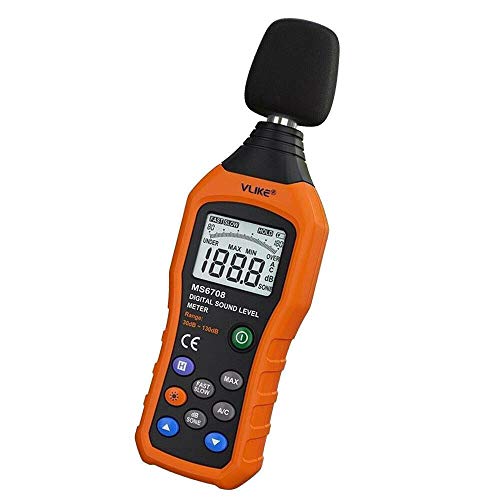
- 30–130 dB range with A/C measurement modes
- Backlit display for low-light readings
- Portable anti-drop casing with max hold
Best For: Quick, real-time sound checks
Best for Flexible Readings
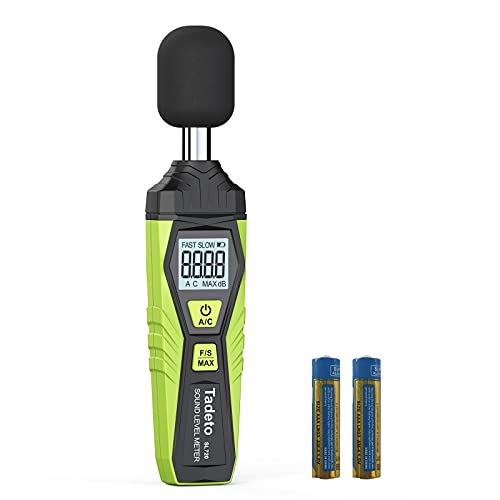
- 30–130 dB range with 0.1 dB display resolution
- A/C weighting for ambient and machine noise
- Fast/slow response, hold, and backlit LCD
Best For: Comparing changing environmental and equipment noise
Best All-Around Pick – TopTes TS-501B
For hobbyists who want a straightforward way to check household, workshop, or entertainment-system noise, the TopTes TS-501B is a practical choice among sound level meters for hobbyists. Its large backlit display, A/C weighting, and peak-reading functions cover everyday sound checks without adding unnecessary complexity.
Best For: Home noise checks, workshops, classrooms, offices, and basic audio-system monitoring.
Pros:
- Large 2.25-inch backlit LCD is easy to read in dim conditions.
- Measures 30–130 dB with A/C weighting and stated ±1.5 dB accuracy.
- MAX/MIN readings, data hold, included batteries, and carrying case add convenience.
Cons:
- Uses replaceable AAA batteries rather than a rechargeable battery.
- Does not list threshold alarms or onboard noise-history recording.
The TS-501B balances useful controls and portability, making it a strong general-purpose meter for hobbyists who want quick, readable measurements.
Best for Tracking Noise – FNIRSI FDM-02
The FNIRSI FDM-02 stands out for hobbyists who want more than a momentary reading. Among sound level meters for hobbyists, its curve view, adjustable thresholds, alarm history, and rechargeable battery make it useful for observing changing noise over time.
Best For: Home theater tuning, speaker placement, hearing-awareness checks, and recurring neighborhood or appliance noise.
Pros:
- 2-inch IPS screen offers light and dark display themes.
- Fast and slow response modes plus a 30-second curve view show changing sound levels.
- Threshold alerts, records for the 30 most recent alarms, and a rechargeable 1500mAh battery support ongoing monitoring.
Cons:
- Its broader monitoring features may be more than needed for occasional spot checks.
- The supplied notes do not specify a carrying-case size or detailed physical dimensions for the meter itself.
Choose the FDM-02 when reviewing patterns and alerts matters as much as seeing the current decibel level; it is particularly well suited to audio and household monitoring projects.
Best for Response Controls – Protmex PT6708
The Protmex PT6708 gives hobbyists useful control over how measurements are captured. It is a solid option among sound level meters for hobbyists who need selectable fast or slow response, A/C weighting, and a readable backlit display for changing or steady noise.
Best For: Environmental noise checks, machinery and workshop measurements, audio experiments, and nighttime readings.
Pros:
- Offers 30–130 dB measurement, 0.1 dB resolution, and stated ±1.5 dB accuracy.
- Fast 0.125-second and slow 1-second response settings accommodate different sound conditions.
- Includes MAX, data hold, A/C weighting, dB/SONE selection, and a backlight.
Cons:
- Cannot keep or generate a report directly from the device.
- The listed weight is 190 g, making it less lightweight than some compact alternatives.
The PT6708 is a good fit for hobbyists who value measurement-mode flexibility and loudness-unit options, but it is better for manual readings than built-in data logging.
Best for Loudness Context – Goldeep SL750A
The Goldeep SL750A adds a SONE mode to standard decibel readings, giving hobbyists another way to interpret perceived loudness. For sound level meters for hobbyists, its A/C weighting, fast/slow response, and MAX/MIN tracking make it versatile for home, music, traffic, and equipment checks.
Best For: Music and audio experiments, household noise checks, instruments, traffic, and machinery.
Pros:
- Measures 30–130 dB with stated ±1.5 dB accuracy and 31.5 Hz–8 kHz frequency response.
- SONE mode complements dB readings for perceived-loudness comparisons.
- Fast/slow response, MAX/MIN tracking, data hold, anti-slip grip, and windbreak ball are included.
Cons:
- Uses two AAA batteries rather than a rechargeable battery.
- The supplied notes do not mention alarm thresholds or stored measurement history.
The SL750A is a versatile pick when hobby projects benefit from both sound intensity and perceived-loudness information, while its simple controls keep routine measurements approachable.
Best for Easy Setup – RISEPRO HT-80A Digital Sound Level Meter
For hobbyists comparing sound level meters for hobbyists, the RISEPRO HT-80A is a practical handheld option with a broad 30–130 dB range, backlit display, and useful MAX/MIN and data-hold functions. Its compact design and included carrying pouch make it convenient for checking noise around the home, workplace, or other environments.
Best For: Everyday handheld noise checks, home projects, and users who want a portable meter with helpful monitoring features.
Pros:
- Measures from 30 to 130 dB with stated accuracy of ±1.5 dB.
- Includes data hold, MAX/MIN readings, backlight, and auto power off.
- Offers FAST 125 ms time weighting and Type A frequency weighting.
- Includes a black carrying pouch and gift box.
Cons:
- The listed frequency range is 31.5 Hz to 4 kHz.
- Its plastic construction may feel less premium than more specialized equipment.
The HT-80A balances useful features and portability without adding unnecessary complexity, making it a strong general-purpose choice for hobbyist measurements.
Best for Visible Monitoring – DANOPLUS 11-Inch Wall-Mount Decibel Meter
If you want sound level meters for hobbyists that can be read from across a room, the DANOPLUS wall-hanging meter stands out with its large 11-inch LED display. It also shows temperature and humidity, offers adjustable brightness, and uses color-coded face icons to indicate different noise levels.
Best For: Studios, classrooms, workshops, offices, and home spaces where continuous, at-a-glance noise monitoring is useful.
Pros:
- Large, brightness-adjustable 11-inch LED screen.
- Displays real-time decibel level, temperature, and humidity.
- Measures 30–130 dB with stated ±1.5 dB accuracy and calibration capability.
- Can be wall-mounted or placed on a desktop and includes a 9.8-foot USB cable.
Cons:
- Its large wall-display format is less portable than a handheld meter.
- The face icons provide visual alerts, but the notes specify no audible alarm.
This model is less about pocket portability and more about making sound levels easy to see, particularly in shared spaces where ongoing monitoring matters.
Best Compact Option – UNI-T UT353 Portable Decibel Meter
The UNI-T UT353 is a compact choice for hobbyists looking for sound level meters for hobbyists that are easy to carry and straightforward to operate. It covers 30–130 dBA, provides 0.1 dBA resolution, and adds fast/slow sampling, MAX/MIN tracking, data hold, and a backlit LCD.
Best For: Portable noise checks, audio and music projects, neighbor-noise documentation, and hobbyists who prefer a lightweight handheld meter.
Pros:
- Lightweight, compact design with an ergonomic grip.
- Measures 30–130 dBA with stated ±1.5 dBA accuracy and 0.1 dBA resolution.
- Supports fast 125 ms and slow 1-second sampling modes.
- Includes MAX/MIN, data hold, backlight, windscreen foam, and three AAA batteries.
Cons:
- It uses three AAA batteries rather than a rechargeable battery.
- The supplied notes describe dBA measurement rather than multiple selectable frequency weightings.
With its portable form and flexible sampling controls, the UT353 is a sensible fit when you want a capable meter that can travel easily between rooms, projects, or recording spaces.
Best Data-Logging Pick – Rechargeable Decibel Meter
For hobbyists who want more than a momentary reading, this sound level meter for hobbyists combines live measurements with onboard recording and computer export. Its 30–130 dB(A) range, A/C weighting, graphical display, and rechargeable battery make it practical for tracking noise at home, in classrooms, or around equipment.
Best For: Hobbyists who want to record and review sound-level data over time.
Pros:
- Records up to 3,100 data points and supports PC data export on compatible Windows systems.
- Offers 30–130 dB(A) and 35–130 dB(C) measurement ranges with stated ±1.5 dB accuracy.
- Includes a three-color alarm system, graphical display, Type-C connection, and rechargeable operation.
Cons:
- Its data-export features may be more than needed for simple spot checks.
- Supplied notes specify Windows 7, 10, and 11 compatibility rather than broader platform support.
This is the most capable option here for hobby projects involving documentation, comparisons, or recurring monitoring. Choose it if storage and computer connectivity matter more than absolute simplicity.
Best Simple Handheld – VLIKE LCD Sound Level Meter
This VLIKE model is a straightforward sound level meter for hobbyists who primarily need real-time readings. It covers 30–130 dB, includes A/C modes, a backlight, maximum locking, and an auto-ranging design in a portable handheld body.
Best For: Hobbyists who need an easy-to-carry meter for live checks around homes, offices, workshops, or audio setups.
Pros:
- Provides a broad 30–130 dB measurement range with A/C weighting modes.
- Backlit display supports readings in darker areas and includes automatic backlight shutoff.
- Portable casing features an anti-drop structure and power-saving circuit design.
Cons:
- Batteries are not included, and the meter requires four AAA batteries.
- It cannot store readings or generate a report directly from the device.
Its strengths are portability and uncomplicated real-time monitoring. It is a sensible choice for occasional checks, but hobbyists needing logged measurements should consider a data-recording model instead.
Best for Flexible Readings – Tadeto Portable SPL Meter
The Tadeto is a practical sound level meter for hobbyists who want adjustable response settings and clear readings. It measures 30–130 dB with 0.1 dB resolution, supports A/C weighting, and adds fast or slow response modes for changing environmental or equipment noise.
Best For: Hobbyists comparing general ambient noise with louder machine or equipment sound.
Pros:
- Measures from 30–130 dB with stated ±2.0 dB accuracy and 0.1 dB display resolution.
- A weighting suits ambient-noise checks, while C weighting is intended for higher-intensity machine sounds.
- Fast and slow response modes, data hold, and a backlit LCD improve usability.
Cons:
- The stated accuracy is lower than the ±1.5 dB specification of the data-logging option.
- Supplied notes do not indicate onboard recording or computer data export.
This meter offers useful control without becoming overly specialized. It fits hobbyists who want to observe both fluctuating environmental sound and more sustained equipment noise using one compact instrument.
How We Picked These Sound Level Meters for Hobbyists
We focused on meters that are practical for non-professional users: accessible controls, readable displays, useful measurement ranges, and features that help with everyday comparisons. Most options cover approximately 30 to 130 dB, a range suitable for checking rooms, appliances, workshops, entertainment spaces, and general environmental noise.
We also considered measurement controls such as A- and C-weighting, fast and slow response modes, maximum/minimum readings, data hold, backlighting, alarms, portability, and recording capability. These features do not automatically make a meter more accurate, but they can make measurements easier to interpret and repeat.
Quick Comparison
| Best For | Features to Look For |
|---|---|
| Basic spot checks | Simple controls, backlit LCD, 30–130 dB range |
| Audio and workshop experiments | A/C weighting, fast/slow response, MAX/MIN |
| Longer-term monitoring | Alarm indicators, wall display, or data logging |
| Portable use | Compact housing, battery power, data hold |
Key Buying Factors for Sound Level Meters for Hobbyists
Measurement Range and Weighting
A 30–130 dB range handles many common household and hobby measurements. A-weighting is generally useful for approximating how people perceive environmental sound, while C-weighting is helpful when comparing louder sounds or low-frequency content. If you only need quick relative comparisons, a basic meter may be sufficient.
Response Speed and Useful Readings
Fast response can help capture changing or short-lived sounds, while slow response produces a steadier reading in fluctuating environments. MAX/MIN and data-hold functions make it easier to record a peak or inspect a reading without watching the screen continuously.
Display, Alarms, and Logging
Backlighting matters in garages, rehearsal spaces, and dim rooms. Large wall displays are better for continuously visible readings, especially where an alarm indicator is useful. A data logger is the better choice when you need to review trends rather than take individual spot measurements.
Portability and Power
For occasional checks, choose a compact battery-powered model. If you expect frequent use, look for convenient controls, automatic shutoff, USB recharging, and a durable design. Remember that placement, distance from the source, reflections, and wind can affect readings as much as the meter itself.
Who Should Buy Which Sound Level Meters for Hobbyists?
Choose a basic handheld meter if you want to compare appliance, room, hobby equipment, or neighborhood noise levels. Models with a backlit screen and data hold offer a good balance of simplicity and convenience.
Choose a feature-rich portable meter if you work with speakers, musical instruments, tools, or changing sound sources. A/C weighting, fast/slow response, and MAX/MIN readings provide more control during experiments.
Choose a wall-mounted monitor for a shared workspace, studio, classroom, or other area where sound needs to remain visible. For recurring measurements, a model with recording, USB connectivity, or a large display can save time.
Whichever meter you select, treat readings as practical guidance rather than a substitute for calibrated professional testing. For the most consistent results, measure from the same position and distance, avoid blocking the microphone, and compare multiple readings instead of relying on one momentary value.