
When a single decibel reading is not enough, a sound level meter with data logging can record changing noise levels over time for later review. That makes it useful for workplace assessments, classroom management, equipment troubleshooting, and environmental monitoring.
This roundup compares 10 options, from affordable rechargeable meters to professional Class 1 and Class 2 instruments with averaging, software, SD-card storage, or smartphone connectivity.
Best 10 Sound Level Meters with Data Logging Picks for 2026
Best Budget-Friendly Pick
Rechargeable Sound Level Data Logger

- 30–130 dB(A) and 35–130 dB(C) ranges
- PC export with USB-C charging
- Graphical display and three-color alarms
Best For: Home, classroom, office, and general noise monitoring
Best Class 1 Option
General Tools DSM403SD Sound Level Meter

- Class 1 meter with 30–130 dB range
- Excel-compatible SD-card data logging
- One-second to one-hour sampling intervals
Best For: Compliance, noise control, and acoustic design work
Best for Neighborhood Monitoring
ennoLogic eS528L Decibel Recorder
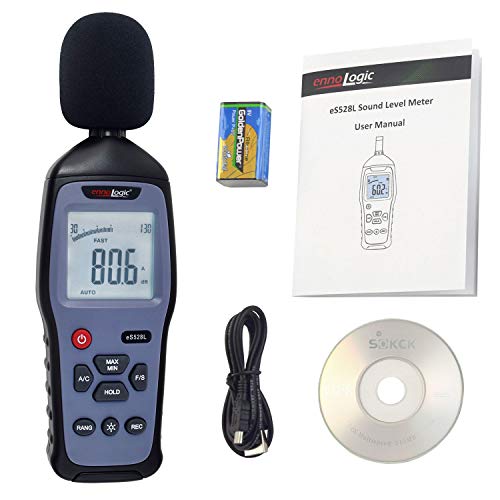
- Records noise for hours or days
- Max/min/hold and A/C weighting
- Includes Windows software and USB cable
Best For: Neighborhood, workplace, equipment, and home noise documentation
Best Professional Logging Features
CRY2832-2 Lite Leq Sound Meter

- IEC 61672-1:2013-compliant design
- Leq, Lpeak, Lmax, and Lmin measurements
- CSV export and extensive connectivity
Best For: Professional workplace, environmental, and industrial noise surveys
Best Overall
DANOPLUS 43,000-Record Sound Level Meter

- Stores up to 43,000 readings with PC and Excel export
- A/C weighting, FAST/SLOW response, and DC output
- Color display and adjustable three-color alarm
Best For: Routine indoor and field noise monitoring with data export
Best for Detailed Analysis
Class 2 Integrating-Averaging Sound Level Meter

- Class 2 design with IEC 61672 and ANSI S1.4 specifications
- Logs multiple metrics and up to 198,948 records
- Includes waveform, FFT, octave-band, and spectrum analysis
Best For: Professional noise studies and advanced post-processing
Best Value
Rechargeable 43,000-Reading Decibel Meter

- Logs up to 43,000 readings with Windows PC syncing
- A/C weighting and FAST/SLOW response modes
- Customizable three-color alerts on an HD screen
Best For: Everyday monitoring in homes, classrooms, offices, and factories
Best USB Data Logger

- Stores 3,100 readings with CSV export
- USB-C rechargeable with up to 8-hour use
- A/C weighting and three-color alarm display
Best For: Handheld monitoring with PC-based analysis
Best Large Display
DANOPLUS Wall-Mount Noise Meter

- Stores up to one year of readings
- 13-inch display with large 4-inch digits
- 16.4-foot sensor and adjustable alarms
Best For: Classrooms and fixed-location monitoring
Best Bluetooth Logger

- Stores over 20,000 data points
- Transfers readings to Android or iOS app
- Lightweight design with 30–130dB range
Best For: Portable smartphone-based sound monitoring
Best Budget-Friendly Pick – Rechargeable Sound Level Data Logger
If you want sound level meters with data logging for home, classroom, office, or light industrial checks, this rechargeable model combines a 30–130 dB(A) range with PC connectivity and a graphical display. Its USB-C charging and adjustable auto-shutoff make it convenient for recurring monitoring.
Best For: Everyday noise checks, classroom and office monitoring, and users who prefer rechargeable power.
Pros:
- Measures 30–130 dB(A) and 35–130 dB(C) with ±1.5 dB accuracy.
- Provides numerical and graphical readings with three-color alarm indications.
- Supports PC data export and includes USB-C charging with about eight hours of operation per charge.
Cons:
- The notes list both 31,000 and 3,100 data records, so confirm the exact storage capacity before buying.
- Windows 7, 10, and 11 compatibility is specified; other operating systems are not mentioned.
This is a practical, compact choice when you need logged readings, visual alerts, and straightforward computer transfer without stepping up to a more specialized professional logger.
Best Class 1 Option – General Tools DSM403SD Sound Level Meter
General Tools DSM403SD Sound Level Meter with Data Logging SD Card, Class 1 Sound
Check Price On AmazonFor buyers seeking sound level meters with data logging for compliance-oriented or acoustic work, the General Tools DSM403SD offers Class 1 performance, auto-ranging from 30 to 130 dB, and removable SD-card storage. Its adjustable sampling interval supports both quick checks and extended logging.
Best For: Noise pollution control, OSHA-related documentation, and acoustics design applications.
Pros:
- Class 1 sound level meter with A or C weighting and fast or slow response modes.
- Logs sampled data to Excel-compatible files on removable SD memory cards.
- Sampling intervals range from one second to one hour, and a 2 GB SD card is included.
Cons:
- Requires six AA batteries, making it less convenient than rechargeable models.
- At 1.08 pounds, it is relatively substantial for a handheld meter.
The DSM403SD stands out when data portability and Class 1 positioning matter more than compact size or rechargeable convenience. The included case and wind shield add useful field practicality.
Best for Neighborhood Monitoring – ennoLogic eS528L Decibel Recorder
The ennoLogic eS528L is one of the more flexible sound level meters with data logging for documenting neighborhood, workplace, equipment, and home noise. It records levels for hours or days and adds max/min/hold functions, analog and digital-style displays, and Windows software for review.
Best For: Long-term noise documentation, workplace checks, neighborhood disputes, and home audio or appliance testing.
Pros:
- Measures 30–130 dBA with ±1.5 dB accuracy and supports A/C weighting plus fast/slow response.
- Can record for hours or days for later review and supporting documentation.
- Includes a backlit 1.5-inch display, analog bar graph, USB cable, Windows software, and a 10-year warranty.
Cons:
- The included software is specified for Windows only.
- It uses a 9V battery rather than a rechargeable battery, though external power is supported.
This model is especially useful when a single reading is not enough and you need a record of changing noise over time. Its tripod mount and external-power option also help with stationary monitoring setups.
Best Professional Logging Features – CRY2832-2 Lite Leq Sound Meter
For professional users comparing sound level meters with data logging, the CRY2832-2 Lite adds Leq, Lpeak, Lmax, and Lmin measurements to a broad selection of testing modes and connectivity options. It is designed for ongoing workplace, environmental, and industrial noise assessment rather than occasional spot checks.
Best For: Acousticians, safety officers, engineers, EHS teams, and recurring industrial or environmental noise surveys.
Pros:
- Meets IEC 61672-1:2013 standards and measures Leq, Lmax, Lmin, and Lpeak.
- Supports Auto, Timing, Trigger, Custom, and Delay modes with A, C, and Z weighting.
- Offers CSV export through microSD plus USB-C, RS232, Bluetooth, and Wi-Fi connectivity.
Cons:
- The microSD card must be purchased separately.
- Its professional feature set may be more than needed for basic household spot checks.
- The listed measurement bandwidth is 20 Hz to 8 kHz, which buyers should consider for specialized acoustic work.
This is the strongest fit for users who need richer acoustic metrics, configurable logging workflows, and system integration. Its connectivity and export options make it suited to documented field and facility assessments.
Best Overall – DANOPLUS 43,000-Record Sound Level Meter
For shoppers comparing sound level meters with data logging, the DANOPLUS stands out with substantial storage, PC export, and a readable color display. It measures 30–130 dB with stated ±1.5 dB accuracy and adds configurable visual alerts for ongoing noise monitoring.
Best For: Home, workplace, and field users who want rechargeable operation, PC data export, and straightforward noise tracking.
Pros:
- Stores up to 43,000 readings and exports them to Excel through Windows 7, 10, or 11.
- Supports A- and C-frequency weighting plus FAST and SLOW response modes.
- Color screen shows line-chart changes, analog bars, and date and time information.
- Three-color alarm indicators have manually adjustable thresholds.
Cons:
- PC connectivity and data analysis require a Windows computer.
- The listed charging time is approximately 1.5 hours.
Its combination of large logging capacity, rechargeable power, and visual alerts makes it a practical all-around choice for routine sound surveys and stored measurement records.
Best for Detailed Analysis – Class 2 Integrating-Averaging Sound Level Meter
Among sound level meters with data logging, this professional Class 2 model is designed for deeper noise analysis rather than basic spot checks. It records multiple sound metrics simultaneously and pairs extensive storage with software for waveform, spectrum, and post-measurement analysis.
Best For: Technical users who need Class 2 measurements, extensive logged records, octave-band data, or advanced computer-based analysis.
Pros:
- Meets IEC 61672 and ANSI S1.4 Class 2 specifications according to the supplied details.
- Records Leq, Lmax, Lmin, Lpeak, and SEL in A, C, and Z weightings.
- Stores up to 198,948 records and includes noise-analysis software.
- Supports octave bands, 400-line FFT, and high-quality waveform audio recording.
Cons:
- Its advanced analysis features may be more than needed for simple household checks.
- Software-based analysis requires using a computer.
This is the strongest fit when measurement depth and post-processing matter most, especially for users who need more than a single dB reading or basic logging.
Best Value – Rechargeable 43,000-Reading Decibel Meter
This compact option gives shoppers looking for sound level meters with data logging a broad 30–130 dB range, A/C weighting, and PC synchronization. Its HD screen and three-color alarm system are useful for quickly checking whether sound levels remain within selected limits.
Best For: Home, classroom, office, and factory users who want accessible logging and visual noise alerts.
Pros:
- Records up to 43,000 data points and supports PC downloads and real-time monitoring.
- Offers A- and C-weighted measurements with FAST and SLOW response modes.
- Three customizable sound-level limits trigger color light alerts.
- Compact housing and automatic power-off support indoor or field use.
Cons:
- Its stated frequency range is 31.5 Hz to 8 kHz, narrower than the professional model in this roundup.
- Automatic shutdown occurs after 15 minutes of inactivity.
- PC compatibility is listed for Windows 7, 8, 10, and 11.
With a large log capacity and clear threshold alerts, this meter is a practical choice for everyday noise checks where simple PC syncing is more important than advanced spectrum analysis.
Best USB Data Logger – Landtek Decibel Meter
For shoppers comparing sound level meters with data logging, this Landtek model offers built-in storage, USB computer connectivity, and a rechargeable battery. It records up to 3,100 data points and supports data export and graphing through a Windows PC.
Best For: Home, office, factory, construction-site, and neighbor-noise monitoring where PC analysis is useful.
Pros:
- Stores up to 3,100 readings and exports data in CSV format.
- USB-C rechargeable 1,000mAh battery provides up to 8 hours of operation.
- Measures 30–130dB(A) and 35–130dB(C) with ±1.5dB accuracy.
- Three-color alarm display, adjustable thresholds, A/C weighting, and fast/slow response modes.
Cons:
- PC software compatibility is specified for Windows 7, 10, and 11.
- Its 3,100-point capacity is smaller than some long-term logging options.
This is a practical handheld choice when you want rechargeable operation and straightforward USB-based reporting rather than an oversized fixed display.
Best Large Display – DANOPLUS Wall-Mount Noise Meter
If visibility and extended monitoring matter most, this DANOPLUS unit stands out among sound level meters with data logging. Its 13-inch HD screen, long sensor cable, and one-year data capacity make it suited to spaces where readings need to be seen from a distance.
Best For: Classrooms, studios, homes, and other rooms needing a prominent desktop or wall-mounted noise monitor.
Pros:
- Records readings every two seconds and can store one year of data.
- Large 13-inch display uses 4-inch digits for viewing from far away.
- Includes a 16.4-foot sensor and adjustable audible and visual alarms.
- Supports desktop or wall mounting, analog bar indication, and a 12V external alarm output.
Cons:
- At 2.66 pounds, it is less portable than handheld meters.
- The supplied notes do not specify the data logger’s exact point capacity.
Choose this model when continuous room monitoring and at-a-glance readability are more important than a compact, travel-ready design.
Best Bluetooth Logger – Portable Bluetooth dB Tester
This compact Bluetooth model is a convenient option among sound level meters with data logging for users who prefer smartphone-based recording. It stores more than 20,000 data points and transfers measurements to Android or iOS devices through the dB Tester app.
Best For: Portable monitoring and users who want to review and manage readings on a smartphone.
Pros:
- Bluetooth connectivity works with Android and iOS devices through the companion app.
- Stores over 20,000 data points for extended monitoring and analysis.
- Measures 30–130dB with ±1.5dB accuracy and 0.1dB display resolution.
- Lightweight 3.4-ounce design includes a 1/4-inch mounting thread.
Cons:
- Requires three AAA batteries rather than a rechargeable battery.
- App-based data management depends on Bluetooth and a compatible smartphone.
Its large logging capacity and very light body make it a strong fit for portable data collection, especially when app access is more useful than built-in computer software.
How We Picked These Sound Level Meters with Data Logging
We focused on meters that do more than display an instant sound-pressure reading. Each selected model offers some form of data capture, such as internal memory, SD-card recording, USB export, computer software, or Bluetooth app storage. We also considered measurement range, weighting options, display readability, alarm features, power source, and portability.
Because specifications and included accessories can vary by seller, verify the current listing for calibration documentation, software compatibility, storage limits, and whether a microphone windscreen or carrying case is included.
Quick Comparison
| Best For | Features to Prioritize | Typical Advantage |
|---|---|---|
| Basic home or classroom checks | Simple controls, visible display, alarm | Lower cost and easy operation |
| Routine workplace logging | Internal memory, USB or SD export, A/C weighting | Convenient record keeping |
| Long-term monitoring | Large storage, programmable intervals, software | More complete trend analysis |
| Professional assessments | Class rating, Leq, Lpeak, calibration support | More defensible measurements |
| Remote or mobile recording | Bluetooth connectivity and app support | Fast sharing and smartphone review |
Key Buying Factors for Sound Level Meters with Data Logging
Accuracy and Standards
Look for a stated IEC or ANSI accuracy class when measurements may support compliance, occupational reports, or disputes. Class 1 instruments generally offer tighter performance than Class 2 models, while basic consumer meters may be best suited to comparisons and screening rather than formal certification.
Logging Capacity and Export
Check the maximum number of stored readings, selectable sampling interval, and export method. USB and SD-card systems are practical for spreadsheet analysis; Bluetooth models may be more convenient but depend on app quality, phone compatibility, and battery life.
Measurement Functions
A/C weighting helps match different measurement tasks, while fast and slow response settings affect how rapidly the display reacts. Leq and Lpeak are particularly valuable for workplace, machinery, and event monitoring because they summarize average or peak exposure more usefully than a single instantaneous value.
Practical Design
A backlit or high-contrast screen, rechargeable battery, tripod or wall-mount option, alarm indicator, and included windscreen can make repeated measurements easier. For outdoor or industrial use, confirm the operating temperature and microphone protection before buying.
Who Should Buy Which Sound Level Meters with Data Logging?
Choose a straightforward rechargeable meter with internal recording for occasional household, classroom, or workshop checks. Select an SD-card or USB model when you expect to transfer logs regularly to a computer. For extended monitoring, prioritize high storage capacity, adjustable intervals, and analysis software. Bluetooth is a strong choice for users who want mobile control and quick sharing.
If results will influence regulatory decisions, health-and-safety documentation, or contractual disputes, favor a documented Class 1 or Class 2 integrating-averaging meter and follow the applicable calibration and measurement procedures. For casual noise awareness, a simpler model with a clear display and three-color alarm may provide the best value.