
Finding the right sound level meter can make noise checks faster, more consistent, and easier to document. The 10 models in this roundup cover simple household testing, workplace measurements, audio troubleshooting, and more advanced data logging.
We compare their measurement ranges, weighting options, displays, calibration details, and recording features so you can choose a meter that fits your accuracy needs and budget.
Best 10 Sound Level Meters Picks for 2026
Best Budget-Friendly Pick

- 30–130 dB range with A/C weighting
- Backlit 2.25-inch display
- MAX/MIN, data hold, batteries, and case included
Best For: Everyday home and workplace noise checks
Best Established Basic Meter
Extech 407730 Digital Sound Level Meter

- 40–130 dB measurement range
- 0.1 dB resolution and 2 dB accuracy
- Analog bar graph plus Max/Min and Max Hold
Best For: Simple general-purpose sound monitoring
Best for Flexible Loudness Checks
Goldeep SL750A Sound Level Meter

- 30–130 dB range with ±1.5 dB accuracy
- FAST/SLOW response and A/C weighting
- dB and SONE units with MAX/MIN tracking
Best For: Environmental and perceived-loudness testing
Best Professional-Grade Choice
CRYSOUND CRY2831 Class 2 Meter

- IEC 61672-1:2013 Class 2 specification
- 29–138 dB range with 20 Hz–12.5 kHz response
- A/C/Z weighting, IP54 housing, and AC/DC power
Best For: Industrial, workplace, and environmental inspections
Best Portable Pick
Tadeto Digital Sound Level Meter
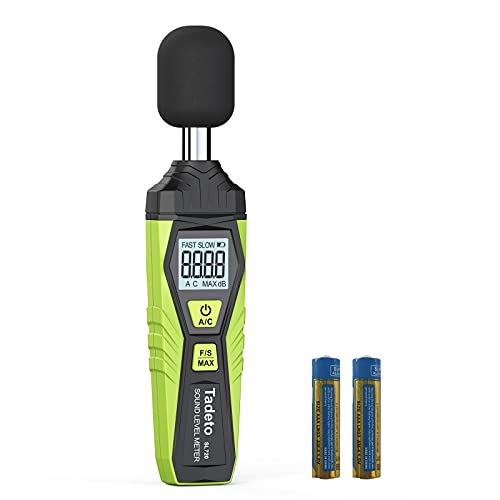
- 30–130 dB range with ±2.0 dB accuracy
- A/C weighting and fast/slow response modes
- Backlit LCD, data hold, and portable design
Best For: Routine home, workplace, and environmental noise checks
Best Accuracy Pick
Protmex PT6708 Sound Level Meter

- Stated ±1.5 dB accuracy across 30–130 dB
- Fast/slow response with A/C weighting
- MAX, data hold, and dB/SONE selection
Best For: More precise handheld workplace and environmental measurements
Best Wall-Mount Display
SW-525A Large Screen Sound Level Meter

- 30–130 dB digital measurement range
- Large red LCD display for visibility
- Wall-hanging design with alarm noted
Best For: Fixed indoor noise monitoring where a visible display matters
Best Everyday Pick
RISEPRO HT-80A Digital Sound Level Meter

- 30–130 dB range with ±1.5 dB accuracy
- MAX/MIN, hold, backlight, and auto power-off
- Includes carrying pouch and gift box
Best For: Routine home, workplace, and personal noise checks
Best for Data Logging
DANOPLUS Rechargeable Sound Level Meter

- Stores and exports up to 43,000 readings
- A/C weighting with FAST/SLOW response
- Three-color alarm and rechargeable USB battery
Best For: Long-term monitoring and PC-based noise analysis
Best Budget Handheld
VLIKE VL6708 LCD Sound Level Meter
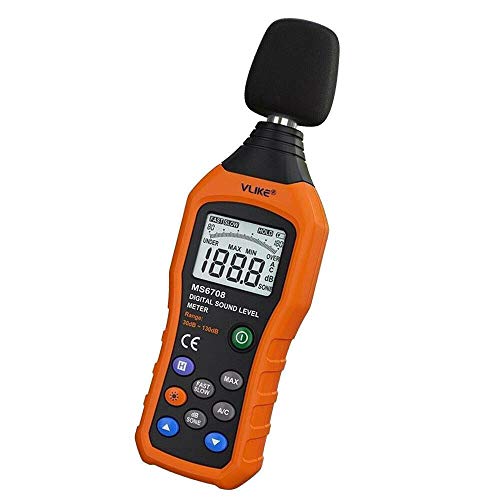
- 30–130 dB range with A/C modes
- MAX lock, backlight, and auto power-off
- Compact design for real-time readings
Best For: Simple portable noise checks without onboard reporting
Best Budget-Friendly Pick – TopTes TS-501B Decibel Meter
For everyday sound level meters use, the TopTes TS-501B combines a readable backlit display with A/C weighting and a 30–130 dB measurement range. Its compact, non-slip design and included batteries make it convenient for checking noise at home, in offices, workshops, or around noisy neighbors.
Best For: Home, office, classroom, workshop, and general noise checks.
Pros:
- Large 2.25-inch LCD with backlight for dim environments
- A/C weighting, 30–130 dB range, and stated ±1.5 dB accuracy
- MAX/MIN readings and data hold help track changing noise
- Includes three AAA batteries and a carry case
Cons:
- Frequency response is limited to 30–8,000 Hz
- Does not list professional compliance certification
The TS-501B is a practical choice when you want straightforward controls and useful monitoring features without a more specialized professional instrument.
Best Established Basic Meter – Extech 407730 Digital Sound Level Meter
The Extech 407730 is a straightforward option among sound level meters, offering a 40–130 dB range, A/C weighting, and a digital display with 0.1 dB resolution. Its fast-responding analog bar graph and Max/Min functions make it useful for observing both current and changing sound levels.
Best For: Users who want a simple, established meter for general sound measurements.
Pros:
- 0.1 dB resolution with stated 2 dB accuracy
- Fast analog bar graph provides a visual view of changing levels
- Max/Min recording, Max Hold, and auto power-off included
- Comes with a microphone windscreen and four AAA batteries
Cons:
- Measures from 40 dB, so it does not cover quieter sounds as well as some alternatives
- The supplied notes do not specify a backlit display
- Its stated accuracy is lower than the ±1.5 dB specification of some competing models
Choose the 407730 if you value clear readouts and familiar monitoring functions over an especially wide low-level measurement range.
Best for Flexible Loudness Checks – Goldeep SL750A Sound Level Meter
The Goldeep SL750A adds useful response and loudness options to the typical sound level meters feature set. It measures 30–130 dB with A/C weighting, supports FAST and SLOW response modes, and can display either dB or SONE units for sound intensity and perceived loudness.
Best For: Home, traffic, office, classroom, construction, and music-related noise checks.
Pros:
- 30–130 dB range with stated ±1.5 dB accuracy
- A/C weighting supports environmental and higher-intensity sound testing
- FAST/SLOW response modes suit changing or steady noise
- dB/SONE units, MAX/MIN tracking, data hold, and windbreak included
Cons:
- Frequency response is limited to 31.5 Hz–8 kHz
- Only two AAA batteries are listed in the package
Its SONE display and adjustable response make the SL750A especially appealing when you want more context than a single instantaneous decibel reading.
Best Professional-Grade Choice – CRYSOUND CRY2831 Class 2 Meter
For demanding sound level meters applications, the CRYSOUND CRY2831 offers IEC 61672-1:2013 Class 2 positioning, a broad 29–138 dB range, and an extended 20 Hz–12.5 kHz frequency response. Its A/C/Z weighting, FAST/SLOW time weighting, IP54 enclosure, and AC/DC power support suit field and industrial work.
Best For: Technicians, EHS teams, facility managers, inspectors, and professional workplace or environmental spot checks.
Pros:
- IEC 61672-1:2013 Class 2 sound level meter with factory calibration
- Wide 29–138 dB range and 20 Hz–12.5 kHz frequency response
- A/C/Z frequency weighting and FAST/SLOW time weighting
- IP54-rated enclosure, -20°C to 60°C operating range, and AC/DC power
Cons:
- Larger and heavier than the listed compact consumer meters
- Professional features may be more than casual household users need
- The supplied notes do not mention data logging or computer connectivity
The CRY2831 is the strongest fit here for users who need broader coverage, field durability, and standards-oriented measurements rather than a basic household noise reader.
Best Portable Pick – Tadeto Digital Sound Level Meter
The Tadeto digital sound level meter is a practical choice for checking noise in homes, factories, offices, schools, vehicles, and construction areas. Its 30–130 dB range, A/C weighting, selectable response speeds, and backlit display cover a variety of everyday sound-measuring tasks.
Best For: Home, workplace, automotive, and general environmental noise checks.
Pros:
- Measures from 30 to 130 dB with stated ±2.0 dB accuracy and 0.1 dB resolution.
- A and C weighting support ambient-noise checks and higher-intensity machine or motor analysis.
- Fast and slow response settings accommodate changing or relatively stable noise levels.
- Lightweight design, data hold, and backlit LCD improve portability and readability.
Cons:
- Its stated accuracy is lower than the Protmex model in this roundup.
- The supplied details do not mention automatic data reporting or computer connectivity.
Choose the Tadeto if you want a straightforward, portable sound level meter with useful weighting and response controls for routine measurements.
Best Accuracy Pick – Protmex PT6708 Sound Level Meter
The Protmex PT6708 is one of the more precise sound level meters in this selection, with stated ±1.5 dB accuracy and 0.1 dB resolution. It also adds A/C weighting, fast and slow response options, MAX and data-hold functions, and dB/SONE unit selection.
Best For: Users who want a more precise handheld meter for work, school, traffic, equipment, or environmental measurements.
Pros:
- 30–130 dB measurement range with stated ±1.5 dB accuracy.
- Fast response, plus selectable slow response for larger noise fluctuations.
- Includes MAX, data hold, under/over indicators, and dB/SONE selection.
- Backlight, anti-slip construction, and automatic backlight shutoff support practical use.
Cons:
- The device cannot keep and generate a report directly.
- The feature set may be more than needed for simple occasional checks.
The PT6708 is a strong option when measurement accuracy and control features matter more than built-in reporting.
Best Wall-Mount Display – SW-525A Large Screen Sound Level Meter
The SW-525A is a wall-hanging sound level meter designed around visibility rather than a long list of handheld controls. Its 30–130 dB range and large red LCD display make it suitable for locations where readings need to be easy to see.
Best For: Fixed indoor setups that benefit from a large, visible digital noise display.
Pros:
- Measures sound levels across a 30–130 dB range.
- Large red LCD display is designed for easy viewing.
- Wall-hanging format can work well in a fixed monitoring location.
Cons:
- The supplied details do not specify accuracy, resolution, weighting options, or response settings.
- Its 0.6 kg weight and wall-hanging design are less convenient for portable measurements.
- The notes mention an alarm but do not provide its operating details.
Consider the SW-525A when display size and fixed placement are your priorities; choose a more fully specified handheld model for detailed measurement control.
Best Everyday Pick – RISEPRO HT-80A Digital Sound Level Meter
The RISEPRO HT-80A is a practical choice among sound level meters for checking noise in homes, workplaces, schools, and other environments. It covers 30–130 dB, offers ±1.5 dB accuracy, and includes useful features for quick spot measurements.
Best For: Everyday noise checks, personal use, basic workplace monitoring, and portable measurements.
Pros:
- Measures from 30–130 dB with stated ±1.5 dB accuracy.
- Includes FAST time weighting and Type A frequency weighting.
- Data hold, MAX/MIN readings, backlight, and auto power-off support convenient operation.
- Includes a black carrying pouch and gift box.
Cons:
- Its frequency range is listed as 31.5 Hz to 4 kHz.
- The plastic housing may be less suited to demanding industrial handling than a more rugged meter.
Choose this model when you want a straightforward sound level meter with a broad measurement range and the core features needed for routine readings, without a data-logging or PC-export workflow.
Best for Data Logging – DANOPLUS Rechargeable Sound Level Meter
The DANOPLUS DP-441 stands out among sound level meters for users who need more than a single live reading. It can store up to 43,000 records, connect to a Windows PC for export and analysis, and display changing noise levels on a colored screen with a line chart.
Best For: Extended monitoring, recordkeeping, PC-based analysis, and users who need exportable noise data.
Pros:
- Stores up to 43,000 data records and supports Excel export through a PC connection.
- Offers selectable A/C frequency weighting and FAST/SLOW response settings.
- Three-color alarm indicators provide low, medium, and high noise alerts with adjustable thresholds.
- Rechargeable 1,000 mAh battery and USB charging support repeated use.
Cons:
- PC connectivity and exporting are compatible with Windows 7, 10, and 11, rather than being described as platform-independent.
- Its larger feature set may be unnecessary for simple spot checks.
This is the strongest option in the group for documenting noise over time. Select it if charting, alarms, storage, and computer-based reporting matter more than having the simplest possible interface.
Best Budget Handheld – VLIKE VL6708 LCD Sound Level Meter
The VLIKE VL6708 is a compact handheld option among sound level meters for real-time checks around homes, offices, schools, roads, workshops, and audio setups. Its 30–130 dB range, A/C modes, backlight, and MAX locking function cover the essentials for portable measurements.
Best For: Basic real-time readings, portable use, and noise checks where onboard reporting is not required.
Pros:
- Provides a 30–130 dB measuring range with A/C mode selection.
- Includes MAX locking, automatic range selection, backlight, and auto power-off.
- Portable mini handheld design with an anti-drop housing structure.
- Power-saving circuit design is intended to help batteries last longer.
Cons:
- Batteries are not included; the unit requires four AAA batteries.
- It cannot keep or generate a report directly from the device.
- The supplied notes do not list a stated accuracy specification.
The VL6708 makes sense for straightforward, on-the-go readings when you want a simple display and useful measurement modes. Look elsewhere if you need stored readings, direct reporting, or PC export.
How We Picked the Best Sound Level Meters
We focused on meters with useful measurement ranges, readable displays, practical controls, and features that support repeatable readings. Models offering A and C weighting, MAX or MIN capture, data hold, backlighting, or data logging received extra consideration because these functions make real-world testing easier.
We also distinguished between basic consumer meters and more specialized instruments. A simple 30–130 dB meter may be sufficient for checking appliances, rooms, speakers, or neighborhood noise. Class 2 or factory-calibrated equipment is a better fit when measurement consistency and documented specifications matter.
Quick Comparison
- Best for general home use: Choose a straightforward portable meter with a backlit screen, A/C weighting, and data hold.
- Best for professional checks: Look for a recognized accuracy specification, such as IEC 61672-1 Class 2, and calibration information.
- Best for long-term monitoring: Select a data logger with substantial internal storage, export capability, and rechargeable power.
- Best for fixed locations: A large-screen or wall-mountable model can be easier to read in workshops, offices, and production areas.
Key Buying Factors for Sound Level Meters
Measurement Range and Resolution
Most of the meters here cover roughly 30 to 130 dB, which suits common indoor, vehicle, equipment, and entertainment measurements. Check the lower limit if you need to measure quiet rooms, and consider display resolution when comparing small changes in sound.
Frequency Weighting
A-weighting approximates human hearing and is commonly used for general environmental and workplace noise checks. C-weighting retains more low-frequency energy and can be useful for loud music, machinery, and bass-heavy sound. Having both gives you greater flexibility.
Accuracy, Calibration, and Standards
For casual comparisons, a consumer meter may be adequate. If readings will support workplace decisions, compliance work, or technical reports, prioritize published accuracy specifications, calibration support, and standards such as IEC 61672-1 Class 2.
Data Capture and Usability
Backlighting helps in dim areas, while MAX/MIN and data-hold functions make it easier to capture changing noise. Choose data logging and computer export when you need to review trends rather than take occasional spot readings. Also check battery type, automatic shutoff, microphone protection, and the clarity of the controls.
Who Should Buy Which Sound Level Meters?
Homeowners and renters should choose an affordable handheld meter with A/C weighting and a backlit display for checking HVAC systems, neighbors, appliances, or room noise. Musicians, audio hobbyists, and event users will benefit from MAX capture, a broad range, and quick one-handed operation. Technicians and facility managers should prioritize calibration information, reliable controls, and data storage. Researchers or users who need records should select a data-logging model with export tools and enough memory for extended monitoring.
Whichever model you choose, take readings from a consistent position, avoid blocking the microphone, and allow the meter to stabilize before recording the result. These simple practices often improve useful accuracy as much as adding extra features.