
Clear, humid nights can turn a productive observing session into a frustrating battle with fogged optics. The right dew heater adds gentle, controlled warmth to your telescope or camera lens, helping maintain visibility without relying on guesswork.
This roundup covers 10 USB-powered and purpose-built options in different lengths, power levels, and control styles. Use the guide below to match a heater to your optical diameter, power setup, and typical observing conditions.
Best 10 Telescope Dew Heaters for Cold Nights Picks for 2026
USB Versatility

- USB-powered with a 1.8m cable
- Three adjustable heating modes
- Fits lenses below 76mm in diameter
Best For: Small telescope and camera lenses using USB power
Dedicated SCT Fit
Celestron 6-inch Dew Heater Ring

- Designed for 6-inch Celestron SCTs
- Direct, continuous 12V heating
- Lightweight aluminum ring with cable clip
Best For: 6-inch Celestron Schmidt-Cassegrain owners
Cold-Weather Flexibility

- Flexible down to -25°C
- USB-powered with three heat levels
- Fits optics up to 4.26 inches
Best For: Cold-weather astrophotography with medium-size optics
Large-Aperture Coverage

- 560mm heating length for large optics
- Supports diameters below 178mm
- 12V power with three heat settings
Best For: Large-aperture telescope and camera lenses
Compact USB Control

- Three heat settings
- Fits optics under 80mm
- USB-powered for field use
Best For: Small telescope optics and camera lenses
Wide Optical Coverage

- Fits optics under 125mm
- Stepless temperature control
- USB-powered with multi-use design
Best For: Larger telescope lenses and varied setups
Dual-Size Bundle

- Includes 240mm and 430mm strips
- Three-gear temperature regulation
- 1.8m USB cable and 66g weight
Best For: Multiple compact telescope and camera setups
Compact USB Pick

- Designed to reduce fogging in cold, humid conditions
- Adjustable fastener for a flexible fit
- Lightweight external USB-powered design
Best For: Small telescope or camera lenses and simple outdoor setups
Adjustable Heat Choice
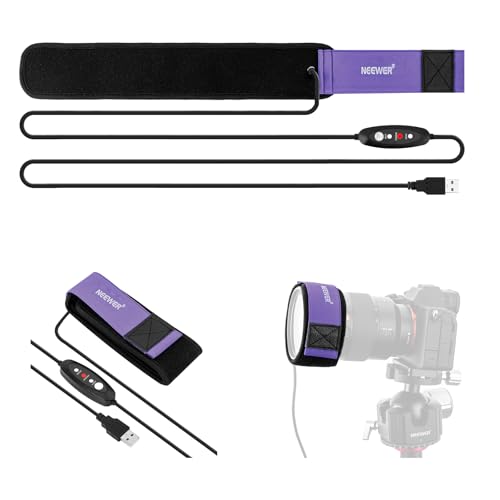
- Three temperature levels for changing conditions
- Fits optics up to 3.39 inches in diameter
- Long 4.9-foot cable and touch-fastener closure
Best For: Smaller telescopes, camera lenses, and binoculars needing heat control
Large-Scope Solution
NEEWER HW-23B 23.6-Inch Heater

- Long strip for larger optical equipment
- Fits up to 18.7 inches in circumference
- Three temperature settings with USB power
Best For: Large telescope tubes and optics requiring extended wrap coverage
USB Versatility – SV172 240mm Lens Warmer
For telescope dew heaters for cold nights, the SVBONY SV172 is a flexible USB-powered option for smaller telescope or camera lenses. Its 240mm length, three heat settings, and lightweight design make it practical when you want adjustable warming without adding much weight.
Best For: Small telescope and camera lenses with an external diameter below 76mm, especially USB power-bank setups.
Pros:
- USB connection works with a power bank or other USB power source.
- Three adjustable heating modes: strong, medium, and weak.
- Lightweight 66g design and narrow 50mm width minimize accessory interference.
- Aluminum construction and insulated heating design support fast, even warming.
Cons:
- Designed for lenses with an external diameter below 76mm.
- Requires a separate USB power source.
The SV172 is a sensible compact choice for observers who value USB convenience and adjustable heat. Check the lens diameter before buying, since its fit is intended for smaller optical assemblies.
Dedicated SCT Fit – Celestron 6-inch Dew Heater Ring
Among telescope dew heaters for cold nights, this Celestron ring is purpose-built for 6-inch Celestron Schmidt-Cassegrain telescopes. Its rigid aluminum construction, direct heating, and external 12V power design are aimed at consistent dew prevention on the corrector lens.
Best For: Owners of 6-inch Celestron Schmidt-Cassegrain telescopes who want a dedicated corrector-lens heater.
Pros:
- Fits all 6-inch Celestron Schmidt-Cassegrain corrector lenses.
- Provides direct, continuous heat from an external 12V DC source.
- Rigid, lightweight aluminum construction supports cable routing.
- Includes a cable-management clip and a 2-year US warranty.
Cons:
- Compatibility is limited to 6-inch Celestron Schmidt-Cassegrain telescopes.
- Requires an external 12V DC power source.
This is the most specialized option in the group. Its dedicated fit can simplify installation and cable management, but verify your telescope model and available 12V power before purchase.
Cold-Weather Flexibility – 350mm Neoprene Lens Heater
For telescope dew heaters for cold nights, this 350mm lens warmer emphasizes flexibility and portable USB operation. Its neoprene construction helps reduce heat loss, while the adjustable strap and three heat levels make it convenient for telescope and camera use.
Best For: Astrophotographers using lenses or telescope optics up to 4.26 inches in diameter in cold conditions.
Pros:
- Flexible neoprene cable remains usable down to -25°C.
- USB power works with a power bank or another USB source.
- Three incremental temperature settings and fast continuous warming.
- Hook-and-loop fastening makes attachment and removal straightforward.
Cons:
- Requires a separate USB power source.
- Maximum compatible diameter is 4.26 inches.
The neoprene strip is a practical pick when cold-weather flexibility and portable power matter. Its 350mm size suits medium-diameter optics, but larger telescope barrels will need a different heater.
Large-Aperture Coverage – SV192 560mm Dew Heater
For telescope dew heaters for cold nights on larger optical assemblies, the SVBONY SV192 provides a 560mm heating length and supports lenses with an outside diameter below 178mm. It uses 12V power, three adjustable heat settings, and a narrow profile designed to reduce interference with focusing and other accessories.
Best For: Large-aperture telescope and camera lenses with an outside diameter below 178mm.
Pros:
- 560mm heating length covers larger lenses and telescope barrels.
- Three adjustable heating modes: strong, medium, and weak.
- 12V input with a 120cm cable and DC 5.5 x 2.1 interface.
- 50mm width helps limit focusing interference and dark corners.
Cons:
- Requires a compatible 12V power source.
- Not intended for lenses with an outside diameter of 178mm or more.
The SV192 stands out when a shorter heater would not provide enough coverage. Confirm both the 560mm length and 12V connector match your setup before ordering.
Compact USB Control – Adjustable 80mm Lens Heater
For telescope dew heaters for cold nights, this compact USB strip is a practical choice for smaller optics. Its adjustable controller offers low, medium, and high settings, while the flexible design fits lenses and eyepieces under 80mm in diameter.
Best For: Small telescope objectives, eyepieces, finderscopes, and camera lenses used with a USB power bank.
Pros:
- Three adjustable heat settings provide simple control.
- Fits lenses with an outer diameter below 80mm.
- USB power works with power banks and other USB sources.
- Low-temperature wiring is rated for use down to -40°C.
Cons:
- Its 80mm size limit excludes larger optics.
- Inventory may include either the newer or older controller appearance.
This is a straightforward, lightweight option for observers who need targeted dew protection on compact optics. Confirm your lens diameter and plan on carrying a suitable USB power source.
Wide Optical Coverage – Astromania 40cm Dew Heater
Among telescope dew heaters for cold nights, the Astromania 40cm strip stands out for its broader fit and stepless temperature control. The hook-and-loop closure lets you adjust it around lenses up to 125mm in diameter, making it useful across several telescope and camera setups.
Best For: Larger telescope lenses, camera optics, and users who prefer continuously adjustable heat rather than preset levels.
Pros:
- Fits optics with an outer diameter below 125mm.
- Stepless controller allows fine temperature adjustment.
- USB connection works with a power bank or other USB source.
- Can also warm bottles or serve as a cold-weather wrist strap.
Cons:
- Its 40cm length may be excessive for very small optics.
- The supplied notes do not specify heat settings beyond the stepless adjustment.
The larger coverage and continuously adjustable controller make this a flexible choice when equipment sizes vary. Check the circumference and diameter of your optic before purchasing.
Dual-Size Bundle – SVBONY SV172 USB Dew Heaters
This SVBONY bundle offers two heater sizes for observers comparing telescope dew heaters for cold nights across different optical setups. The 240mm and 430mm strips use USB power and three-gear regulation, while the narrower 50mm design is intended to avoid interfering with focusing or creating dark corners.
Best For: Astronomers who want two heater lengths for compact optics and broader lenses, with convenient USB operation in the field.
Pros:
- Bundle includes 240mm and 430mm heater strips.
- Three-gear temperature regulation provides selectable output.
- USB cable measures 1.8m and works with a power bank.
- Fits external diameters below 76mm and weighs 66g.
Cons:
- The stated fit limit is below 76mm, narrower than some competing strips.
- The supplied notes do not specify separate controls for each heater.
With two lengths and a relatively light design, this bundle is useful for keeping different compact optical configurations ready for damp conditions. Verify your equipment diameter and cable-management needs before heading out.
Compact USB Pick – 5V Telescope Dew Heater Strip
For shoppers comparing telescope dew heaters for cold nights, this compact 5V strip focuses on straightforward fog prevention and easy outdoor use. Its adjustable fastener helps it fit different lens sizes, while the external USB connection works with a suitable power source.
Best For: Astronomers seeking a lightweight, basic heater strip for small telescope or camera lenses.
Pros:
- Designed to remove fogging in low-temperature, high-humidity conditions
- Adjustable fastener supports a snug, removable fit
- USB-powered design is convenient for outdoor use
- Lightweight at 2.36 ounces
Cons:
- No temperature settings are listed
- The supplied notes do not specify supported lens diameter or circumference
This is a practical, no-frills option when simplicity and portability matter more than adjustable heat control. Confirm the strip’s fit for your telescope and bring a compatible USB power source.
Adjustable Heat Choice – NEEWER HW-29B 16-Inch Heater
The NEEWER HW-29B is a versatile choice among telescope dew heaters for cold nights, pairing a 16-inch wrap with three temperature levels. It is designed for lenses, telescopes, and binoculars up to 3.39 inches in diameter and connects to common 5V USB power sources.
Best For: Astrophotographers who want adjustable heat and a compact heater for smaller optical equipment.
Pros:
- Three settings provide low, medium, and high heat options
- Fits equipment up to 3.39 inches in diameter
- Includes a 4.9-foot USB cable for flexible positioning
- Touch fasteners allow quick, secure adjustment
Cons:
- Its 16-inch length may not suit larger telescope barrels
- Requires a 5V USB power source
With adjustable output and broad compatibility across cameras, telescopes, and binoculars, the HW-29B is a balanced option for changing conditions. Check your optical equipment’s diameter before ordering.
Large-Scope Solution – NEEWER HW-23B 23.6-Inch Heater
For larger equipment, the NEEWER HW-23B offers extended coverage for telescope dew heaters for cold nights. Its 23.6-inch overall length, 20-inch effective length, and three temperature settings are designed for optics with a circumference up to 18.7 inches.
Best For: Larger telescope tubes, camera lenses, and binoculars that need a longer wrap.
Pros:
- Long 23.6-inch strip provides broad coverage
- Supports equipment up to 18.7 inches in circumference
- Three heat settings accommodate different weather conditions
- 4.9-foot USB cable supports flexible setup
Cons:
- Larger format may be excessive for small lenses
- Requires a compatible 5V USB power source
The HW-23B is the strongest fit in this group for larger optical assemblies, especially when a short strip would not wrap fully. Measure your equipment’s circumference and account for the listed 20-inch effective length.
How We Picked These Telescope Dew Heaters for Cold Nights
We focused on heaters designed to prevent dew, fog, and condensation on telescope optics and camera lenses. The selection includes several lengths, USB 5V models, multi-level temperature controls, and telescope-specific designs such as the Celestron aluminum dew heater ring. We also considered practical installation factors: whether a strip can wrap securely around an optical tube, how easily its cable reaches a power source, and whether the heater offers enough control for mild or severe conditions.
Because dew formation depends on humidity, wind, optical surface area, and local temperature, no single heater is ideal for every setup. A correctly sized strip with modest heat control is usually more useful than simply choosing the highest advertised wattage.
Quick Comparison
| What to compare | Best match |
|---|---|
| Compact telescope or camera lens | 240mm heater strips |
| Medium optical tube | 350mm to 430mm models |
| Large objective or telescope lens | 560mm to 600mm models |
| Simple portable power | USB 5V heaters |
| Fine adjustment in changing weather | Three-level or regulated models |
| Compatible Schmidt-Cassegrain telescope | Dedicated aluminum heater ring |
Key Buying Factors for Cold Nights
Length and Fit
Measure the circumference of the section you intend to heat, rather than choosing by telescope name alone. The strip should sit snugly around the lens cell or corrector plate without being stretched excessively. A heater that is too short may leave cold gaps; one that is too long may overlap awkwardly or transfer heat unevenly.
Power and Temperature Control
USB heaters are convenient with power banks, USB adapters, and many astronomy battery systems. Check the required voltage and current before connecting one to your field power supply. Three temperature levels or a regulator make it easier to use the lowest effective setting, conserving battery life and reducing unnecessary heat near delicate optics.
Construction and Cable Placement
Look for flexible materials, secure fasteners, and a cable that can route away from the focuser or mount. Cold-weather flexibility matters when the strip is installed outdoors. If your setup has limited cable management, a shorter lead or dedicated ring may be easier to use.
Power Planning
Estimate runtime from your battery capacity and the heater’s draw, then allow extra capacity for the mount, camera, and accessories. A heater can prevent condensation, but it cannot compensate for water already covering an optic, so install it before dew becomes visible.
Who Should Buy Which Telescope Dew Heaters for Cold Nights?
Choose a 240mm heater for compact refractors, guidescopes, binocular objectives, or camera lenses when the circumference matches. Medium-length 350mm to 430mm strips suit many general-purpose telescope and DSLR setups. For larger optical assemblies, the 560mm and 600mm options provide more wraparound coverage.
If you want straightforward field use, select a USB model with a familiar 5V power source. Observers in rapidly changing or especially humid conditions should favor a regulated or three-level heater so they can balance dew protection against battery consumption. Owners of compatible Schmidt-Cassegrain telescopes may prefer the dedicated Celestron ring for a more tailored fit. Before buying, measure the optic, confirm your power source, and prioritize adjustable output when you regularly observe through long, cold nights.