
Choosing among telescope filter wheels for astrophotography can make a major difference in imaging efficiency. The right setup lets you switch filters quickly while keeping your camera, adapters, and optical train organized.
This roundup covers 10 filter wheels and filter drawers in common 1.25-inch and 2-inch formats, including options with LRGB filters, adapter rings, and different mounting standards.
Best 10 Telescope Filter Wheels for Astrophotography Picks for 2026
Best LRGB Starter Wheel
Astromania 9-Position Filter Wheel

- Nine 1.25-inch filter positions
- Includes LRGB filter set
- Light-tight aluminum housing
Best For: Deep-sky imagers using 1.25-inch LRGB filters
Best Compact Magnetic Drawer
SVBONY SV226 M42-M48 Filter Drawer

- Holds two 1.25-inch or 2-inch filters
- Dual magnetic filter holders
- Locking screw helps limit light leaks
Best For: Fast two-filter changes across compatible threaded setups
Best Planetary Value Set
Astromania 5-Position Filter Wheel

- Five 1.25-inch filter positions
- Includes four planetary color filters
- Includes T- and eyepiece adapters
Best For: Lunar and planetary observation with 1.25-inch accessories
Best Full-Frame 2-Inch Drawer
SVBONY SV226 M54-M48 Filter Drawer
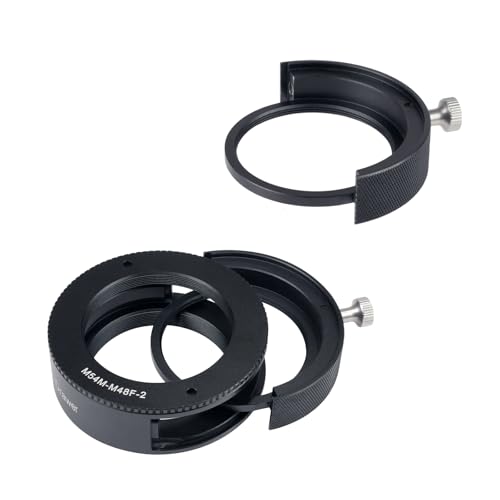
- Designed for 2-inch filters
- Supports compatible full-frame cameras
- Includes M54-M48 adapter
Best For: Wide-field deep-sky setups with compatible M54/M48 threads
Best Value Manual Wheel
Astromania 5-Position Filter Wheel

- Five-position wheel for 1.25-inch filters
- Includes eyepiece, nosepiece, and T2 adapters
- Useful for lunar, planetary, and tricolor imaging
Best For: Budget-conscious observers needing visual and imaging flexibility
Best LRGB Companion
Alstar 1.25-Inch Deluxe LRGB Kit

- Includes luminance, red, green, and blue filters
- Designed for monochrome CCD color imaging
- Parfocal filters help limit refocusing
Best For: Monochrome-camera users building an LRGB filter-wheel setup
Best Light-Tight Design
SVBONY SV133 5-Position Filter Wheel

- Light-tight interior helps reduce stray light
- Supports five 1.25-inch filters
- Includes T2, eyepiece, and focuser adapters
Best For: Short-back-focus imaging systems and mixed visual use
Versatile 2-Inch Choice
Astromania 5-Position Filter Wheel

- Five numbered positions for standard 2-inch filters
- Light-tight aluminum housing for imaging
- Short design with supplied 2-inch telescope adapter
Best For: Lunar, planetary, and nebula imaging with 2-inch filters
Compact Threaded Adapter

- Accepts 1.25-inch and 2-inch filters
- M42-to-M42 threaded connection
- Lightweight aluminum body adds 18 mm optical path
Best For: Flexible single-filter use with compatible threaded setups
Ready-Made LRGB Setup
Astromania 1.25-Inch LRGB Filter Wheel

- Includes five-position wheel and four LRGB filters
- Quick manual filter changes without removing camera
- Supports standard 1.25-inch filters and T-thread mounting
Best For: Starting LRGB imaging with a 1.25-inch telescope setup
Best LRGB Starter Wheel – Astromania 9-Position Filter Wheel
Astromania 1.25" Multiple 9-Position Filter Wheel for Telescope - with LRGB Filter Set
Check Price On AmazonFor astrophotographers seeking telescope filter wheels for astrophotography, this Astromania model combines nine 1.25-inch positions with a supplied LRGB set. Its rotary design lets you switch filters without removing the eyepiece or camera, while the light-tight aluminum housing helps protect filters and reduce stray light.
Best For: Deep-sky imagers building an LRGB workflow with 1.25-inch filters.
Pros:
- Nine numbered positions provide room for the included LRGB filters and additional 1.25-inch filters.
- Includes red, green, blue, and luminance filters in metal cells.
- Aluminum construction is described as suitable for heavier cameras.
- Attaches through the supplied 1.25-inch or T-thread connection.
Cons:
- It is designed for 1.25-inch filters rather than 2-inch filters.
- The manual rotary wheel requires physical filter changes during imaging.
- It weighs 1.3 pounds, which may matter in weight-sensitive setups.
This is a particularly complete choice if you want an LRGB-capable wheel with substantial spare capacity. Confirm your camera and focuser connection requirements before ordering.
Best Compact Magnetic Drawer – SVBONY SV226 M42-M48 Filter Drawer
This SVBONY SV226 is a drawer-style alternative for telescope filter wheels for astrophotography, using dual magnets to hold two filters and a locking screw to help limit light leaks. The M42-M48 adapter broadens connection options, while its 21mm thickness is intended to account for back focal length and optical-path constraints.
Best For: Astrophotographers who want fast swapping of one 1.25-inch and one 2-inch filter.
Pros:
- Two filter holders support both 1.25-inch and 2-inch filters.
- Dual magnets enable quick installation and removal.
- Locking tension adjustment helps reduce gaps and light leakage during long exposures.
- CNC aluminum construction is designed for precise, sturdy use.
Cons:
- It is a drawer system rather than a multi-position rotating wheel.
- The 21mm thickness must be considered when calculating back focus.
- Compatibility depends on matching threads and included adapter arrangements.
Choose this model when rapid, two-filter access matters more than carrying a large filter library. Check your camera, reducer, and telescope threads carefully, especially when combining M42 and M48 components.
Best Planetary Value Set – Astromania 5-Position Filter Wheel
For planetary observers comparing telescope filter wheels for astrophotography, this Astromania package pairs a five-position 1.25-inch wheel with red, blue, yellow, and green filters. The wheel keeps the filters installed and ready to dial in, while the color set is intended to enhance views of the Moon and planets.
Best For: Planetary and lunar observers starting with a simple 1.25-inch color-filter setup.
Pros:
- Five positions allow the included four filters to remain installed.
- Includes red, blue, yellow, and green planetary filters.
- Enclosed design helps protect filters from external impact and supports storage.
- Includes a T-adapter and eyepiece adapter.
Cons:
- It has fewer positions than the nine-position Astromania wheel.
- The included set is aimed at planetary color enhancement rather than LRGB imaging.
- It requires an additional 20mm of focus travel.
This is a straightforward entry point for visual planetary work and basic planetary imaging. It makes the most sense if your telescope accepts 1.25-inch accessories and you specifically want color filters rather than a deep-sky LRGB set.
Best Full-Frame 2-Inch Drawer – SVBONY SV226 M54-M48 Filter Drawer
This M54 version of the SVBONY SV226 targets deep-sky setups using 2-inch filters and full-frame cameras. Its dual-magnet holders support quick filter swaps, while the M54-to-M48 adapter, locking mechanism, and 20mm thickness address connection, light-leak, and optical-clearance considerations.
Best For: Full-frame deep-sky astrophotography using compatible M54/M48 threaded equipment.
Pros:
- Designed for 2-inch filters and full-frame camera compatibility.
- Dual magnets hold the filter holders securely for quick changes.
- Locking screw helps prevent gaps and light leaks during long exposures.
- Includes an M54 male-to-M48 female adapter, storage box, and Allen wrench.
Cons:
- It holds two filters, not a large collection of filters at once.
- The 20mm thickness must be included in back-focus calculations.
- It requires compatible M54/M48 threads or additional appropriate adapters.
This drawer is a strong fit for a streamlined full-frame workflow where wide-field clearance and rapid filter changes are priorities. Verify the complete optical path before buying, including camera threads, reducer spacing, and available back focus.
Best Value Manual Wheel – Astromania 5-Position Filter Wheel
For astrophotographers who want a straightforward way to manage several 1.25-inch filters, this Astromania model is a practical telescope filter wheel for astrophotography. Its five-position design lets you rotate different filters into the light path without repeatedly removing the camera or eyepiece.
Best For: Planetary, lunar, and tricolor astrophotography using 1.25-inch filters.
Pros:
- Holds up to five 1.25-inch filters for quick changes.
- Includes a 1.25-inch eyepiece adapter, nosepiece, and T2 camera adapter.
- Numbered positions make filter selection easy to track.
- Can support both visual observation and camera-based imaging.
Cons:
- Requires 23 mm of inward focus travel.
- That focus requirement may be problematic for some Newtonian reflectors.
- Manual operation and no stated coating may be less appealing for specialized imaging setups.
This is a flexible choice when you need one compact wheel for visual use and basic astrophotography. Check your telescope’s available focus travel before buying, especially if you use a Newtonian reflector.
Best LRGB Companion – Alstar 1.25-Inch Deluxe LRGB Kit
This Alstar kit is not a wheel itself, but it is a useful companion for telescope filter wheels for astrophotography. The four 1.25-inch filters—luminance, red, green, and blue—are designed for combining monochrome-camera exposures into color images.
Best For: Deep-sky and planetary color imaging with a monochrome CCD camera and a compatible filter wheel.
Pros:
- Includes luminance plus red, green, and blue filters.
- Filters are described as parfocal to reduce refocusing between exposure sets.
- Dichroic glass and blocking coatings are designed for high transmission and color separation.
- 1.25-inch format fits compatible telescope accessories and filter wheels.
Cons:
- Requires a separate filter wheel for fast filter changes.
- Designed primarily for monochrome CCD imaging rather than a complete camera setup.
- The supplied notes do not identify a wheel, camera, or mounting hardware in the kit.
Choose this set when your imaging system already supports 1.25-inch filters and you want a conventional LRGB workflow. Pairing it with a five-position wheel leaves room for an additional filter or keeps the LRGB sequence installed.
Best Light-Tight Design – SVBONY SV133 5-Position Filter Wheel
The SVBONY SV133 is a strong option for telescope filter wheels for astrophotography when stray light control and a short optical design matter. It accepts five 1.25-inch filters, includes camera and eyepiece adapters, and is built for quick manual changes during visual or imaging sessions.
Best For: Astrophotographers using 1.25-inch filters with DSLR or CCD cameras, including short-back-focus Newtonian and Dobson telescopes.
Pros:
- Light-tight interior is designed to limit reflections and stray light.
- Five numbered filter positions allow fast changes with the camera or eyepiece mounted.
- Includes a 1.25-inch eyepiece adapter, focuser nosepiece, T2 camera adapter, and locking ring.
- Short design can suit systems with limited back focus, while the aluminum housing supports heavier cameras.
Cons:
- Only compatible with 1.25-inch filters and suitable threaded devices.
- Manual rotation is required; no electronic filter control is listed.
- Its 0.5 kg listed weight may be worth considering for lightweight focusers or mounts.
The SV133 stands out for imaging setups where internal light control and compact spacing are priorities. Its included adapters also make it easier to move between eyepiece-based observing and camera imaging.
Versatile 2-Inch Choice – Astromania 5-Position Filter Wheel
For astrophotographers comparing telescope filter wheels for astrophotography, this five-position 2-inch model offers quick manual filter changes without removing the eyepiece or camera. Its light-tight aluminum housing, supplied 2-inch telescope adapter, and M48x0.75 male threads make it a flexible option for lunar, planetary, and nebula imaging.
Best For: Users working with standard 2-inch filters, heavier cameras, or setups needing a short, enclosed filter wheel.
Pros:
- Holds up to five standard 2-inch filters with clearly numbered positions.
- Light-tight interior helps reduce reflections and stray light during imaging.
- Sturdy aluminum construction is designed to support cameras with reduced flexure or tilt.
- Short design and supplied 2-inch adapter suit many Newtonian and Dobsonian setups.
Cons:
- Requires 22.5 mm of inward focusing distance from the normal focus position.
- Camera mounting may require a separate M48-to-T2 adapter, which is not included.
- Its 2-inch format may be unsuitable for users invested only in 1.25-inch filters.
This is a practical choice when you want fast access to several larger filters and a light-controlled optical path. Check your available focus travel and camera-thread requirements before buying.
Compact Threaded Adapter – Astromania M42 Filter Drawer
This Astromania drawer is a compact alternative to conventional telescope filter wheels for astrophotography, using an M42-to-M42 threaded interface rather than multiple rotating positions. It supports either 1.25-inch or 2-inch filters through its internal adapter and adds 18 mm to the optical path, excluding the T2 threads.
Best For: Astrophotographers who need a lightweight, removable filter holder for threaded camera or telescope accessories.
Pros:
- Supports both 1.25-inch and 2-inch filters, including filters up to 12 mm thick.
- M42 male-to-female threading provides a straightforward connection between compatible accessories.
- Lightweight anodized aluminum construction helps limit added equipment load.
- Can be used with eyepieces for visual observation or cameras for astrophotography.
Cons:
- It is a single filter drawer, not a multi-position wheel for rapid filter changes.
- Adds an 18 mm optical-path extension before accounting for its threaded ends.
- Requires compatible M42/T2 accessories for installation.
Choose this drawer if threaded simplicity and support for both common filter sizes matter more than rotating through several filters. Confirm the M42 connections and available focus travel in your optical train.
Ready-Made LRGB Setup – Astromania 1.25-Inch LRGB Filter Wheel
For beginners building a color-imaging workflow with telescope filter wheels for astrophotography, this kit combines a five-position 1.25-inch wheel with red, green, blue, and luminance filters. The manual wheel lets you rotate the selected filter into place while keeping the camera or eyepiece attached.
Best For: Astrophotographers who want an included LRGB set for planetary, lunar, or deep-sky imaging with 1.25-inch accessories.
Pros:
- Includes a five-position wheel plus red, green, blue, and luminance filters.
- Allows quick manual filter selection without removing the eyepiece or camera.
- Accepts standard 1.25-inch filters and can attach through the supplied nosepiece or T-thread.
- Metal construction is intended to support heavier cameras.
Cons:
- Requires approximately 20 mm of additional focus travel.
- Limited to 1.25-inch filters and may not fit setups built around 2-inch filters.
- The included wheel uses manual rotation rather than automated filter control.
This kit is a convenient starting point for LRGB imaging because the core filters are included. Before ordering, verify that your telescope can accommodate the added focus travel and that your camera setup accepts 1.25-inch accessories.
How We Picked the Best Telescope Filter Wheels for Astrophotography
We compared these products by filter format, capacity, mounting compatibility, included accessories, and suitability for monochrome or color astrophotography. We also considered whether each design is better suited to frequent filter changes, a compact imaging train, or a more permanent observatory-style setup.
Compatibility is especially important because filter wheels and drawers may use different camera-side threads, telescope-side adapters, and filter sizes. Always confirm the exact thread standard and optical spacing before ordering.
Quick Comparison
- 1.25-inch filter wheels: A practical choice for many smaller cameras, compact telescopes, and LRGB filter sets.
- 2-inch filter wheels: Better suited to larger sensors, wide-field imaging, and systems designed around 2-inch filters.
- Filter drawers: Usually offer a simpler, lower-profile way to install or remove one filter at a time.
- Five-position models: A useful balance between capacity, size, and ease of operation.
- Nine-position models: Helpful for imaging sequences that use multiple color, luminance, narrowband, or specialty filters.
Key Buying Factors for Telescope Filter Wheels for Astrophotography
Filter Size and Capacity
Match the wheel to the filters you already own or plan to buy. A 1.25-inch model can reduce cost and bulk, while 2-inch filters may better prevent vignetting with larger sensors and faster optical systems. Capacity also matters: five positions may be enough for LRGB imaging, while nine positions provide more flexibility for narrowband and calibration workflows.
Thread and Adapter Compatibility
Check whether the wheel or drawer uses M42, M48, M54, or another connection standard. Confirm both sides of the imaging train, including the camera adapter, telescope focuser, field flattener, reducer, and any required extension rings.
Back Focus and Spacing
Filter wheels add optical path length. Compare the unit’s thickness with your camera’s required back focus and the spacing specified for your reducer or flattener. A model that fits mechanically may still require spacers or a different adapter to achieve correct stars across the frame.
Imaging Workflow
For automated mono imaging, prioritize secure filter retention, repeatable positioning, and compatibility with your control software or manual workflow. For occasional visual or planetary use, a straightforward manual wheel or drawer may be more convenient and economical.
Who Should Buy Which Telescope Filter Wheels for Astrophotography?
- Beginners building a mono setup: Choose a 1.25-inch five-position wheel with an LRGB set if your camera and telescope support that format.
- Imagers using many filters: Consider a nine-position wheel to keep LRGB, narrowband, and specialty filters installed and ready.
- Large-sensor astrophotographers: Look at 2-inch options when your optical system requires greater clear aperture or uses 2-inch filters.
- Low-profile imaging setups: A compatible filter drawer may be preferable when back focus is limited or only one filter is needed at a time.
- Buyers upgrading an existing rig: Prioritize thread standards and spacing over included filter bundles, since mechanical compatibility determines whether the accessory will integrate cleanly.