
Choosing the right guide scope can make a noticeable difference in tracking accuracy, focusing consistency, and the overall weight of a refractor imaging setup.
These 10 options cover compact mini guide scopes, versatile finder-guide designs, and larger 50mm to 70mm models for astrophotographers with different mounts and cameras.
Best 10 Telescope Guide Scopes for Refractor Telescopes Picks for 2026
Best Lightweight APO Guide Scope

- 50mm APO doublet with ED glass
- Finder stalk and Vixen-style rail included
- Can become an astrograph with optional adapter
Best For: Astrophotographers wanting a versatile, lightweight guide scope
Best Guided Beginner Refractor
Celestron StarSense Explorer DX 102AZ

- 102mm refractor for bright visual views
- Smartphone sky recognition simplifies navigation
- Includes slow-motion controls and two eyepieces
Best For: Beginners seeking an app-assisted primary telescope
Best Helical-Focus Guide Scope
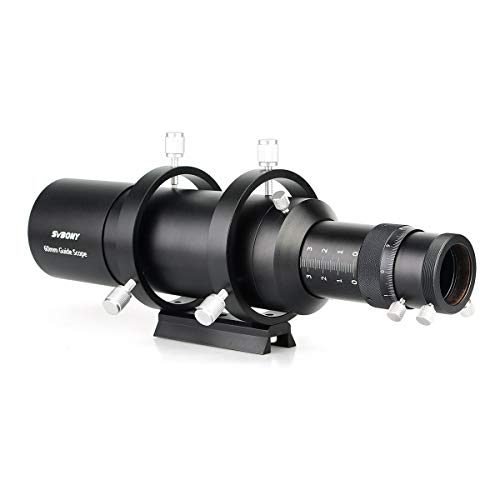
- Non-rotating helical focuser with 8mm travel
- Up to 35mm additional drawtube back-travel
- Works with compatible cameras or optional eyepiece
Best For: Astrophotographers needing precise, multi-use focusing
Best Portable Starter Refractor

- 70mm refractor for lunar and daytime viewing
- Backpack and tripod included for travel
- Two eyepieces and 5x24 finderscope included
Best For: Beginners wanting a portable visual telescope kit
Versatile 60mm Guide Scope
Astromania 60mm Helical Focuser

- 240mm focal length with a 2.7-degree field
- Precise helical focusing with low rotation
- Includes rings and Synta-style dovetail plate
Best For: Astrophotographers needing a sturdy guiding and finder scope
Compact Mini Guide Scope
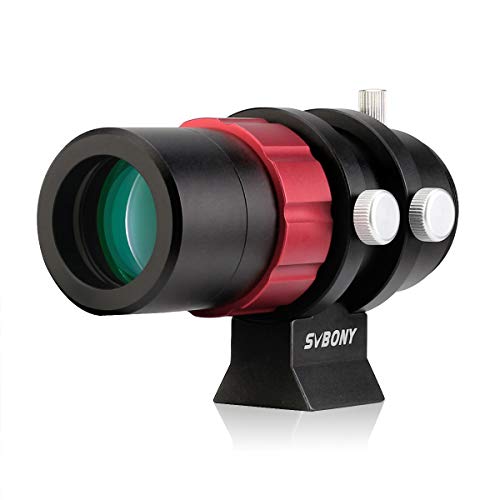
- Lightweight 342g construction
- Wide 2.86-degree field for quick target finding
- 1.25-inch and M42 camera interfaces
Best For: Compact imaging rigs with compatible autoguiding cameras
Long-Focal-Length Guide Scope
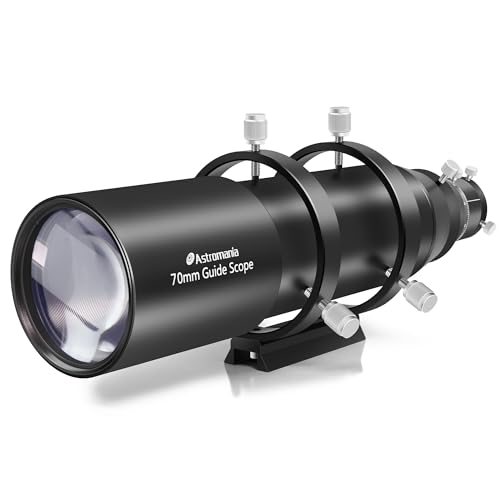
- 70mm objective with a 400mm focal length
- Dual helical focusing with a worm focuser
- Includes rings and Synta-style mounting plate
Best For: Users wanting a bright, dual-use guide and finder scope
Compact Precision Pick

- Designed for refractor OTAs up to 700mm
- 1.25-inch and M42 camera interfaces
- Scaled focuser and adjustable six-point guide ring
Best For: Compact refractor astrophotography setups
Long-Reach Finder Choice
Alstar 50mm Helical Guide Scope

- 50mm aperture for guide stars and visual finding
- 40mm helical focus range with micro-adjustment
- Designed for telescopes up to 1500mm focal length
Best For: Longer refractors and dual-purpose guiding
Flexible Focusing Option
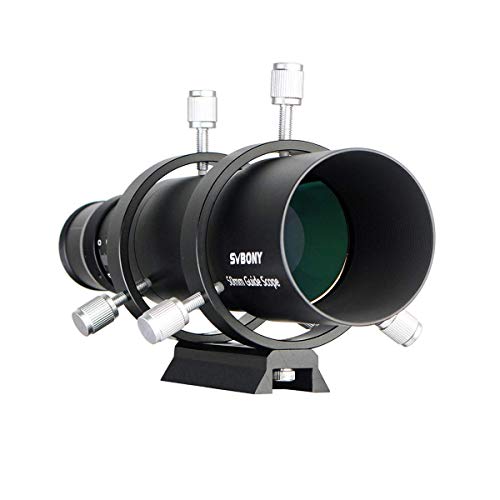
- 50mm aperture with fully multi-coated optics
- 8mm helical travel plus 30mm drawtube back-travel
- Includes adjustable rings and dovetail mounting bar
Best For: Flexible 50mm guiding on refractor setups
Best Lightweight APO Guide Scope – Sky-Watcher EvoGuide 50DX
For astronomers comparing telescope guide scopes for refractor telescopes, the Sky-Watcher EvoGuide 50DX is a lightweight, adaptable option. Its 50mm f/4.8 apochromatic doublet uses ED glass and includes both a finder stalk and Vixen-style mounting plate for flexible installation.
Best For: Astrophotographers who want a compact guide scope that can also support visual observing or optional astrograph use.
Pros:
- 50mm APO doublet with matched ED glass for contrast-rich views
- Includes a finder stalk and V-style mounting rail
- 242mm focal length and 1.25-inch helical focuser
- Built-in T-threads support optional adapter-based astrograph use
Cons:
- Adapter for astrograph conversion is optional and not included
- Its 2.7-pound weight may be more than some minimalist guide setups require
The EvoGuide 50DX stands out when mounting flexibility and optical versatility matter. It is a particularly well-rounded choice for refractor owners who want one compact scope for guiding, finding, and occasional imaging experiments.
Best Guided Beginner Refractor – Celestron StarSense Explorer DX 102AZ
The Celestron StarSense Explorer DX 102AZ is a complete 102mm refractor telescope rather than a dedicated guide scope. For shoppers researching telescope guide scopes for refractor telescopes, it is best viewed as a beginner-friendly observing platform with smartphone-assisted object locating.
Best For: Beginners and families who want a larger refractor with app-guided navigation for lunar, planetary, and selected deep-sky viewing.
Pros:
- 102mm aperture provides bright views of the Moon, planets, and deep-sky targets
- StarSense Explorer app uses sky recognition to help locate objects
- Manual altazimuth mount includes dual-axis slow-motion controls
- Includes 25mm and 10mm eyepieces plus a two-year warranty
Cons:
- It is a full telescope, not a compact autoguiding guide scope
- At 14.2 pounds, it is less portable than dedicated guide-scope options
This model makes sense for visual observers who prioritize easy setup and target-finding assistance. It is not the right choice for attaching to another refractor as a guide scope, but it can be a capable primary telescope for newcomers.
Best Helical-Focus Guide Scope – SVBONY SV106 60mm
The SVBONY SV106 is a practical candidate for telescope guide scopes for refractor telescopes, especially when precise focusing and camera compatibility are priorities. Its helical focuser preserves device orientation while providing 8mm of focus travel, with an additional telescoping drawtube for back-travel.
Best For: Astrophotographers who want a multi-use guide scope that can accept compatible autoguider cameras or serve as a finder.
Pros:
- Helical focuser adjusts focus without rotating the attached device
- 8mm helical travel plus up to 35mm of drawtube back-travel
- Male T-threads and compression ring support secure accessory attachment
- Can function as a straight-through finder with an optional 1.25-inch eyepiece
Cons:
- Optional eyepiece is required for finder-scope use
- Compatibility depends on the autoguider or accessory having suitable connections
- Listed specifications identify a 50mm objective despite the 60mm product title
The SV106’s strongest feature is its focusing design. If you regularly switch between guiding and finding, its non-rotating helical adjustment and flexible back-travel can make setup more convenient.
Best Portable Starter Refractor – Celestron Travel Scope 70
The Celestron Travel Scope 70 is a portable 70mm refractor kit for beginners. While it is not a dedicated guide scope, it may appeal to shoppers comparing telescope guide scopes for refractor telescopes who also want a simple visual telescope for travel, daytime use, and introductory stargazing.
Best For: Beginners and families wanting an easy-to-carry refractor with a tripod, eyepieces, finderscope, and backpack included.
Pros:
- 70mm fully coated objective supports lunar, planetary, and daytime viewing
- Includes 20mm and 10mm eyepieces for different magnifications
- No-tool setup and included backpack improve portability
- Comes with a 5×24 finderscope and software for learning the sky
Cons:
- Designed as a complete beginner telescope, not an autoguiding accessory
- Manual altazimuth mount is intended for visual observing
- Included 45-degree diagonal is oriented toward convenient viewing rather than specialized imaging
The Travel Scope 70 is a sensible entry-level package when portability and simplicity matter most. Choose it for casual observing and travel rather than for mounting as a dedicated guide scope on another refractor.
Versatile 60mm Guide Scope – Astromania 60mm Helical Focuser
For anyone comparing telescope guide scopes for refractor telescopes, this 60mm Astromania model offers a flexible setup for both visual finding and autoguiding. Its 240mm focal length, fully multi-coated optics, and built-in helical focuser are suited to astrophotography systems up to 1500mm focal length.
Best For: Astrophotographers who want one sturdy scope for guiding, visual finding, and direct T-thread camera attachment.
Pros:
- 60mm optics and a 240mm focal length provide a wide 2.7-degree field for locating guide stars.
- Helical worm focuser supports precise adjustments while minimizing camera or eyepiece rotation.
- Includes guide rings, Teflon inlays, and a Synta-style dovetail mounting plate.
- Male T-threads allow compatible guide cameras to attach directly to the focuser collar.
Cons:
- The larger 60mm design may be more scope than needed for compact guiding setups.
- Compatibility depends on having a suitable dovetail base and compatible female T-thread camera.
With its robust metal construction, adjustable mounting hardware, and 45mm total focusing range, this is a practical choice when stability and multi-use flexibility matter more than minimizing size.
Compact Mini Guide Scope – SVBONY SV165 30mm F4
The SVBONY SV165 is a lightweight option for shoppers looking at telescope guide scopes for refractor telescopes. Its 30mm achromatic optics, F4 aperture, and 120mm focal length create a wide field for quickly locating targets, while the 45mm back focus supports straightforward camera focusing.
Best For: Compact deep-sky imaging rigs using compatible 1.25-inch or M42 autoguiding cameras.
Pros:
- Small 342g design adds relatively little weight to an astrophotography setup.
- F4 optics and a 2.86-degree field help locate targets quickly.
- Supports compatible cameras from SVBONY, ZWO, QHY, and Orion through its 1.25-inch and M42 interfaces.
- Nylon-tipped thumbscrews help protect the telescope tube from scratches.
Cons:
- Some camera models may need additional accessories to achieve focus.
- It cannot be used with a dielectric mirror star diagonal because it will not focus.
- The image is inverted when used with an eyepiece.
This mini guide scope is a sensible choice when low weight and broad target coverage are priorities. Before buying, confirm your camera interface and back-focus requirements.
Long-Focal-Length Guide Scope – Astromania 70mm Deluxe
For refractor owners comparing telescope guide scopes for refractor telescopes, the Astromania 70mm Deluxe emphasizes bright, wide-field guiding with a 400mm focal length. It also accepts a 1.25-inch eyepiece, making it useful as both a guide scope and a visual finder.
Best For: Astrophotographers and visual observers who want a larger, long-focal-length guide scope with dual helical focusing.
Pros:
- 70mm objective and 400mm focal length provide bright optics and numerous potential guide stars.
- Built-in worm focuser enables fast focusing while helping prevent camera or eyepiece rotation.
- Includes matching pipe clamps and a Synta-style mounting plate for installation.
- Works with 1.25-inch eyepieces and autoguiding cameras.
Cons:
- At 2.5 pounds, it is substantially heavier than a compact mini guide scope.
- The longer 40cm optical tube requires more space on the telescope setup.
- Its larger form may be unnecessary for lightweight refractor rigs.
This model suits users who value a bright, long-focal-length guiding view and dual-use finder capability. Its weight and tube length should be checked against your mount and available mounting space.
Compact Precision Pick – SVBONY SV165 40mm Guide Scope
For refractor owners choosing telescope guide scopes for refractor telescopes, the SVBONY SV165 is a compact option suited to optical tubes with focal lengths up to 700mm. Its 40mm fully multi-coated achromatic optics, front focuser, and adjustable guide ring support straightforward guiding and astrophotography setups.
Best For: Compact refractor rigs up to 700mm focal length and users who want a guide scope compatible with common autoguiding cameras.
Pros:
- Compact 40mm design with fully multi-coated achromatic glass.
- 1.25-inch and M42 interfaces support SV305 Pro, Orion, ZWO, and QHY cameras.
- Front focuser includes a scale and locking ring for repeatable focus.
- Six-point guide ring allows adjustment of guide-scope coaxiality.
Cons:
- Recommended for telescope focal lengths within 700mm.
- Some eyepiece and camera combinations may require shortening the tube to reach focus.
The SV165 makes sense when low bulk and broad camera compatibility matter more than the larger light-gathering capacity of a 50mm model. Its focusing accessories may require setup experimentation, but the locking and scaling features can make repeated focusing more consistent.
Long-Reach Finder Choice – Alstar 50mm Helical Guide Scope
The Alstar 50mm is a practical choice among telescope guide scopes for refractor telescopes when you need a larger aperture and compatibility with longer optical tubes. Its fully multi-coated optics, 200mm-class focal length, and helical focuser are intended for guiding telescopes up to 1500mm focal length.
Best For: Longer refractors, visual finding, and astrophotographers who want a 50mm guide scope with a precise helical focusing system.
Pros:
- 50mm aperture gathers light for guide-star acquisition and object finding.
- Helical focuser provides 40mm of focus range, including 10mm of micro-focus adjustment.
- Fully multi-coated optics are designed for bright, wide-field views.
- Includes pipe clamps and a Synta-style dovetail mounting plate.
Cons:
- At 1.3 pounds, it is heavier than a compact 40mm guide scope.
- Its larger form may require more careful balancing on a portable mount.
Choose the Alstar when aperture and focusing control are priorities. The all-metal construction and locking helical system suit more demanding setups, while the included mounting hardware helps simplify installation on compatible telescope bases.
Flexible Focusing Option – SVBONY SV106 50mm Guide Scope
The SVBONY SV106 combines a 50mm aperture with a compact helical focuser, making it a versatile option when comparing telescope guide scopes for refractor telescopes. Its included rings and dovetail bar support aiming adjustments, while the focuser offers fine travel plus additional drawtube back-travel for different autoguider configurations.
Best For: Refractor users who want a 50mm guide scope with flexible mounting, threaded camera attachment, and fine manual focusing.
Pros:
- 50mm fully multi-coated objective supports guide-star viewing.
- Helical focuser provides 8mm of precise travel plus up to 30mm of drawtube back-travel.
- Focuser can be locked after adjustment to help maintain focus.
- Includes heavy-duty rings and a 3.5-inch dovetail mounting bar.
Cons:
- At 1.7 pounds, it adds noticeable weight to a refractor setup.
- Manual focusing requires adjustment for each camera and configuration.
The SV106 is a strong middle-ground choice for users who value both aperture and setup flexibility. Its threaded focuser collar, adjustable rings, and extra back-travel make it adaptable, although the added weight should be considered when balancing a portable mount.
How We Picked These Telescope Guide Scopes for Refractor Telescopes
We focused on the specifications that matter most in a guiding setup: aperture, focal length, optical design, focuser type, mounting flexibility, and overall size. The selection includes compact models for lightweight refractor rigs as well as larger guide scopes that can provide a wider range of guide-star options.
We also considered practical usability. A guide scope should be easy to attach securely, simple to focus with an astronomy camera, and appropriate for the payload limits of the primary mount. Product descriptions and feature sets were compared for compatibility and versatility rather than assuming that the largest aperture is automatically best.
Quick Comparison
| Guide scope type | Best suited to | Main advantage |
|---|---|---|
| 30mm to 40mm mini scopes | Small refractors and lightweight mounts | Low weight and compact size |
| 50mm guide scopes | General-purpose astrophotography | Balanced aperture and portability |
| 60mm to 70mm models | Larger refractors and flexible guiding | More aperture and broader usability |
| Double-helical-focuser models | Frequent camera changes or precise focusing | Convenient, controlled focus adjustment |
Key Buying Factors for Telescope Guide Scopes for Refractor Telescopes
Aperture and Focal Length
More aperture can make it easier to find suitable guide stars, but it usually adds weight and bulk. Compact 30mm or 40mm scopes are often a good match for short refractors, while 50mm and larger models may be more practical for longer focal-length imaging systems.
Focuser Design
A helical focuser allows fine focus changes without shifting the entire scope. This is useful when switching guide cameras or making small adjustments on a night of imaging. Check whether the focuser accepts your camera or requires an adapter.
Mounting and Stability
Guiding performance depends on a rigid connection. Look for compatible rings, a standard finder shoe, or a dovetail arrangement that matches your optical tube. Avoid flexible mounting hardware, which can introduce differential flexure and produce elongated stars even when the guide software reports good tracking.
Weight and Balance
Include the guide scope, camera, rings, and mounting hardware when calculating payload. A lightweight setup is easier for a small equatorial mount to control and may balance more reliably than a larger guide scope.
Guide-Camera Compatibility
Confirm the camera’s thread size, sensor format, and required back focus. A scope that works well with one guide camera may need spacers or adapters with another. A wider field of view can also make star acquisition easier.
Who Should Buy Which Telescope Guide Scopes for Refractor Telescopes?
Choose a 30mm or 40mm mini guide scope if you use a compact refractor, portable mount, or lightweight camera and want to minimize payload.
Choose a 50mm model if you want an all-around option for common refractor astrophotography setups and a useful compromise between size and guide-star availability.
Choose a 60mm or 70mm guide scope if your mount has sufficient capacity, your primary telescope has a longer focal length, or you want additional flexibility when selecting guide stars.
Choose a helical-focuser model if precise focusing and frequent equipment changes matter more to you than the absolute lowest price or weight. Before ordering, verify the mounting hardware and camera adapters required for your specific refractor and imaging system.