
Finding the best telescope for deep-sky viewing means balancing aperture, optical design, mount stability, portability, and ease of use. The right choice depends on whether you want to explore galaxies and nebulae visually, capture astrophotography, or learn the night sky with guided technology.
We selected 10 telescopes spanning beginner, intermediate, and advanced setups, including Dobsonians, Newtonian reflectors, compound telescopes, and apochromatic refractors. Use the guide below to narrow the list by observing goals, budget, and practical setup requirements.
Best 10 Telescopes for Deep Sky Viewing Picks for 2026
Best Overall Deep-Sky Dobsonian
Celestron StarSense Explorer 10-inch Dobsonian

- 254mm reflector for bright deep-sky views
- StarSense app guides target locating
- Stable manual Dobsonian base
Best For: Visual observers who want large-aperture performance with guided setup
Best High-Contrast Compound Scope
Sky-Watcher Skymax 180mm Maksutov

- 180mm aperture with 2700mm focal length
- 94% reflectivity mirror coatings
- Fully baffled, matched Maksutov optics
Best For: Experienced observers prioritizing contrast and compact compound optics
Best for Guided Tracking
Celestron Advanced VX 8-inch Newtonian

- 200mm f/5 parabolic reflector
- GoTo equatorial mount with SkyAlign
- Periodic Error Correction for tracking
Best For: Developing astrophotographers and observers wanting guided equatorial operation
Best Refractor for Astrophotography
SVBONY SV550 122mm Triplet APO

- 122mm FPL-51 triplet APO optics
- Dual-speed 1:10 focuser
- Portable 14.18-pound optical tube
Best For: Astrophotographers wanting a corrected, portable refractor OTA
Best Premium WiFi Pick

- 8-inch Schmidt-Cassegrain optics
- WiFi app-based GoTo control
- Built-in 10-hour battery
Best For: Convenient deep-sky observing in the field
Best Manual Beginner Value
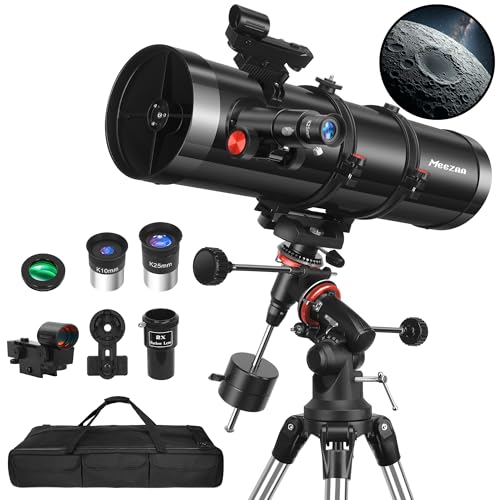
- 150mm reflector aperture
- 26X–130X stated magnification
- Equatorial mount and carry bag included
Best For: Beginners learning hands-on astronomical observing
Best Automated Classic

- 8-inch Schmidt-Cassegrain optics
- 40,000+ object GoTo database
- SkyAlign simplifies setup
Best For: Automated deep-sky and planetary observing
Best Beginner Value

- 130mm reflector for bright deep-sky views
- Equatorial mount with slow-motion controls
- Includes two eyepieces and red-dot finder
Best For: Beginners learning hands-on backyard astronomy
Best High-Aperture Option

- 11-inch Schmidt-Cassegrain aperture
- GoTo database with over 40,000 objects
- Stable 2-inch steel tripod and equatorial mount
Best For: Experienced observers and astroimaging enthusiasts
Best Smartphone-Guided Pick
Celestron StarSense Explorer DX 130AZ
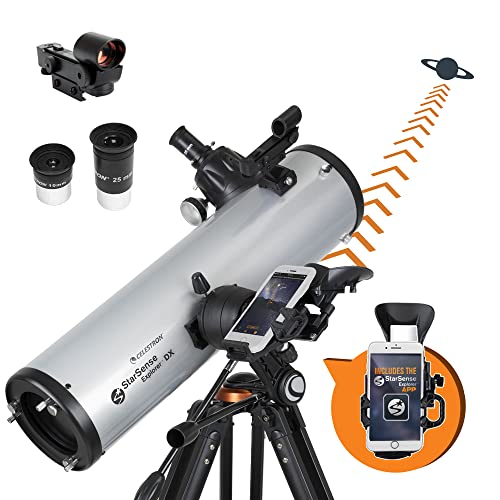
- App-guided target finding with StarSense
- 130mm reflector for deep-sky favorites
- Manual mount with dual-axis slow-motion controls
Best For: Beginners and families wanting guided backyard observing
Best Overall Deep-Sky Dobsonian – Celestron StarSense Explorer 10-inch Dobsonian
If you want one of the most capable telescopes for deep sky viewing without adding a powered mount, this 10-inch Celestron Dobsonian is a strong choice. Its 254mm reflector gathers substantial light, while the StarSense Explorer app helps you locate targets using your smartphone.
Best For: Beginners and visual observers seeking bright views of nebulae, galaxies, star clusters, and planets.
Pros:
- Large 10-inch aperture supports impressive deep-sky performance.
- StarSense app provides guided, smartphone-based target locating.
- Stable manual Dobsonian base requires no external power.
- Includes a 2-inch Crayford focuser, eyepieces, finder, and collimation cap.
Cons:
- At 54.8 pounds, it is less convenient to move than smaller telescopes.
- The manual mount does not provide automatic tracking.
- Its large 56-inch optical tube requires substantial storage space.
This model combines generous aperture with unusually approachable navigation. It is especially compelling for visual deep-sky observing, though its size and manual operation may not suit shoppers prioritizing portability or automated tracking.
Best High-Contrast Compound Scope – Sky-Watcher Skymax 180mm Maksutov
The Sky-Watcher Skymax 180mm is a specialized option among telescopes for deep sky viewing, using matched Maksutov-Cassegrain optics, a fully baffled tube, and high-reflectivity mirror coatings. Its compact optical design is suited to observers who value contrast and a long focal length.
Best For: Experienced observers who want contrast-rich views and a compact compound optical tube for visual astronomy or camera compatibility.
Pros:
- 180mm aperture provides substantial light-gathering ability.
- Matched optics and a fully baffled tube help produce dark, high-contrast views.
- 94% reflectivity mirror coatings support strong light transmission.
- Includes a 28mm 2-inch eyepiece, diagonal, and 9×50 finder.
Cons:
- The 2700mm focal length is less suited to very wide-field deep-sky views.
- An altazimuth mount is supplied, but the optical tube does not include a complete tracking system.
- The long focal length can make target acquisition more demanding for beginners.
With its combination of aperture, baffling, and matched optics, the Skymax emphasizes controlled, contrast-rich observing. It is a better fit for deliberate target selection than for sweeping large nebulae or extremely wide star fields.
Best for Guided Tracking – Celestron Advanced VX 8-inch Newtonian
For shoppers comparing telescopes for deep sky viewing with astrophotography potential, the Celestron Advanced VX 8-inch Newtonian adds a GoTo equatorial mount and precision tracking features. Its 200mm f/5 parabolic reflector is designed for bright, relatively wide-field views.
Best For: Observers and developing astrophotographers who want a Newtonian reflector with equatorial GoTo operation and tracking controls.
Pros:
- 200mm f/5 aperture offers bright deep-sky and planetary views.
- Parabolic primary mirror helps minimize spherical aberration.
- GoTo equatorial mount includes All-Star Polar Alignment and SkyAlign.
- Permanent Periodic Error Correction supports improved tracking performance.
Cons:
- At 103.2 pounds, the complete setup is difficult to transport.
- Requires a DC power supply for the mount.
- Equatorial alignment and tracking features create a steeper learning curve than a simple Dobsonian.
This is a feature-rich platform for users who want more than casual visual observing. The capable mount and tracking features add versatility, but the weight, power requirement, and setup complexity make it less convenient for quick observing sessions.
Best Refractor for Astrophotography – SVBONY SV550 122mm Triplet APO
The SVBONY SV550 is a portable, camera-ready refractor for shoppers seeking telescopes for deep sky viewing and astrophotography. Its 122mm FPL-51 triplet APO design is intended to reduce chromatic aberration, while the dual-speed focuser supports precise focusing.
Best For: Deep-sky photographers and visual observers who need a portable optical tube with corrected, sharp refractor views.
Pros:
- 122mm aperture gathers light for detailed deep-sky observation.
- FPL-51 triplet APO design helps reduce chromatic aberration.
- 1:10 dual-speed focuser enables fast and fine focusing.
- 14.18-pound optical tube is relatively portable and includes a long dovetail for balancing.
Cons:
- The optical tube is supplied without a complete mount or eyepiece set.
- Its 122mm aperture gathers less light than the larger reflectors in this roundup.
- Manual focus and equatorial mounting require compatible supporting equipment.
This SVBONY is an appealing optical-tube choice when image correction, portability, and camera compatibility matter most. Budget separately for a suitable mount and accessories, and consider its smaller aperture when targeting faint objects.
Best Premium WiFi Pick – NexStar Evolution 8
For serious deep-sky viewing, the Celestron NexStar Evolution 8 combines an 8-inch Schmidt-Cassegrain optical tube with app-based GoTo control. Its large aperture, StarBright XLT coatings, and automatic tracking make it a strong choice for observers who want bright views without manually locating every target.
Best For: Experienced beginners and hobbyists seeking convenient deep-sky observing with WiFi control and built-in field power.
Pros:
- 8-inch aperture gathers substantial light for deep-sky and planetary views.
- SkyPortal app can locate and track objects automatically.
- Built-in 10-hour LiFePO4 battery reduces the need for an external power supply.
- Manual clutches, carry handles, accessory trays, and USB charging add field convenience.
Cons:
- Its 17.46 kg weight makes it less convenient to transport than smaller scopes.
- Manual focusing may require more hands-on adjustment during observing.
The Evolution 8 is a capable, feature-rich option for deep-sky viewing, particularly when automatic object finding and smooth tracking matter. It costs portability, but the integrated battery and compact Schmidt-Cassegrain design help offset that trade-off.
Best Manual Beginner Value – MEEZAA 150EQ Reflector
The MEEZAA 150EQ is a practical entry point for telescopes for deep sky viewing, using a 150mm reflector aperture and 650mm focal length to collect light from galaxies, planets, and lunar targets. Its manual equatorial mount also gives beginners a hands-on way to learn tracking.
Best For: Adults, families, and beginners who want a large-aperture manual telescope with travel-friendly accessories.
Pros:
- 150mm aperture offers useful light-gathering capability for deep-space observation.
- Included eyepieces and 2X Barlow lens provide a stated 26X to 130X range.
- German equatorial mount includes precision dials and slow-motion controls.
- Carry bag, phone adapter, moon filter, and no-tool setup add convenience.
Cons:
- Manual tracking requires more user involvement than computerized GoTo telescopes.
- Kellner eyepieces are basic compared with more advanced accessory designs.
This package offers a lot for beginners, especially those who value a 150mm aperture and complete accessory set. Expect a learning curve with the equatorial mount, but the controls can help build foundational observing skills.
Best Automated Classic – NexStar 8SE
The Celestron NexStar 8SE is built for observers who want telescopes for deep sky viewing with minimal manual searching. Its 8-inch Schmidt-Cassegrain optics pair with a computerized GoTo mount, SkyAlign, and a database of more than 40,000 objects.
Best For: Observers moving beyond manual scopes who want automated target selection and tracking for deep-sky and planetary viewing.
Pros:
- 8-inch Schmidt-Cassegrain optics are designed to reveal galaxies, globular clusters, lunar details, and planets.
- GoTo system automatically slews to and tracks selected targets.
- SkyAlign can align the mount using three bright stars or planets.
- Includes a 2-year US warranty and unlimited technical support.
Cons:
- Power options require AA batteries, an AC adapter, or an external PowerTank, and these are not all included.
- The computerized mount adds setup and alignment steps compared with a simple manual scope.
The NexStar 8SE is a strong all-around automated telescope for deep-sky targets, with substantial aperture in a recognizable, portable design. Budget for a suitable power solution if you plan extended observing sessions away from an outlet.
Best Beginner Value – Celestron AstroMaster 130EQ
The Celestron AstroMaster 130EQ is a practical starting point for anyone shopping for telescopes for deep sky viewing. Its 130mm Newtonian reflector gathers useful light for bright deep-sky objects, while the equatorial mount and slow-motion controls help beginners aim and make adjustments manually.
Best For: Beginners who want a traditional telescope with capable 130mm optics, manual tracking controls, and a straightforward backyard setup.
Pros:
- 130mm coated Newtonian optics provide bright Moon and deep-sky views.
- Equatorial mount includes right-ascension and declination slow-motion controls.
- Includes 20mm and 10mm eyepieces, a red-dot finderscope, and astronomy software.
- Adjustable tripod and relatively quick, tool-free setup suit adults and kids.
Cons:
- Manual operation requires learning how to align and use an equatorial mount.
- At 17 pounds, it is less convenient to transport than a compact tabletop telescope.
The AstroMaster 130EQ offers a balanced combination of aperture, accessories, and hands-on controls. It is a strong fit when you want to learn the basics while still having enough light-gathering ability for popular deep-sky targets.
Best High-Aperture Option – Celestron CGEM II 11-Inch SCT
For serious telescopes for deep sky viewing, the Celestron CGEM II combines an 11-inch Schmidt-Cassegrain optical system with StarBright XLT coatings and a computerized equatorial mount. Its large aperture is designed for strong light gathering, while the GoTo system can locate and track targets from a database of more than 40,000 objects.
Best For: Experienced observers and astroimaging users seeking maximum aperture, automated object locating, and a highly stable equatorial setup.
Pros:
- Large 11-inch aperture offers exceptional light-gathering ability.
- StarBright XLT coatings support bright, sharp, high-contrast views.
- Computerized GoTo mount provides access to more than 40,000 celestial objects.
- Sturdy 2-inch steel tripod and robust mount help minimize vibration.
Cons:
- Its 148.5-pound weight makes transport and setup demanding.
- Battery power is required for the computerized mount.
- The advanced system is substantially less beginner-friendly than a manual telescope.
The CGEM II is the performance-focused choice in this group. Its aperture and automated mount make it well suited to ambitious observing, but the considerable weight and complexity favor a permanent or semi-permanent observing location.
Best Smartphone-Guided Pick – Celestron StarSense Explorer DX 130AZ
The Celestron StarSense Explorer DX 130AZ makes telescopes for deep sky viewing easier to navigate by using a smartphone as a sky guide. Its StarSense app identifies star patterns, recommends targets based on your location and time, and provides on-screen directions to objects such as the Orion Nebula and Andromeda Galaxy.
Best For: Beginners and families who want guided target finding, simple manual operation, and 130mm optics for backyard astronomy.
Pros:
- Smartphone-powered StarSense technology helps locate celestial targets.
- 130mm reflector provides views of bright nebulae, galaxies, planets, and star clusters.
- Manual altazimuth mount includes dual-axis slow-motion controls.
- Includes 25mm and 10mm eyepieces, a StarPointer finder, mount, and tripod.
Cons:
- Using the guided navigation system requires a compatible smartphone.
- Manual operation does not provide automatic tracking.
- The 18-pound setup is portable, but not as lightweight as smaller beginner scopes.
This model is a compelling choice if finding targets is your main obstacle. It retains the useful 130mm aperture of a traditional beginner reflector while adding app-based guidance that can shorten the learning curve.
How We Picked the Best Telescopes for Deep Sky Viewing
We focused on the specifications that most directly affect deep-sky performance: aperture, optical quality, focal length, mount design, tracking capability, portability, and user-friendliness. Larger apertures generally collect more light, revealing fainter galaxies, nebulae, and star clusters, but they also add weight and setup demands.
We also considered how each telescope fits a realistic observing workflow. A simple Dobsonian can provide excellent visual performance for the money, while a computerized GoTo model may be better for locating difficult targets. Equatorial mounts and high-quality refractors are particularly relevant to users planning astrophotography.
Quick Comparison
- Best for maximum visual value: Large-aperture Dobsonian telescopes offer substantial light-gathering power without the cost of a motorized mount.
- Best for guided observing: Smartphone-assisted and GoTo telescopes help beginners locate thousands of celestial objects more quickly.
- Best for portability: Maksutov-Cassegrain and Schmidt-Cassegrain designs provide long focal lengths in relatively compact tubes.
- Best for astrophotography potential: Stable equatorial mounts and apochromatic refractors provide better tracking or contrast for imaging.
Key Buying Factors for Telescopes for Deep-Sky Viewing
Aperture and Light Gathering
Aperture is often the most important specification for visual deep-sky observing. More mirror or lens area gathers more light and can improve resolution. However, aperture alone does not guarantee a better experience; optical quality, collimation, sky darkness, and atmospheric conditions also matter.
Optical Design
Newtonian reflectors typically provide strong aperture-per-dollar value. Schmidt-Cassegrain and Maksutov-Cassegrain telescopes are compact and versatile, though their narrower fields of view may be less convenient for very large nebulae. ED and apochromatic refractors offer sharp, high-contrast views with minimal maintenance, but large premium refractors can be expensive.
Mount and Tracking
A stable mount is essential. Dobsonian mounts are simple and excellent for visual use, while GoTo systems automatically locate and track targets. German equatorial mounts can support longer exposures, but they require more setup, alignment, and balancing. Smartphone-guided systems provide a useful middle ground for new observers.
Location and Portability
Dark skies make a dramatic difference, especially for faint galaxies and nebulae. If you must travel away from city lights, consider tube length, total weight, tripod size, and how easily the telescope can be assembled. A slightly smaller instrument that gets used regularly may outperform a larger telescope that is difficult to transport.
Who Should Buy Which Telescopes for Deep Sky Viewing?
Beginners should prioritize straightforward setup, a stable mount, and guidance features. A smartphone-guided reflector or beginner-friendly Dobsonian is often a better first purchase than an elaborate system that requires extensive alignment.
Visual deep-sky observers should favor the largest practical aperture, especially if they have access to dark skies. Dobsonians and large compound telescopes are strong choices for seeing more detail in clusters, nebulae, and galaxies.
Observers who want tracking should consider GoTo or equatorial mounts. These systems are useful for public outreach, high-magnification viewing, and keeping targets centered during longer sessions.
Aspiring astrophotographers should look beyond aperture alone. Mount tracking accuracy, payload capacity, compatibility with cameras, and optical correction are critical. A quality equatorial mount and suitable refractor may be a more practical starting point than the biggest available telescope.