
USB duplicators make it easier to copy, verify, and erase multiple flash drives without connecting each one to a computer. They are useful for IT teams, content distributors, schools, repair shops, and businesses that regularly prepare batches of identical drives.
We selected 10 standalone models covering two-drive desktop units, compact portable duplicators, and high-capacity systems with up to 31 target ports. The right choice depends on throughput, copy mode, drive compatibility, and how many devices you need to process at once.
Best 10 USB Duplicators Picks for 2026
Best Compact USB Duplicator
StarTech 1:2 Standalone Duplicator

- Copies or erases two USB drives without a computer
- Supports sector-by-sector cloning and overwrite modes
- LCD monitoring with copy-and-compare verification
Best For: Small IT batches and USB sanitizing
Best High-Volume USB Duplicator

- Copies to up to 15 USB drives simultaneously
- Standalone operation requires no computer or software
- Supports synchronous and asynchronous copy modes
Best For: Large business and production batches
Best Touchscreen USB Duplicator
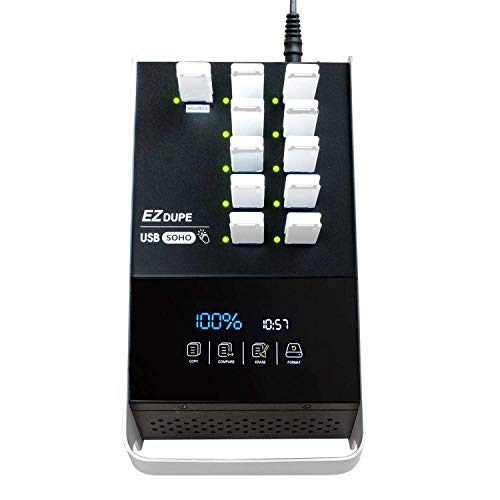
- Touchscreen controls copy, compare, format, and erase tasks
- Supports USB 2.0, 3.0, and 3.1 thumb drives
- Duplicates to up to 10 targets at 35MB per second
Best For: User-friendly daily flash-drive workflows
Best Mid-Volume USB Duplicator

- Copies to seven target USB drives at once
- Standalone operation with synchronous and asynchronous modes
- Supports USB 1.1, 2.0, and 3.0 flash drives
Best For: Moderate business and technician workloads
Best for Easy Setup

- Copies up to seven USB drives at once
- Standalone operation needs no computer
- Rated speed up to 2.5GB per minute
Best For: Compact small-batch USB duplication
Best High-Capacity USB Duplicator

- Duplicates up to 31 USB drives simultaneously
- Supports bit-by-bit copying
- Offers synchronous and asynchronous modes
Best For: High-volume business duplication
Best USB Duplicator With Erasing
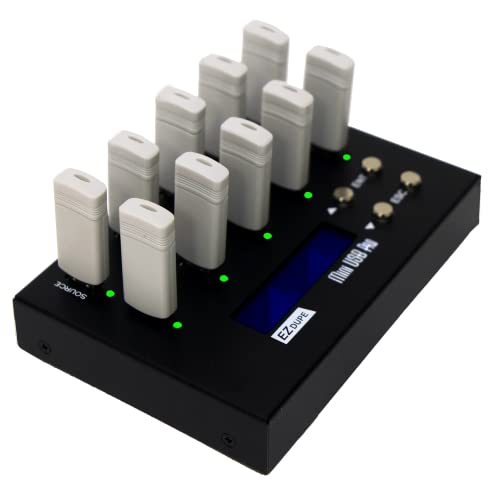
- Copies up to nine USB drives at once
- Includes quick and sector-by-sector modes
- Provides two erase functions
Best For: Duplication and drive-sanitizing tasks
Best with Extra Features

- Copies one USB drive to two targets without a computer
- Supports quick data copying and bit-for-bit cloning
- Includes testing, verification, and erase functions
Best For: Portable two-drive duplication and basic media deployment
Best Heavy-Duty Pick

- Copies to five USB targets simultaneously
- Supports cloning, erasing, diagnostics, and verification
- Works with USB 3.0, 2.0, and 1.1 media
Best For: IT teams handling repeated duplication and sanitization
Best Portable USB Duplicator
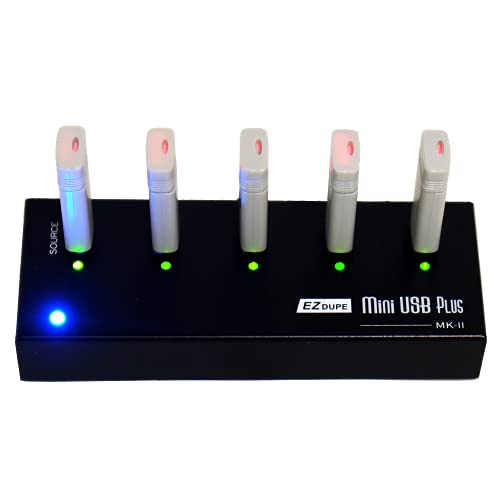
- Copies one source to four USB drives
- Supports USB 1.0, 2.0, and 3.0 media
- Offers asynchronous copying and flexible power options
Best For: Portable four-drive duplication and small batch workflows
Best Compact USB Duplicator – StarTech 1:2 Standalone Duplicator
For technicians and IT professionals who need a compact option among USB duplicators, the StarTech USBDUP12 provides standalone copying and erasing for up to two USB drives at a time. It supports system-and-file or sector-by-sector duplication, plus several erase modes, without requiring a computer.
Best For: Small-scale IT workflows, boot-drive preparation, USB sanitizing, and teams that need copy-and-compare verification.
Pros:
- Duplicates or erases USB 3.0/2.0 flash drives without a computer.
- Supports file-based copying, sector-by-sector cloning, quick erase, and one- or three-pass overwriting.
- LCD menu, activity/error LEDs, and copy-and-compare verification support easier monitoring.
- Asynchronous mode helps process additional drives with less interruption when source content is under 64 MB.
Cons:
- Only provides two target ports.
- Asynchronous copying is limited to source content under 64 MB.
- Some external USB devices may need their own power source.
The StarTech is a practical choice when portability, drive sanitization, and verification matter more than high-volume duplication. Its two-port design is best suited to smaller batches rather than production-scale copying.
Best High-Volume USB Duplicator – Systor 1 to 15 Duplicator
The Systor SYS-USBD-15 is built for organizations that need to produce many copies at once. This standalone USB duplicator supports up to 15 target drives, copies bit by bit, and offers synchronous and asynchronous modes at speeds up to 2GB per minute.
Best For: Business, IT, and production environments that regularly duplicate large batches of USB flash drives.
Pros:
- Supports one source drive and up to 15 target drives.
- Works without a computer or software.
- Performs bit-by-bit copying for direct duplication.
- Copy speed is rated up to 2GB per minute and is designed to remain consistent as the number of loaded drives increases.
Cons:
- Uses a USB 2.0 interface.
- Its 15-port capacity may be excessive for occasional or small-batch users.
- The supplied notes specify duplication features but do not list dedicated erase modes.
With 15 target ports, the SYS-USBD-15 is the strongest fit here for throughput and repeatable batch work. Choose it when minimizing repeated copy cycles is more important than a compact footprint or advanced erase controls.
Best Touchscreen USB Duplicator – EZ Dupe SOHO Touch 1:10
The EZ Dupe SOHO Touch combines a 10-target USB duplicator with a touchscreen interface. Its menu provides direct access to copy, compare, format, and erase functions, while intelligent copy and comparison features are designed to simplify recurring flash-drive tasks.
Best For: Users who want straightforward touchscreen control for daily duplication, comparison, formatting, and erasing.
Pros:
- Touchscreen menu simplifies copying, comparing, formatting, and erasing.
- Supports USB 2.0, 3.0, and 3.1 thumb drives.
- Handles all file formats, file sizes, and drive capacities according to the supplied notes.
- Provides up to 10 target ports and a rated duplication speed of 35MB per second.
Cons:
- Its 35MB-per-second speed is lower than the 2GB-per-minute rating of the Systor models.
- The product has a one-year manufacturer warranty.
- The supplied information does not specify whether operation is fully standalone.
The SOHO Touch stands out among USB duplicators for its approachable touchscreen workflow and broad drive support. It is a good middle ground for regular users who need more capacity than a two-port unit without moving to a 15-target system.
Best Mid-Volume USB Duplicator – Systor 1 to 7 USB Duplicator
The Systor SYS-USBD-7 offers a useful middle ground for USB duplicator buyers who need more than a two-port model but do not require 15 targets. It copies bit by bit, supports synchronous and asynchronous modes, and operates without a computer or software.
Best For: Small businesses, technicians, and personal users handling recurring batches of up to seven USB drives.
Pros:
- Copies from one source to up to seven target drives.
- Standalone design requires no computer or software.
- Supports USB 1.1, 2.0, and 3.0 flash drives.
- Offers hot-swappable operation and synchronous or asynchronous copying.
Cons:
- Uses a USB 1.1 interface on the listed specifications.
- Its 33MB-per-second copy rate is slower than some higher-throughput options.
- The supplied notes do not detail separate erase-pass options.
The SYS-USBD-7 is a balanced choice for moderate duplication workloads. Its seven target ports provide useful batch capacity while keeping the setup less specialized than a 15-port production unit.
Best for Easy Setup – EZ Dupe Mini USB Plus MK III
The EZ Dupe Mini USB Plus MK III is a practical choice for buyers who need compact USB duplicators without a computer. It can copy up to seven USB flash drives simultaneously and offers a rated speed of up to 2.5GB per minute, depending on the connected drives.
Best For: Small offices, technicians, and users who need standalone duplication for several USB drives at once.
Pros:
- Copies up to seven USB flash drives simultaneously.
- Standalone plug-and-use operation requires no computer.
- Supports USB 1.0, 2.0, and 3.0 media.
- Supports external USB storage above 2TB when it has its own power source.
Cons:
- External USB hard drives require a separate power source.
- Actual copy speed depends on the read and write performance of the connected drives.
With asynchronous copying and updated compatibility, this model is well suited to repeated small-batch duplication. Its seven-port capacity keeps the unit compact while still improving throughput over one-at-a-time copying.
Best High-Capacity USB Duplicator – Systor 1 to 31 USB Duplicator
The Systor SYS-USBD-31 is designed for high-volume duplication, supporting up to 31 USB drives in one standalone unit. It performs bit-by-bit copying and offers synchronous and asynchronous modes, making it a strong option among USB duplicators for business workflows.
Best For: Businesses, production environments, and users who need to duplicate large batches of USB flash drives.
Pros:
- Supports simultaneous duplication to up to 31 USB drives.
- Operates without a computer or software.
- Performs bit-by-bit copies for full-media duplication.
- Supports both synchronous and asynchronous copy modes.
Cons:
- Its large 31-drive capacity may be excessive for occasional home use.
- The listed transfer rate is up to 2GB per minute, or 33MB per second.
This Systor model prioritizes scale and repeatability over compactness. Its high port count, standalone design, and dual copy modes make it particularly appropriate when many identical USB drives must be prepared regularly.
Best USB Duplicator With Erasing – EZ Dupe MiniUSB Pro 1 to 9
The EZ Dupe MiniUSB Pro combines duplication with data-erasing functions in a standalone USB duplicator. It can copy up to nine flash drives simultaneously, supports quick and whole-media copy modes, and includes two erase functions for reuse and sanitizing tasks.
Best For: Users who need both USB duplication and basic drive-erasing capabilities in one compact device.
Pros:
- Copies up to nine USB flash drives simultaneously.
- Offers quick-copy and sector-by-sector whole-media modes.
- Includes two erase functions for data-sanitizing tasks.
- Works with USB 1.0, 2.0, and 3.0 media.
Cons:
- External USB hard drives must have their own power source.
- External USB hard-drive support is listed up to 2TB.
- Rated copy speed is up to 2GB per minute, or 35MB per second.
For buyers who want more than simple cloning, the MiniUSB Pro adds useful erase functionality without requiring a computer. Its nine-drive capacity offers a practical middle ground between compact personal units and larger production duplicators.
Best with Extra Features – Standalone 1:2 USB 2.0 Copier
If you need a straightforward way to create two USB copies without a computer, this compact USB duplicator is a practical choice. It supports Quick Copy for data files and Whole Media Copy for bit-for-bit cloning, with a simple LCD and button-based operation.
Best For: IT departments, schools, technicians, and field deployments that need portable two-drive duplication.
Pros:
- Duplicates one USB drive to two targets simultaneously without a computer.
- Offers both data-only copying and whole-media cloning.
- Includes capacity checks, device information, speed tests, and erase functions.
- Compact design with LCD monitoring and individual port status LEDs.
Cons:
- Limited to two target drives at a time.
- Designed for USB 1.1 and USB 2.0 media rather than newer USB 3.x media.
- Memory-card duplication requires a compatible USB card reader sold separately.
The BestDuplicator UB300 is a useful entry-level standalone unit when portability and uncomplicated operation matter more than high-volume throughput. Its verification and maintenance tools add value for repeated deployment and backup tasks.
Best Heavy-Duty Pick – StarTech 1:5 Drive Cloner
For teams that regularly prepare several USB drives at once, this StarTech USB duplicator provides five target ports and standalone operation. It combines file-level and sector-by-sector copying with drive erasing, testing, and copy verification.
Best For: IT professionals and technicians managing multiple boot drives, data distribution, or USB sanitization workflows.
Pros:
- Duplicates one source drive to up to five targets simultaneously.
- Supports USB 3.0, USB 2.0, and USB 1.1 flash media and external USB storage.
- Provides file-system copying, whole-drive sector copying, and multiple erase modes.
- Includes Copy & Compare, bad-sector scanning, LCD controls, and upgradeable firmware.
Cons:
- External USB devices may require their own power source.
- Asynchronous copying is limited to source content under 64 MB.
- Its larger five-port design may be more than needed for occasional two-drive jobs.
The StarTech USBDUP15 is the strongest fit here for higher-volume workflows and maintenance tasks. Its erase standards, diagnostics, and verification options make it more versatile than a basic copier, especially in managed IT environments.
Best Portable USB Duplicator – EZ Dupe 1:4 Mini USB Plus
This updated EZ Dupe USB duplicator is a compact option for copying one source to four USB drives at once. Its standalone plug-and-use design supports USB 1.0, 2.0, and 3.0 media, while asynchronous copying lets you replace finished drives without waiting for a full batch.
Best For: Portable four-drive duplication where speed, compact size, and flexible power options are important.
Pros:
- Copies to up to four USB flash drives simultaneously.
- Updated version offers up to 2.5 GB/min or 45 MB/s, depending on drive speed.
- Supports USB 1.0, 2.0, and 3.0 flash drives and compatible external storage.
- Asynchronous copy mode allows completed drives to be replaced during an ongoing workflow.
Cons:
- External USB storage must have its own power source.
- Actual copy speed depends on the read/write performance of the connected drives.
- It does not include the broader erase and diagnostic feature set described for the StarTech model.
The EZ Dupe Mini USB Plus MK II balances four-port capacity with a small footprint and flexible power support, including a power bank or USB power source. It is a convenient choice for mobile duplication jobs and recurring small batches.
How We Picked These USB Duplicators
We focused on standalone USB Duplicators that can operate without a host computer and support practical workflows such as drive-to-drive copying, duplication of multiple targets, and secure erasing or sanitizing. The lineup includes models with different port counts, speeds, physical designs, and interface support so you can match capacity to your workload.
We also considered whether each unit is suited to occasional use, portable deployment, or repeated batch production. Features such as LCD or touchscreen controls, USB 2.0 and USB 3.x compatibility, independent operation, and advertised transfer rates helped shape the comparison.
Quick Comparison
| Best for | Recommended capacity | What to prioritize |
|---|---|---|
| Occasional home or office cloning | 1:2 to 1:4 | Simple controls and compact size |
| Small business batch jobs | 1:5 to 1:10 | Balanced speed, compatibility, and controls |
| IT departments and deployment teams | 1:7 to 1:15 | Throughput, verification, and repeatability |
| High-volume production | 1:15 to 1:31 | Maximum port count and reliable cooling |
Key Buying Factors for USB Duplicators
Port Count and Workload
A 1:2 duplicator is economical for occasional copying, while a 1:7 or 1:10 model can significantly reduce batch time. Larger units make sense only when you regularly have enough target drives to keep their ports occupied.
Copy Speed and Verification
Advertised speeds are usually maximum figures and vary with the source drive, target media, file size, and data type. Look for a unit that supports verification if accuracy matters more than raw throughput. A slower verified copy can be preferable for business-critical deployment.
USB Compatibility
Check whether your drives are USB 2.0, USB 3.0, or USB 3.1 and confirm that the duplicator supports the connectors and capacities you use. Newer ports may improve performance, but they do not automatically make older flash drives faster.
Erasing and Sanitizing
If you reuse loaner, returned, or retired media, choose a model with dedicated erase or sanitize functions. Confirm which erase modes are available and whether they meet your organization’s data-handling requirements.
Controls and Physical Design
LCD menus are often sufficient for repeatable office tasks, while touchscreen controls can make larger workflows easier to navigate. Also consider footprint, cooling, power requirements, and whether the unit will stay on a workbench or travel between locations.
Who Should Buy Which USB Duplicators?
Choose a compact 1:2 or 1:4 unit for occasional cloning, classroom preparation, field work, or small offices. A 1:5 to 1:10 model is a better all-purpose option for repair shops, IT technicians, and organizations that prepare drives every week. For frequent deployments, media distribution, or sanitizing large batches, step up to a 1:15 or 1:31 system to reduce operator time. Before purchasing, estimate your normal batch size, verify the source and target drive formats, and leave some capacity for future growth.