
Zoom telescope eyepieces make observing more convenient by letting you adjust magnification without repeatedly changing eyepieces. They are especially useful for lunar viewing, planets, double stars, and casual deep-sky sessions where conditions can change quickly.
This roundup compares 10 options across common 1.25-inch and 2-inch formats, with attention to focal-length range, field of view, eye relief, optical design, and overall versatility.
Best 10 Zoom Telescope Eyepieces Picks for 2026
Best All-Around Zoom
Celestron 8-24mm Zoom Eyepiece

- Smooth 8-24mm zoom range
- Fully multi-coated optics
- Works with standard 1.25-inch holders
Best For: Flexible stargazing with one eyepiece
Best Wide-Field Upgrade

- Wide 70-degree field of view
- Lanthanum glass optical elements
- Fully multi-coated lenses
Best For: Wide, high-resolution fixed-eyepiece viewing
Best Value Zoom
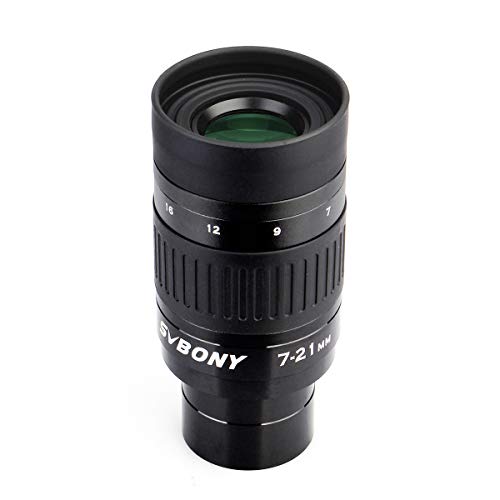
- Adjustable 7-21mm focal length
- Comfortable eye relief for glasses
- Fully multi-coated six-element design
Best For: Affordable all-purpose telescope viewing
Best for Planetary Detail
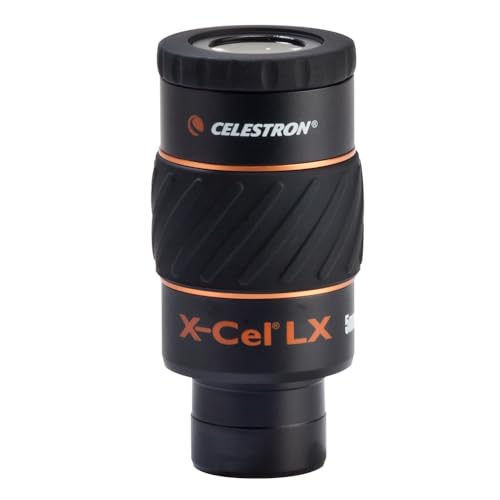
- Dedicated 5mm high power
- 60-degree field of view
- Adjustable rubber eyeguard
Best For: High-power planetary observation
Flexible Zoom Viewing
SVBONY SV191 7.2-21.6mm Zoom Eyepiece

- 7.2-21.6mm variable magnification
- 42-65° apparent field of view
- 18-20mm eye relief and 1.25-inch fit
Best For: Convenient viewing with fewer eyepiece changes
Premium Wide-Field Zoom
Baader Hyperion Mark IV 8-24mm Zoom

- Five click-stop focal lengths from 8mm to 24mm
- 68° wide field with Phantom multicoatings
- Includes 1.25-inch and 2-inch barrels
Best For: Wide-field observing across multiple telescope formats
Complete Accessory Set
Celestron 1.25-inch Eyepiece and Filter Kit

- Five Plössl eyepieces from 6mm to 32mm
- Includes 2x Barlow and viewing filters
- Foam-lined metal case with room to expand
Best For: Beginners building a versatile telescope accessory collection
Premium Parfocal Choice

- Parfocal design reduces refocusing
- 63° field of view
- 1.25-inch and 2-inch interfaces
Best For: Planetary observing and glasses wearers
Wide-Range Value Pick

- Broad 7-21mm focal-length range
- 40°-57° field of view
- 15mm eye relief with rubber eye guard
Best For: General-purpose 1.25-inch telescope viewing
Lightweight Everyday Option

- Flexible 7-21mm zoom range
- 220g lightweight design
- Fully multi-coated five-element optics
Best For: Everyday lunar, planetary, and deep-sky viewing
Best All-Around Zoom – Celestron 8-24mm Zoom Eyepiece
If you want flexible zoom telescope eyepieces without buying several fixed focal lengths, the Celestron 8-24mm Zoom Eyepiece is a practical option. Its 3:1 range lets you adjust magnification smoothly, while fully multi-coated optics are designed to improve brightness, color, and contrast.
Best For: Stargazers who want one versatile eyepiece for telescopes or spotting scopes with a standard 1.25-inch holder.
Pros:
- Adjustable 8-24mm focal length replaces multiple fixed eyepieces.
- Fully multi-coated optics support brightness, color, and contrast.
- 55-degree field of view and smooth twist-zoom operation.
- Accepts 1.25-inch filters and includes T-threads for astrophotography.
Cons:
- Limited to telescopes and scopes accepting 1.25-inch eyepieces.
- Manual focusing and zoom adjustment require hands-on operation.
With its broad focal-length range, filter compatibility, and included two-year U.S. warranty, this Celestron is a convenient starting point for observers who value flexibility over maintaining a large eyepiece set.
Best Wide-Field Upgrade – Pentax XW 20 Eyepiece
Pentax 70516 SMC-XW 20 1.25-Inch Eyepiece for Telescopes and Pentax Spotting Scopes
Check Price On AmazonThe Pentax XW 20 is a fixed-focal-length alternative to zoom telescope eyepieces, aimed at viewers who prioritize a broad view and refined optical performance. Its 70-degree field of view and lanthanum glass elements are designed for bright, high-resolution images with reduced aberrations and distortion.
Best For: Telescope users and compatible Pentax spotting-scope owners seeking a wide, high-quality viewing experience.
Pros:
- Wide 70-degree field of view makes viewing more comfortable.
- Fully multi-coated lenses improve light transmission and color quality.
- Lanthanum glass elements support high-resolution images with minimal aberrations.
Cons:
- Fixed focal length does not provide zoom flexibility.
- Compatibility details specifically list Pentax PF-series spotting scopes and telescope mounts.
This Pentax is best considered a premium fixed eyepiece rather than a variable zoom. It makes sense for observers who would rather have a wide, optically optimized view than adjust focal length during an observation.
Best Value Zoom – SVBONY SV135 7-21mm Eyepiece
The SVBONY SV135 is one of the more flexible zoom telescope eyepieces for observers who want adjustable magnification in a compact 1.25-inch format. Its 7-21mm range, fully multi-coated six-element design, and variable 40-57-degree field of view suit lunar, planetary, deep-sky, and landscape observation.
Best For: Budget-conscious beginners and eyeglass wearers who want one adjustable eyepiece for varied viewing.
Pros:
- 7-21mm zoom range provides the flexibility of multiple eyepieces.
- 18mm-16.3mm eye relief is suited to comfortable viewing, including with glasses.
- Six-element, four-group fully multi-coated design supports edge and center sharpness.
- Standard 1.25-inch barrel fits compatible telescopes.
Cons:
- Field of view varies from 40 to 57 degrees across the zoom range.
- Warranty coverage is one year, with a 30-day no-reason return period noted.
The SV135 offers useful focal-length flexibility and comfortable eye relief at a value-oriented price point. It is a sensible choice when versatility matters more than the widest possible field of view.
Best for Planetary Detail – Celestron X-Cel LX 5mm
For observers choosing between zoom telescope eyepieces and a dedicated high-power option, the Celestron X-Cel LX 5mm focuses on planetary viewing. Its six-element fully multi-coated system provides a 60-degree field of view, while the adjustable rubber eyeguard is designed for comfortable, higher-contrast observation.
Best For: Telescope users seeking a dedicated high-power eyepiece for planetary views.
Pros:
- 5mm focal length is designed for high-power planetary viewing.
- Six-element fully multi-coated lens system offers a 60-degree field of view.
- Pop-up rubber eyeguard improves comfort and contrast.
- Threaded 1.25-inch barrel accepts filters.
Cons:
- Fixed 5mm focal length lacks the flexibility of a zoom eyepiece.
- High power may be less versatile for broad, low-magnification views.
This X-Cel LX is a focused addition for planetary observation rather than an all-purpose replacement. Its ergonomic grip, adjustable eyeguard, and filter-ready barrel make it a practical dedicated high-power choice.
Flexible Zoom Viewing – SVBONY SV191 7.2-21.6mm Zoom Eyepiece
The SVBONY SV191 is a practical choice for anyone comparing zoom telescope eyepieces and wanting variable magnification without repeatedly changing eyepieces. Its 7.2-21.6mm range, 42-65° apparent field of view, and standard 1.25-inch fit make it suitable for telescopes and spotting scopes.
Best For: Observers who want convenient magnification changes, comfortable eye relief, and compatibility with standard 1.25-inch equipment.
Pros:
- Zooms from 7.2mm to 21.6mm without swapping eyepieces.
- Seven-element, four-group fully multi-coated optical design with blackened edges.
- 18-20mm eye relief and a twist-up rubber eyecup support extended viewing, including with glasses.
- Accepts standard 1.25-inch filters through its M28.5*0.6 threaded adapter.
Cons:
- Requires refocusing after zooming because it is not parfocal.
- Its field of view changes from 42° to 65° across the zoom range.
The SV191 offers useful all-purpose flexibility in a compact 1.25-inch format. It is especially appealing when convenience matters more than maintaining one fixed field of view while changing magnification.
Premium Wide-Field Zoom – Baader Hyperion Mark IV 8-24mm Zoom
Baader 1.25" & 2" 8-24mm Hyperion Universal Mark IV Zoom Eyepiece # HYP-Zoom 2454826
Check Price On AmazonThe Baader Hyperion Universal Mark IV is a premium option among zoom telescope eyepieces, offering five defined focal lengths from 8mm to 24mm and a 68° wide field. Its included 1.25-inch and 2-inch barrels provide broad telescope compatibility.
Best For: Experienced observers who want a wide-field zoom with multiple mounting options, adjustable eye-cup choices, and camera-adaptation features.
Pros:
- Provides five click-stop focal lengths: 8, 12, 16, 20, and 24mm.
- Offers a 68° wide field with Baader Phantom coating group multicoatings.
- Includes both 1.25-inch and 2-inch barrels for use with compatible focusers.
- Includes adjustable, straight, and winged eyecup options plus an M43 photo/video thread.
Cons:
- Its zoom range is limited to 3x, compared with wider-range zoom designs.
- Compatibility depends on the telescope’s 1.25-inch or 2-inch focuser and available threads.
The Hyperion Mark IV is built for users who value optical versatility and accessories over a minimalist setup. The defined click stops and dual barrels make it a strong choice for varied observing and optional projection photography.
Complete Accessory Set – Celestron 1.25-inch Eyepiece and Filter Kit
The Celestron Eyepiece, Barlow & Filter Kit is a comprehensive alternative to buying individual zoom telescope eyepieces. It includes five 1.25-inch Plössl eyepieces, a 2x Barlow lens, viewing filters, and a protective case for a broad range of magnifications and observing needs.
Best For: Beginners and telescope owners who want a ready-to-use collection of fixed eyepieces, a Barlow lens, and basic lunar and planetary filters.
Pros:
- Includes 32mm, 17mm, 13mm, 8mm, and 6mm Plössl eyepieces.
- Each eyepiece has a four-element design and 52° field of view.
- The 2x Barlow doubles the magnification of the included eyepieces or other 1.25-inch eyepieces.
- Includes a Moon Filter, planetary filters, and a durable foam-lined metal case.
Cons:
- This is a fixed-eyepiece kit rather than a single zoom eyepiece.
- All components use a 1.25-inch barrel, limiting compatibility with larger 2-inch focusers without additional equipment.
The Celestron kit suits shoppers who want maximum accessory coverage in one purchase. While it lacks the one-piece convenience of zoom telescope eyepieces, its range of focal lengths, Barlow, filters, and storage case offers a flexible starting setup.
Premium Parfocal Choice – SVBONY SV245 8-16mm Zoom
The SVBONY SV245 is a versatile option for shoppers comparing zoom telescope eyepieces, combining an 8-16mm range with a 63° field of view. Its parfocal design helps minimize refocusing while you adjust magnification, and the dual 1.25-inch/2-inch interface broadens compatibility.
Best For: Planetary and detailed observing when smooth, efficient magnification changes matter.
Pros:
- Parfocal across the zoom range for less refocusing.
- 63° field of view provides immersive views during zooming.
- 17-18mm eye relief and a folding eye mask accommodate glasses wearers.
- Supports both 1.25-inch and 2-inch interfaces.
Cons:
- Heavier than the other listed options at 486g.
- The 8-16mm range is narrower than 7-21mm alternatives.
Choose the SV245 if optical flexibility, eye comfort, and minimal refocusing are higher priorities than keeping the eyepiece especially light or compact.
Wide-Range Value Pick – NEEWER LS-T22 7-21mm Zoom
The NEEWER LS-T22 gives zoom telescope eyepiece shoppers a broad 7-21mm focal-length range in a standard 1.25-inch barrel. Its 40°-57° field of view, 15mm eye relief, and five-element optical design support both high-magnification planetary viewing and lower-magnification sky or landscape observation.
Best For: Beginners and observers who want one 1.25-inch eyepiece for varied viewing targets.
Pros:
- 7-21mm range covers both detailed and wider views.
- 15mm eye relief and rubber eye guard improve viewing comfort.
- Five elements in three groups are designed for sharpness and reduced chromatic aberration.
- Multiple coatings help reduce glare and reflections.
Cons:
- Compatible with 1.25-inch telescope fittings only.
- Field of view narrows to 40° at the higher-magnification end.
The LS-T22 is a practical all-purpose choice when a wide focal-length range and comfortable handling are more important than a premium dual-barrel interface.
Lightweight Everyday Option – SVBONY SV135 7-21mm Zoom
The SVBONY SV135 is a straightforward choice among zoom telescope eyepieces, offering a 7-21mm range without requiring frequent eyepiece changes. Its 1.25-inch format, fully multi-coated optics, and 36°-52° field of view suit lunar, planetary, nebula, and star-cluster viewing.
Best For: Everyday observers seeking a compact, flexible 1.25-inch zoom eyepiece.
Pros:
- 7-21mm range supports multiple targets and magnification levels.
- Five-element, three-group design provides sharp, high-contrast views.
- 13-14mm eye relief with rubber eyecup supports extended viewing.
- Groove anti-drop design helps prevent accidental falls.
Cons:
- Its 36° minimum field of view is narrower than the SV245 and NEEWER options.
- The manufacturer notes that normal shaking noise can occur because of the zoom components.
- It uses a 1.25-inch interface rather than supporting 2-inch accessories.
The SV135 makes sense for users who want broad zoom coverage and a lighter 220g design, provided a narrower high-power field of view is acceptable.
How We Picked These Zoom Telescope Eyepieces
We focused on the specifications that most directly affect real-world observing: usable focal-length range, apparent field of view, eye relief, barrel compatibility, optical coatings, build quality, and intended use. The selection includes compact budget zooms, premium wide-field models, fixed high-power eyepieces, and accessory kits that may suit beginners building a complete setup.
Because performance depends on the telescope, we did not treat the widest zoom range or highest magnification as automatically best. A well-matched eyepiece can be more useful than one with impressive specifications that exceed the telescope’s practical limits.
Quick Comparison
Most of the zoom models here cover roughly 7–21mm or 8–24mm, providing low-to-medium magnification in many telescopes. The Pentax and Celestron X-Cel LX are fixed-focal-length choices rather than zooms, but they may provide a more specialized experience for wide-field or high-power viewing. The Baader Hyperion Mark IV stands out for its premium construction and 1.25-inch/2-inch compatibility, while accessory kits offer broader functionality beyond a single eyepiece.
Key Buying Factors for Zoom Telescope Eyepieces
Focal-Length Range and Magnification
Eyepiece magnification equals your telescope’s focal length divided by the eyepiece focal length. Shorter settings produce higher magnification; longer settings produce a wider, brighter view. Check your telescope’s focal length before buying and avoid assuming that the highest available power will always show more detail.
Field of View
A wider apparent field of view can make targets easier to locate and help maintain a more immersive view, especially at higher magnifications. Many economical zooms narrow noticeably at the longest focal-length setting, so compare the stated field-of-view range rather than looking only at the zoom numbers.
Eye Relief and Viewing Comfort
Eye relief describes how far your eye can be from the lens while still seeing the complete image. Longer eye relief is particularly important for eyeglass wearers and for extended lunar or planetary sessions. Twist-up or adjustable eyecups can also improve comfort and positioning.
Barrel Size and Telescope Compatibility
Confirm whether your focuser or diagonal accepts a 1.25-inch barrel or a 2-inch barrel. Some models support both sizes through an integrated or removable interface, while others require an adapter. Also check clearance, weight, and whether the eyepiece may stress a small or lightweight mount.
Optical Quality and Practical Limits
Fully multi-coated optics can improve light transmission and reduce reflections, but coatings alone do not guarantee perfect edge performance. Atmospheric turbulence, telescope collimation, light pollution, and mount stability often limit useful magnification more than the eyepiece does.
Who Should Buy Which Zoom Telescope Eyepieces?
For Beginners and General-Purpose Observing
A compact 7–21mm or 8–24mm zoom is a practical first choice because it covers several useful magnifications in one unit. It can simplify observing sessions and reduce the need to carry multiple eyepieces.
For Serious Planetary Viewing
Consider a fixed short-focal-length model such as a 5mm eyepiece when your telescope, seeing conditions, and mount can support high magnification. Fixed eyepieces may offer a more consistent field of view and specialized performance.
For Premium Versatility
A premium zoom with broad barrel compatibility is better suited to experienced observers who want improved ergonomics, build quality, and flexibility across multiple telescopes.
For a Broader Starter Kit
An accessory kit can be worthwhile if you also need a Barlow lens, filters, or several basic viewing tools. Compare the included accessories carefully, since a smaller number of higher-quality components may outperform a large kit with limited optical value.