
The best advanced physics experiment sets turn abstract ideas into hands-on discoveries. This roundup compares 10 options covering circuits, electromagnetism, optics, motion, magnets, and energy for young learners and student labs.
Use the guide below to match the kit’s subject focus, complexity, included components, and learner age with the kind of experiments you want to perform.
Best 10 Advanced Physics Experiment Sets Picks for 2026
Best Complete Electromagnetism Kit
School Physics Labs Electricity & Magnetism
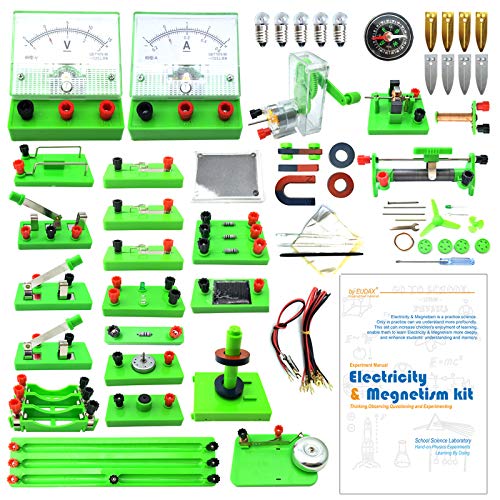
- 79 pieces for electricity and magnetism experiments
- Includes circuits, electromagnets, and Ohm’s law projects
- Color manual and storage bag included
Best For: Grades 9–11 students studying introductory electromagnetism
Best Newton’s Laws Building Set
Engino Inertia, Momentum & Energy

- Build eight working physics models
- Covers Newton’s laws and kinetic energy
- Includes theory, experiments, quizzes, and 3D app
Best For: Hands-on learners ages 9 and up
Best Optics Demonstration Set
Multifunctional Light & Lens Experiments

- Includes lenses, prism, reflector, and light source
- Demonstrates reflection and refraction principles
- Designed for learners ages 14 and up
Best For: Optics lessons and classroom demonstrations
Best Motion Mechanics Kit
Engino Inertia, Friction & Circular Motion

- Build six working motion-based models
- Covers inertia, friction, and circular motion
- Includes theory, experiments, quizzes, and 3D app
Best For: Young builders ages 9 and up learning mechanics
Best Optics Learning Kit
37-Piece Physics Light Experiment Set

- Explores reflection, refraction, lenses, imaging, and color
- Includes a no-assembly 60cm optical bench
- Designed for learners aged 14 and up
Best For: Hands-on optics study at home, in labs, or in classrooms
Best Electricity and Magnetism Set

- Includes 18 guided electricity and magnetism experiments
- Provides meters, circuit parts, magnets, and motor components
- Recommended for ages 8 to 18
Best For: Family learning, school projects, and introductory circuit practice
Best Compact Optics Set
Physics Prism and Refraction Experiment Kit

- Covers mirrors, lenses, prisms, imaging, and light colors
- Includes a no-assembly 60cm optical bench
- Batteries are not included
Best For: Home, laboratory, and institutional optics demonstrations
Best All-Around Advanced Physics Kit

- 71 pieces for electricity and magnetism experiments
- Hand-crank generator and solar panel included
- Illustrated manual with portable storage case
Best For: Ages 8-16 exploring circuits, electromagnetism, and energy conversion
Best Guided Learning Starter

- More than 50 guided DIY experiments
- Includes circuit, magnetism, and Joule's law modules
- 55 items in an organized portable case
Best For: Students ages 13-18 learning electricity and magnetism
Best Comprehensive Advanced Physics Set

- 79 pieces with 48 unique accessories
- Sensitive galvanometer and multiple measuring tools
- Detailed manual and durable storage case
Best For: Aspiring engineers and classrooms needing extensive circuit and magnetism projects
Best Complete Electromagnetism Kit – School Physics Labs Electricity & Magnetism
For students ready to move beyond simple demonstrations, this advanced physics experiment set focuses on hands-on electricity and magnetism. It includes 79 items, a color-page manual, and projects such as series and parallel circuits, fruit batteries, Ohm’s law, electromagnets, and a hand-crank generator.
Best For: Students in grades 9–11 exploring introductory electricity, magnetism, and electronics.
Pros:
- Supports a broad range of electricity and magnetism experiments.
- Includes 56 electricity items, 21 magnetism items, and repair tools.
- Color manual encourages guided, exploratory STEM learning.
- Components store together in a carrying bag.
Cons:
- Three AA batteries are required but not included.
- The kit may be more involved than necessary for younger beginners.
This is a practical choice when you want one set to cover multiple foundational electromagnetism topics. Its project variety makes it especially useful for structured lessons or independent exploration.
Best Newton’s Laws Building Set – Engino Inertia, Momentum & Energy
This advanced physics experiment set combines model building with guided lessons on Newton’s laws, inertia, momentum, and kinetic and potential energy. Children can construct eight working models, including a catapult, crash-test car, and balloon-powered plane.
Best For: Kids ages 9 and up who learn best through construction, experiments, and motion-based demonstrations.
Pros:
- Offers eight working model options focused on motion and energy.
- Includes theory, experiments, fascinating facts, and a quiz section.
- Free interactive 3D app adds a virtual building option.
- Two-year manufacturer warranty is listed.
Cons:
- AA batteries are required.
- Its construction-based format may appeal less to children seeking conventional lab equipment.
Engino makes abstract mechanics more accessible by tying each principle to a buildable model. It is a strong fit for families seeking an engaging introduction to Newtonian physics rather than a component-heavy laboratory set.
Best Optics Demonstration Set – Multifunctional Light & Lens Experiments
For learners focused on light behavior, this advanced physics experiment set provides a compact collection of lenses, a triangular prism, reflector, and adjustable three-way light source. It supports demonstrations of refraction, reflection, diffuse reflection, and convex and concave mirror behavior.
Best For: Students ages 14 and up, teachers, and home educators demonstrating core optics principles.
Pros:
- Covers several reflection and refraction experiments in one set.
- Includes three biconvex lenses, concave and convex lenses, and a prism.
- Adjustable three-way linear light source supports demonstrations.
- English color-page manual is included.
Cons:
- Two AAA batteries are needed and not included.
- Some light-source adjustment requires a screwdriver.
- The set is intended for indoor, manual use rather than automated experiments.
This set is best treated as a focused optics teaching tool rather than a general physics kit. Its specialized components make visible demonstrations of lenses, mirrors, and prisms easier to organize.
Best Motion Mechanics Kit – Engino Inertia, Friction & Circular Motion
This advanced physics experiment set uses six buildable models to make inertia, friction, and circular motion tangible. Projects include a rocket launcher, crash-test rig, and sharpening wheel, supported by theory pages, experiments, facts, quizzes, and a 3D building app.
Best For: Kids ages 9 and up developing construction, critical-thinking, and introductory mechanics skills.
Pros:
- Six working models provide varied motion-based projects.
- Explains inertia, friction, and circular motion through hands-on building.
- Includes 12 pages of theory, experiments, and a four-page quiz.
- Free interactive 3D app supports virtual construction.
Cons:
- The plastic construction format may not suit children wanting standalone lab apparatus.
- The recommended age range begins at 9 years.
Choose this kit when the goal is to connect physics concepts with mechanical design. The mix of physical models and guided learning gives young builders a clear route from construction to observation and explanation.
Best Optics Learning Kit – 37-Piece Physics Light Experiment Set
For learners exploring advanced physics experiment sets, this 37-piece optics kit provides a broad way to investigate reflection, refraction, lenses, imaging, and color. Its integrated 60cm optical bench requires no assembly, making it practical for home learning, labs, or classroom demonstrations.
Best For: Teens, adults, parents, educators, and institutions focused on hands-on optics and STEM learning.
Pros:
- Covers plane, diffuse, convex-mirror, concave-mirror, lens, prism, pinhole, and color experiments.
- Includes three adjustable light sources and acrylic optical components.
- Comes with a broad selection of optics accessories, a manual, and storage box.
- Shatterproof acrylic lenses and prisms are designed for repeated educational use.
Cons:
- The manufacturer recommends it for ages 14 and up.
- The large number of components may require organized storage and setup.
This is the strongest choice of the three for dedicated optics study because it combines multiple light experiments in one ready-to-use package. Choose it when reflection, refraction, and imaging are the main priorities.
Best Electricity and Magnetism Set – 50-Piece Circuit Physics Kit
This electricity and magnetism kit is a practical option among advanced physics experiment sets for younger learners who want to build circuits and observe electromagnetic effects. It combines 18 activities with meters, components, magnets, a motor model, and a 40-page illustrated manual.
Best For: Children ages 8 to 18, family science activities, school projects, and introductory electricity and magnetism practice.
Pros:
- Offers 18 hands-on experiments, including a fruit battery, electric bell, and hand-crank generator.
- Includes an ammeter, voltmeter, bulbs, switches, resistors, potentiometer, and wiring.
- Adds magnets, a compass, solenoid, motor model, fan blade, and double-rail module.
- The full-color 40-page manual supports guided parent-child exploration.
Cons:
- It is recommended for ages 8 to 18, so advanced learners may outgrow the guided activities.
- The kit focuses on electricity and magnetism rather than optics or mechanics.
With its combination of measurement tools and buildable demonstrations, this set offers a more approachable route into circuit and electromagnetism concepts. It is especially suitable when family participation and structured instructions matter.
Best Compact Optics Set – Physics Prism and Refraction Experiment Kit
For shoppers comparing advanced physics experiment sets, this optics-focused prism kit offers hands-on investigations into reflection, refraction, lenses, imaging, and primary colors. The integrated bench and included components make it suitable for home experiments, laboratories, and institutional STEM instruction.
Best For: Optics demonstrations and STEM instruction where a broad, ready-to-use light experiment system is needed.
Pros:
- Supports mirror reflection, lens refraction, prism refraction, pinhole imaging, and color experiments.
- Uses a 60cm integrated optical bench that requires no assembly.
- Includes lenses, prisms, light sources, mirrors, screens, water boxes, and a manual.
- Durable, shatterproof acrylic optical components are intended for home or laboratory use.
Cons:
- Batteries are not included.
- The extensive component list may be more than casual learners need.
- The supplied notes do not specify a recommended age range.
This kit is a strong fit for buyers who want a comprehensive optics platform without assembling a separate bench. It closely suits demonstrations and repeated STEM activities centered on light behavior.
Best All-Around Advanced Physics Kit – Magnet Science Lab
For learners who want broad coverage without moving straight to the largest set, this 71-piece kit is a practical choice among advanced physics experiment sets. It combines electricity, magnetism, circuit building, and energy conversion activities with tools such as an ammeter, voltmeter, hand-crank generator, and solar panel.
Best For: Students ages 8-16 exploring electricity, magnetism, renewable energy, and hands-on laboratory skills at home or in the classroom.
Pros:
- Includes 71 components for circuits, electromagnetism, and energy-conversion experiments.
- Hand-crank generator and solar panel provide practical mechanical- and light-energy demonstrations.
- Illustrated, step-by-step manual and portable storage case support repeated use.
Cons:
- The broad age range may mean some experiments need adult or teacher guidance.
- The kit focuses primarily on electricity and magnetism rather than a wider range of physics topics.
This is a well-rounded option for families or classrooms seeking a reusable introduction to more involved physics projects, especially when energy conversion is a priority.
Best Guided Learning Starter – Electricity and Magnetism Lab
This Mysterystone set is a useful starting point for students who want structured practice with circuits and electromagnetism. Among advanced physics experiment sets, it stands out for its more than 50 guided projects, 55 included items, and manual that explains both what to do and why the experiments work.
Best For: Students, particularly those ages 13-18, building foundational electricity and magnetism knowledge through guided experiments.
Pros:
- Offers more than 50 DIY experiments covering circuits, electromagnets, magnetic switches, and related concepts.
- Includes distinctive modules such as light-control LED and a Joule’s first law experiment module.
- Solid portable case keeps the 55 components organized for home or group use.
Cons:
- Its educational focus is more introductory than the larger professional-style kits.
- The supplied notes identify the materials as plastic, metal, and silicon, but do not specify non-toxic construction.
Choose this kit when clear explanations and experiment variety matter more than having the largest component count or the most advanced measurement hardware.
Best Comprehensive Advanced Physics Set – Ultimate Magnet Lab
When you want the broadest selection of components in this group, the 79-piece Ultimate Physics Lab is the strongest fit. It is one of the more comprehensive advanced physics experiment sets, adding a sensitive galvanometer, multiple measurement tools, varied resistors, diodes, switches, and magnetic components for more involved circuit and electromagnetism work.
Best For: Ages 8-16, aspiring engineers, and classrooms needing a durable, portable lab for repeated electricity, magnetism, and energy-conversion experiments.
Pros:
- 79 total pieces and 48 unique accessories support a wide range of circuit and magnetism projects.
- Includes an ammeter, voltmeter, sensitive galvanometer, rheostats, diodes, magnets, and a solar panel.
- In-depth illustrated manual and durable storage case support independent, repeated experimentation.
Cons:
- The larger component selection may feel complex for beginners.
- It is centered on electricity, magnetism, and energy conversion rather than general physics.
This is the best choice here for learners who want maximum component variety and more precise exploration, provided they are comfortable following a detailed manual and managing a larger kit.
How We Picked These Advanced Physics Experiment Sets
We selected kits across the main areas of introductory and intermediate physics: electricity, magnetism, optics, mechanics, motion, and energy. We also considered whether each set supports repeatable experiments rather than a single demonstration, and whether its components are practical for home learning, classrooms, or supervised lab work.
Because “advanced” can mean different things for different learners, this list includes structured circuit and optics kits alongside broader STEM engineering sets. Check the listed age range and contents carefully: some products are designed for children beginning hands-on science, while others provide more focused equipment for students studying specific concepts.
Quick Comparison
- Best for electricity and magnetism: Circuit-focused kits from EUDAX, Teenii, and Mysterystone.
- Best for optics: Prism, lens, mirror, refraction, reflection, and color-exploration sets.
- Best for mechanics: Engino kits covering inertia, friction, circular motion, and energy.
- Best for magnet investigations: The 71-piece and 79-piece magnet science kits.
- Best for broad STEM building: Engineering-focused sets that combine construction with physics principles.
Key Buying Factors for Advanced Physics Experiment Sets
Subject Coverage
Choose a focused kit if the learner has a clear goal, such as building circuits or studying lenses. A broader set is more useful when you want to sample several physics topics before committing to a more specialized lab setup.
Experiment Depth and Components
Look beyond the piece count. A useful kit should include components that support multiple configurations, clear instructions, and enough measuring or demonstration tools to show cause and effect. For optics, inspect the included lenses, mirrors, prisms, light source, and image-forming accessories. For electrical kits, check for circuit boards, wires, switches, bulbs, magnets, and any required power source.
Age, Supervision, and Difficulty
Age ratings are helpful but not definitive. Younger children may need an adult to explain measurements and prevent misuse of small parts, while older students may quickly outgrow simple demonstrations. Confirm whether batteries, power supplies, or other materials are sold separately.
Storage and Repeat Use
Small experiment components are easy to lose, so organized storage matters. Favor kits with durable parts and repeatable activities if the set will be used in a classroom, homeschool routine, or science club.
Who Should Buy Which Advanced Physics Experiment Sets?
Choose an electricity-and-magnetism kit for learners interested in switches, current, magnetic fields, and basic circuit design. Optics sets are a better fit for students curious about light paths, color, lenses, mirrors, and image formation. Engino’s mechanics-oriented options suit builders who learn best by assembling models and testing motion, force, friction, or energy concepts. Magnet kits work well for exploratory activities and demonstrations, especially when a learner wants a large variety of magnetic investigations.
For a first purchase, prioritize clear instructions and a manageable scope over the highest piece count. For an experienced student, choose a set that offers interchangeable components and enough flexibility to design variations on the included experiments. Always follow the manufacturer’s safety guidance, supervise younger users, and never connect components to an unapproved power source.