
Long exposures reveal far more stars than a standard tripod can capture, but your DSLR needs accurate, steady tracking to keep those images sharp. The right mount depends on your camera weight, lens or telescope setup, portability needs, and whether you want automated GoTo control.
This roundup covers portable equatorial camera mounts, tracking systems, T-rings, dovetail plates, and telescope adapters so you can build a compatible setup without buying more hardware than necessary.
Best 10 Astrophotography Mounts for Dslr Cameras Picks for 2026
Best GoTo Mount
Star Adventurer GTi Mount Head Kit

- Full GoTo tracking in a compact equatorial mount
- Built-in Wi-Fi and illuminated polar scope
- Includes counterweight bar and 5 lb. counterweight
Best For: Portable DSLR astrophotography with automated GoTo control
Best Telescope Adapter
Celestron Universal 1.25-inch T-Adapter

- Connects DSLR or SLR cameras for prime-focus imaging
- Fits telescopes with 1.25-inch focusers
- Requires a camera-specific T-ring sold separately
Best For: Adding a DSLR to a compatible telescope setup
Best Portable Tracker
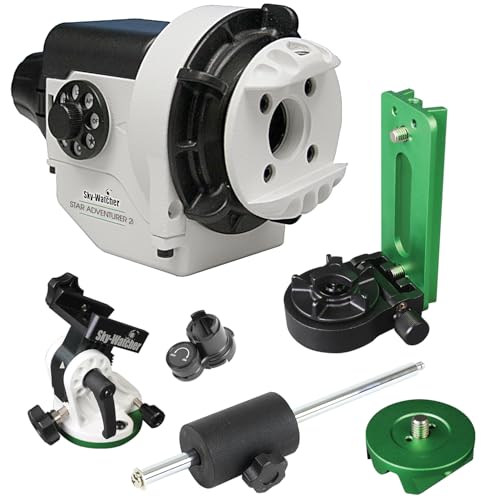
- Portable motorized platform for wide-field imaging
- Works with existing photographic tripods
- Wi-Fi control through the SAM Console app
Best For: DSLR nightscapes, Milky Way images, and time-lapse
Best Canon Adapter Set
Astromania Canon EOS T-Ring and 1.25-inch Adapter

- Fits listed Canon EOS and Rebel DSLR models
- Includes a 1.25-inch telescope adapter
- Manual focus and aperture operation required
Best For: Connecting compatible Canon EOS DSLRs to telescopes
Budget Mounting Plate
Yueoct 80mm Vixen Dovetail Rail

- Vixen-style dovetail compatibility
- 1/4-inch and 3/8-inch camera screws
- 52mm balance slot with reference scale
Best For: Lightweight camera-to-telescope mounting
Best for Everyday Use
iOptron SkyGuider Pro Camera Mount

- Supports up to 11 pounds when balanced
- Illuminated polar scope for alignment
- Internal battery rated for up to 20 hours
Best For: Traveling DSLR astrophotography setups
DIY Rig Adapter
Yueoct 120mm Vixen Dovetail Rail

- Longer 120mm Vixen-style rail
- 1/4-inch and 3/8-inch mounting screws
- M5 holes support a two-plate L-bracket
Best For: Custom camera rigs and adjustable balancing
Nikon DSLR T-Ring Adapter
Astromania T2 T Ring and T Adapter

- Nikon F-bayonet compatibility
- 1.25-inch telescope connection
- All-metal design with manual operation
Best For: Nikon DSLR owners connecting to compatible 1.25-inch telescope systems
Finder-Dovetail Camera Mount
Aluminum Adapter with 1/4-inch Camera Screw

- Fits compatible finder dovetail bases
- 1/4-inch camera mounting screw
- Rubber pads help prevent slipping
Best For: Lightweight camera or accessory mounting on compatible finder bases
Hotshoe Finder Adapter
Dovetail Base to Camera Flash Shoe

- Connects finder dovetails to camera shoes
- Hand-tightening locking ring
- Includes 1/4-inch threaded mounting hole
Best For: DSLR or mirrorless cameras using hotshoe and finder-accessory connections
Best GoTo Mount – Star Adventurer GTi Mount Head Kit
For photographers seeking astrophotography mounts for DSLR cameras, the Sky-Watcher Star Adventurer GTi offers GoTo operation in a compact equatorial package. Its built-in Wi-Fi, illuminated polar scope, counterweight system, and DSLR-compatible dovetail support portable tracking setups, although the camera itself is not included.
Best For: Portable DSLR or mirrorless astrophotography setups that benefit from GoTo control.
Pros:
- Full GoTo performance in a compact mount head.
- Built-in Wi-Fi supports wireless control.
- Includes a counterweight bar and 5 lb. counterweight.
- Built-in illuminated polar scope assists polar alignment.
Cons:
- DSLR or mirrorless camera is not included.
- Its 6.9 kg weight may be substantial for some portable setups.
The GTi is the most feature-rich tracking mount in this group, combining portability with GoTo functionality and useful alignment hardware. It is a strong choice when convenience and automated positioning matter more than the smallest possible travel footprint.
Best Telescope Adapter – Celestron Universal 1.25-inch T-Adapter
The Celestron Universal T-Adapter is a simple accessory for photographers building astrophotography mounts for DSLR cameras around a telescope. It connects a DSLR or SLR camera to telescopes with a 1.25-inch focuser for prime-focus imaging, but requires a camera-specific T-ring sold separately.
Best For: DSLR owners who want to connect their camera directly to a compatible 1.25-inch telescope focuser.
Pros:
- Supports prime-focus DSLR and SLR astrophotography.
- Fits most telescopes accepting 1.25-inch accessories.
- Works with cameras using standard T-threads.
- Includes a two-year US warranty and access to Celestron support.
Cons:
- A camera-specific T-ring is required and sold separately.
- It is an adapter rather than a tracking mount.
This adapter can complete a telescope-based imaging setup, but it does not provide tracking or mounting by itself. Confirm that your telescope accepts 1.25-inch accessories and purchase the correct T-ring for your camera before ordering.
Best Portable Tracker – Star Adventurer 2i Pro Pack
The Sky-Watcher Star Adventurer 2i Pro Pack is a portable tracking platform for wide-field astrophotography with DSLR cameras. Its modular design works with photographic tripods, while the equatorial base supports polar alignment and built-in Wi-Fi enables smartphone control through the Sky-Watcher SAM Console app.
Best For: Wide-field DSLR nightscapes, Milky Way photography, eclipses, and time-lapse work.
Pros:
- Designed as a portable motorized tracking platform.
- Works with existing photographic tripods.
- Built-in Wi-Fi supports smartphone control.
- Deluxe equatorial base helps position the tracker for polar alignment.
Cons:
- It is a tracking platform rather than a full GoTo mount.
- Its 7-pound weight may affect travel convenience.
The 2i Pro Pack is a practical choice for photographers prioritizing portability and wide-field results. Its tripod compatibility and smartphone control make it approachable, while the equatorial base helps prepare the system for tracking exposures.
Best Canon Adapter Set – Astromania Canon EOS T-Ring and 1.25-inch Adapter
The Astromania T2 T-ring and adapter set is a camera-connection accessory for Canon EOS DSLR astrophotography setups. It combines a Canon-compatible T-ring with a 1.25-inch telescope adapter, allowing attachment to standard 1.25-inch focusers, diagonals, or Barlow lenses. The camera’s focus and aperture must be adjusted manually.
Best For: Canon EOS owners connecting a compatible DSLR to a telescope with a 1.25-inch focuser.
Pros:
- Designed for Canon EOS and Rebel SLR/DSLR cameras with EF mounts.
- Includes a compatible 1.25-inch telescope adapter.
- All-metal aluminum construction is intended for long-term use.
- Includes a hex wrench for camera-angle adjustment.
Cons:
- Compatibility is limited to the listed Canon EOS camera families.
- No electrical contacts means focus and aperture adjustments are manual.
- It is an adapter set, not a motorized tracking mount.
For Canon users, this set provides a direct way to connect a compatible DSLR to common 1.25-inch telescope accessories. Check your exact camera mount and be prepared to operate focus and aperture manually.
Budget Mounting Plate – Yueoct 80mm Vixen Dovetail Rail
For photographers assembling astrophotography mounts for DSLR cameras, the Yueoct 80mm rail bar is a compact adapter for attaching a camera or other threaded device to a Vixen-style telescope saddle. Its slotted design helps with positioning and balance.
Best For: DSLR or camera setups that need a lightweight Vixen-style dovetail connection.
Pros:
- Accepts Vixen-style dovetail saddles.
- Includes 1/4-inch and 3/8-inch D-ring mounting screws.
- 52mm slot and 1mm reference scales support positioning and balancing.
- Rubber pads and a safety stop screw help secure attached equipment.
Cons:
- Maximum recommended weight is listed as 76g, limiting heavier DSLR setups.
- This is an adapter plate, not a motorized tracking mount.
The AT-02 is best viewed as a small connection and balancing accessory rather than a complete camera mount. Verify your camera and saddle compatibility, especially if your setup exceeds its stated weight recommendation.
Best for Everyday Use – iOptron SkyGuider Pro Camera Mount
The iOptron SkyGuider Pro is a complete tracking option for photographers comparing astrophotography mounts for DSLR cameras. Its all-metal construction, illuminated polar scope, adjustable base, and internal battery are designed for portable long-exposure work.
Best For: Mobile astrophotographers who need a compact camera tracker for balanced camera and lens combinations.
Pros:
- Supports up to 11 pounds, or 4.99kg, when balanced.
- Compact 2.2-pound mount body is suitable for travel.
- AccuAlign illuminated polar scope assists with polar alignment.
- Internal rechargeable battery provides up to 20 hours of operation at 20°C.
Cons:
- Requires careful balancing and polar alignment for best tracking results.
- The mount is not listed as water resistant.
- The supplied specifications list a 30-second maximum shutter speed.
With its 5kg balanced capacity and portable design, the SkyGuider Pro is the most complete astrophotography solution in this group. Check the combined weight of your DSLR, lens, and accessories before buying.
DIY Rig Adapter – Yueoct 120mm Vixen Dovetail Rail
The Yueoct 120mm rail bar is a longer adapter for photographers building astrophotography mounts for DSLR cameras around a Vixen-style saddle. Its threaded holes and counterbores also support creating a DIY L-bracket with a second matching plate.
Best For: Custom camera mounting and balancing arrangements that benefit from a longer Vixen-style plate.
Pros:
- Designed for Vixen-style dovetail saddles.
- Provides 1/4-inch and 3/8-inch D-ring mounting screws.
- 120mm length offers more adjustment room than a shorter rail.
- Side counterbores and M5 holes enable a DIY L-bracket with two plates.
Cons:
- Only one plate is included; a DIY L-bracket requires two.
- This is a passive adapter, not a tracking mount.
- One safety stop screw may need removal for saddles that do not support drop-in loading.
The AT-03 is a flexible foundation for a custom rig, particularly when extra rail length or an L-bracket configuration is useful. Confirm the saddle loading method and plan for a second plate if building the bracket.
Nikon DSLR T-Ring Adapter – Astromania T2 T Ring and T Adapter
For photographers assembling astrophotography mounts for dslr cameras, this Astromania set provides a direct Nikon F-bayonet connection to a telescope’s standard 1.25-inch focuser. It is designed for manual telescope imaging of the Moon, planets, and nebulae.
Best For: Nikon SLR/DSLR owners who want to connect their camera to compatible telescopes and 1.25-inch accessories.
Pros:
- Compatible with Nikon F-bayonet SLR and DSLR cameras.
- Includes a universal 1.25-inch T-adapter with a standard filter thread.
- All-metal aluminum construction and included hex wrench support secure installation and angle adjustment.
- Works with standard 1.25-inch telescope focusers, diagonal mirrors, and Barlow lenses.
Cons:
- The T-ring has no electrical contacts, so focusing and aperture adjustment are manual.
- Requires a compatible telescope with a 1.25-inch focuser.
This is a focused camera-to-telescope adapter rather than a tracking mount, but it is a practical choice when your Nikon DSLR setup already includes a compatible telescope and 1.25-inch accessories.
Finder-Dovetail Camera Mount – Aluminum Adapter with 1/4-inch Camera Screw
When comparing astrophotography mounts for dslr cameras, this compact adapter is useful for attaching a camera to a telescope’s finder dovetail base. Its 1/4-inch mounting screw accommodates cameras and other equipment with matching threads.
Best For: Users who need a simple, lightweight camera platform for a compatible finder dovetail base.
Pros:
- Solid aluminum construction with stainless-steel components.
- Fits standard finder dovetails compatible with 33–36 mm finder bases.
- Two anti-slip rubber pads help grip and protect the camera.
- Includes a 4 mm Allen wrench for installation.
Cons:
- Compatibility depends on having a matching finder dovetail base.
- Uses a 1/4-inch mounting screw, so the camera must have a compatible thread.
This adapter suits setups that already use a compatible finder shoe and need a straightforward way to position a threaded camera or accessory. Verify both the dovetail dimensions and camera thread before purchasing.
Hotshoe Finder Adapter – Dovetail Base to Camera Flash Shoe
For astrophotography mounts for dslr cameras, this Yueoct adapter bridges a camera hotshoe or cold shoe with a compatible finder-scope dovetail. It offers a convenient way to attach a camera to finder or guide-scope hardware while retaining a separate 1/4-inch threaded mounting option.
Best For: DSLR or mirrorless users whose camera and telescope accessories use standard hotshoe, cold shoe, or finder-dovetail connections.
Pros:
- Male flash shoe fits the hotshoe or cold shoe on most cameras.
- Standard finder base accepts compatible guide-scope and finder dovetails.
- Knurled locking ring is designed for hand tightening.
- Rubber padding helps protect the flash shoe, and a 1/4-inch threaded hole supports additional brackets.
Cons:
- Requires compatible hotshoe/cold-shoe and finder-dovetail equipment.
- It is a mounting adapter, not a motorized tracking mount or camera-to-telescope T-ring.
This is a flexible connection piece for mixed camera-and-finder hardware. Check your camera shoe and the dimensions of the guide-scope or finder dovetail before adding it to an astrophotography setup.
How We Picked These Astrophotography Mounts for Dslr Cameras
We selected products that address the main parts of a DSLR deep-sky setup: tracking, camera-to-telescope connection, balance, and physical mounting. The list includes complete camera mounts such as the Star Adventurer and SkyGuider Pro, along with T-rings, T-adapters, dovetail plates, and finder-shoe accessories that can help integrate a DSLR with existing astronomy equipment.
Compatibility matters more than feature count. Before buying, verify your camera mount—Canon EF, Nikon F, or another system—along with the telescope’s connection standard, dovetail size, payload requirements, and whether the package includes a counterweight, declination bracket, or tripod.
Quick Comparison
| Product type | Best for | What to check |
|---|---|---|
| Portable tracking mount | Wide-field Milky Way and deep-sky imaging | Payload, tracking accuracy, polar alignment, power |
| GoTo equatorial mount | Automated target locating and longer sessions | Tripod, counterweight, alignment, portability |
| T-ring and T-adapter | Connecting a DSLR to a telescope | Camera brand and telescope-side thread or nosepiece |
| Dovetail rail | Attaching a camera or scope securely | Vixen-style compatibility, length, screw spacing |
| Finder-shoe adapter | Mounting compact cameras or accessories | Base-shoe and hot-shoe fit, clearance, load limit |
Key Buying Factors for Astrophotography Mounts for Dslr Cameras
Tracking and Payload Capacity
A tracking mount must carry the camera, lens, ball head or declination hardware, and any accessories without excessive vibration. Stay below the advertised payload, especially for long lenses. A mount that tracks smoothly with a moderate load usually produces better results than one operated at its limit.
Polar Alignment and Portability
Equatorial trackers need accurate polar alignment. Built-in polar scopes, illuminated alignment tools, or electronic alignment features can make setup easier in the field. If you travel frequently, compare the mount head, counterweight, tripod, and carrying weight—not just the published mount weight.
Camera and Telescope Compatibility
A T-ring is camera-specific, while a T-adapter provides the telescope-side connection. Confirm the correct Canon or Nikon ring and check whether your telescope accepts a T-thread, 1.25-inch nosepiece, or another interface. Adapters do not replace a compatible focuser or guarantee enough back focus.
Mounting Hardware and Balance
Dovetail plates and finder-shoe adapters are useful only when their profiles and screw patterns match your equipment. Check rail width, clamping direction, thread sizes, and camera clearance. Proper balance reduces motor strain and helps prevent blurred frames.
Who Should Buy Which Astrophotography Mounts for Dslr Cameras?
Choose a portable tracker if you primarily use a DSLR with a wide or medium telephoto lens and want a lightweight setup for landscapes, star fields, and brighter deep-sky targets. The Star Adventurer and SkyGuider Pro style of mount suits this role.
Choose a GoTo equatorial mount if automated target finding, guided expansion, or heavier equipment matters more than minimum weight. Allow room in the budget for a stable tripod and correct counterweight.
Choose a T-ring and T-adapter when you already own a suitable telescope and need a direct prime-focus DSLR connection. Select the camera-brand version first, then match the telescope-side adapter.
Choose a dovetail or finder-shoe accessory when your main problem is mechanical attachment rather than tracking. These parts can complete a custom rig, but they cannot compensate for an overloaded or inaccurate tracking mount.