
The best interactive solar system models turn astronomy into something children can build, operate, observe, and explain. From talking kits and projector sets to gear-driven and glow-in-the-dark designs, these hands-on tools support learning beyond a flat textbook diagram.
We compared 10 options across age range, interaction type, educational value, assembly, durability, and play potential so you can choose a model that fits your child, classroom, or science project.
Best 10 Interactive Solar System Models Picks for 2026
Best Interactive Projector
Bilingual Talking Solar System

- Projects planets and space images onto walls or ceilings
- Provides English and Spanish astronomy facts
- Doubles as a night light or flashlight
Best For: Bilingual learning and bedtime space exploration
Best Orbiting Display
GeoSafari Orbiting Solar System

- Features eight planets on moving orbiting arms
- Includes 32 images on four projection discs
- Combines a model, projector, and space facts
Best For: Hands-on orbit observation and projected astronomy learning
Best Glow-In-The-Dark Kit

- Build and customize all eight planets and the Sun
- Includes paints, decals, brush, and fact poster
- Movable arms and glow-in-the-dark accents enhance display
Best For: Creative astronomy projects and space-themed room decor
Best Mechanical STEM Build

- Builds a rotating model powered by a wind-up motor
- Explores gear ratios and planetary gears
- Requires no batteries and suits science fair projects
Best For: Mechanical STEM learning and intermediate builders
Best Creative Starter Kit
Wookidel 64-Piece Solar System Project Kit

- Includes foam planets, paints, brushes, stars, and assembly supplies
- Combines introductory astronomy with hands-on crafting
- Designed for school projects and family activities
Best For: Young learners who enjoy painting and building space-themed projects
Best Glow-In-The-Dark Model
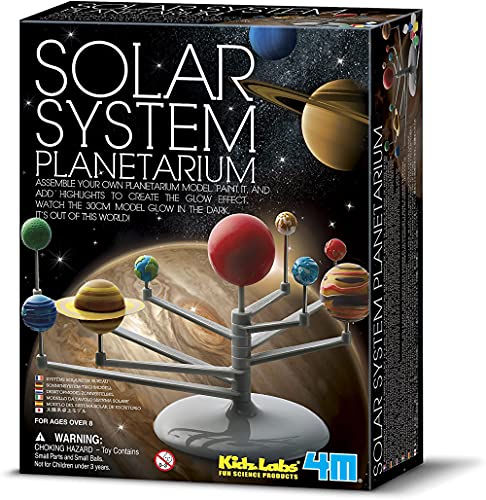
- DIY kit includes planets, glow paint, rods, string, and stencils
- Includes a fact-filled wall chart and astronomy quiz questions
- Battery-free project for ages 8 and up
Best For: Older kids who want a buildable, glowing planetarium display
Best Display Poster
Crayola Solar System Science Kit

- Includes painted planet hemispheres and a large mounting poster
- Learning guide covers planets, stars, meteors, and more
- Washable paint strips and stickers support an approachable craft
Best For: Kids who want to make and display a colorful solar system project
Best Hands-On Build

- Builds a rotating planetary model
- Introduces orbits, day, and night
- Designed for ages 8–14
Best For: Hands-on STEM learning and building-focused play
Best for Room-Size Learning

- Includes 10 large inflatable pieces
- Supports planet-size comparison
- Suitable for ages 3–7 and classrooms
Best For: Large educational displays and younger learners
Best Creative Science Project

- Includes wood model, puzzle, and fact cards
- Adds paint and brushes for creative play
- Builds in approximately 1–2 hours
Best For: Science fairs and paint-and-build learning projects
Best Interactive Projector – Bilingual Talking Solar System
For younger children seeking interactive solar system models, this kit combines a physical eight-planet setup with talking astronomy facts, projection, and a night-light function. English and Spanish audio options, plus 24 space images across three discs, add variety beyond a static display.
Best For: Ages 5 and up, bilingual learning, bedtime space exploration, and children who enjoy projected images.
Pros:
- Projects the planets and space images onto a wall or ceiling.
- Offers educational planet facts in English and Spanish.
- Includes 24 images featuring planets, astronauts, spaceships, and the solar system.
- Works as a night light or flashlight.
Cons:
- Requires three AA batteries, which are not included.
- The projector and lights may be more appealing than hands-on mechanical building.
This is a versatile choice when you want interactive solar system models that support language learning and imaginative nighttime play. Its broad recommended age range and easy snap-together assembly make it especially practical as a gift.
Best Orbiting Display – GeoSafari Orbiting Solar System
This GeoSafari model suits shoppers comparing interactive solar system models with both moving planets and projected media. Eight planets rotate on moving arms around the Sun-shaped projector, while four discs provide 32 images covering planets, constellations, asteroids, and other space topics.
Best For: Children ages 5 and up who want a hands-on orbiting model with a larger set of projected astronomy images.
Pros:
- Eight planets move on orbiting arms for hands-on observation.
- Includes 32 premium images across four projector discs.
- Includes NASA images, a guide, and space-related facts.
- Can project outer-space imagery onto a ceiling.
Cons:
- Requires three AA batteries, not included.
- Manual operation means it does not provide automated electronic controls.
Among interactive solar system models, this option emphasizes observation: children can watch the planets orbit while exploring projected visuals. It is a strong fit for families wanting one space toy to combine display, motion, and guided discovery.
Best Glow-In-The-Dark Kit – Build-and-Paint Solar System
For kids who prefer making their own display, this National Geographic kit is one of the more creative interactive solar system models. Children build and customize the Sun and eight planets, paint them with the included supplies, and arrange the planets on movable arms before displaying the finished model.
Best For: Ages 8 and up, hands-on crafting, space-themed room decor, and astronomy STEM projects.
Pros:
- Includes the planets, paints, brush, palette, decals, and fact poster.
- Glow-in-the-dark paint adds a display feature after assembly.
- Movable arms allow the planetary arrangement to be adjusted.
- Supports construction, creative, problem-solving, and hand-eye coordination skills.
Cons:
- Designed for ages 8 and up, so it is less suitable for younger children.
- Requires more assembly and painting time than a ready-to-display model.
This model stands out when the activity of building and decorating matters as much as the final display. Choose it for an older child who enjoys creative projects and wants a glow-in-the-dark result rather than projection or electronic features.
Best Mechanical STEM Build – Wind-Up Orbiting Solar System
This Thames & Kosmos kit takes a mechanical approach to interactive solar system models. Children assemble a rotating planet display powered by a wind-up motor, then explore gear ratios and planetary gears without relying on batteries.
Best For: Ages 6 to 14+, science fair projects, and learners interested in mechanical STEM concepts.
Pros:
- Uses a wind-up motor, so batteries are not required.
- Demonstrates planetary motion through a rotating model.
- Introduces gear mechanics, gear ratios, and planetary gears.
- Includes a potential expansion slot for Planet Nine.
Cons:
- Intermediate difficulty may require more guidance than simpler kits.
- It does not include a projector or electronic astronomy facts.
- The small model may offer less visual presence than larger displays.
This is the best match for buyers prioritizing construction and mechanical learning over lights or projection. Its battery-free wind-up design and science-fair potential make it a focused STEM project for curious school-age builders.
Best Creative Starter Kit – Wookidel 64-Piece Solar System Project Kit
For younger learners who enjoy hands-on projects, this Wookidel kit is one of the more craft-focused interactive solar system models. Children can paint foam planets, assemble the display, and use the included guide to connect the activity with basic astronomy lessons.
Best For: Kids ages 6–12, classroom projects, and family activities that combine art with introductory space learning.
Pros:
- Includes foam pieces, paints, brushes, sticks, flags, stars, and an instruction guide.
- Coloring and assembly encourage hand-eye coordination, focus, and creativity.
- Paints are described as safe and odorless, and the foam has a smooth surface for coloring.
Cons:
- The model is a craft project rather than a powered or electronic interactive toy.
- Assembly and painting require adult guidance for younger children.
Choose this set when you want a generously supplied solar system activity with plenty of room for creative customization. Its strongest appeal is learning through making, not detailed mechanical operation.
Best Glow-In-The-Dark Model – 4M Solar System Planetarium
The 4M Solar System Planetarium adds a display element to interactive solar system models: children assemble and paint the planets, then use the glow paint to create a room-friendly astronomy project. It also includes reference and quiz materials for extending the activity beyond construction.
Best For: Children ages 8 and up who want a DIY planetarium project with glow-in-the-dark appeal and STEM-focused learning materials.
Pros:
- Includes planets, stencils, rods, string, glow paint, and complete assembly instructions.
- A fact-filled wall chart and 10 sets of Kidz Quiz questions support learning.
- Requires no batteries and includes all eight planets, with Pluto excluded.
Cons:
- Recommended for ages 8 and up, so it may be too challenging for younger children.
- The kit requires painting and assembly before it can be displayed.
This is a strong pick for older children who appreciate a longer DIY activity and a visual glow effect. The included chart and quizzes make it more educationally structured than a basic decorative model.
Best Display Poster – Crayola Solar System Science Kit
Crayola Solar System Science Kit, Educational Toy, Gift for Kids, Ages 7, 8, 9, 10
Check Price On AmazonCrayola’s kit takes a straightforward craft approach to interactive solar system models, with planet hemispheres to paint and a large poster for mounting the finished project. The learning guide and included stickers add an easy way to introduce planets, stars, and meteors.
Best For: Kids ages 8 and up who want to create a colorful solar system display for a bedroom, classroom, or science activity.
Pros:
- Includes nine planet hemispheres, a Sun hemisphere, washable paint strips, and a brush.
- The approximately three-foot mounting poster creates a prominent finished display.
- Includes stickers, double-sided tape, a galaxy poster, and a learning guide.
- Paint is described as washable, and the kit is intended for ages 8 and up.
Cons:
- The hemispheres and poster require painting and mounting rather than electronic interaction.
- The included paint comes as color strips, which may offer less flexibility than separate paint bottles.
Consider this kit if the final wall display matters as much as the activity itself. It offers a clear, manageable project format and a large poster that helps children show what they learned.
Best Hands-On Build – Gear-Driven Solar System Kit
For kids who learn best by making, this interactive solar system model combines construction with a rotating planetary display. It is designed for ages 8–14 and introduces planets, orbits, day, night, and basic astronomy through hands-on STEM play.
Best For: Children ages 8–14 who enjoy building projects and want a reusable, rotating solar system model.
Pros:
- Gear-driven design lets children build and rotate the model.
- Connects construction and creativity with basic astronomy concepts.
- Uses child-safe, eco-friendly MDF materials.
- Gift-ready packaging suits birthdays and other occasions.
Cons:
- Recommended for ages 8 and up, so it may not suit younger children.
- Includes the model kit in the box, but the notes do not specify additional paint or craft supplies.
This is a strong choice when the building process matters as much as the finished display. Its rotating mechanism adds interaction, while the compact design makes it practical for a bedroom or study area.
Best for Room-Size Learning – Inflatable Solar System Model
This interactive solar system model is designed for visual, hands-on exploration rather than tabletop construction. The 10-piece set includes the Sun, nine planets, and Pluto in inflatable forms, making it useful for classrooms, themed rooms, and party displays.
Best For: Younger children ages 3–7, classroom displays, and families wanting large-scale planet decor with educational value.
Pros:
- Includes 10 large inflatable celestial bodies for size comparison.
- Features scientifically accurate colors and realistic cloud patterns.
- Can be inflated with regular air, so helium is not required.
- Works for indoor learning displays, bedroom decor, or parties.
Cons:
- Requires inflation and suitable space for displaying pieces up to 28 inches in diameter.
- The manual setup is more display-oriented than a mechanical moving model.
- Recommended for indoor use.
Choose this set when visibility and scale are priorities. Its oversized inflatable planets can make astronomy more engaging for younger learners, although it needs more room than a compact desktop model.
Best Creative Science Project – DIY Nine Planets Model
For a creative project with a finished display, this interactive solar system model combines a wood model, puzzle, paint, brushes, and fact cards. Designed for ages 8–12, it gives children a structured way to build, decorate, and learn about the nine major planets.
Best For: Kids ages 8–12 completing a science project, science-fair display, or paint-and-build astronomy activity.
Pros:
- Includes a wood model, puzzle, paint, brushes, and planet fact cards.
- Combines crafting with science awareness and astronomy learning.
- Can be displayed in a bedroom, classroom, or science fair.
- Build time is approximately 1–2 hours.
Cons:
- Painting and assembly require more time and hands-on effort than a ready-made model.
- The recommended age range is narrower than some younger-child options.
- The supplied notes list a 30-day manufacturer warranty.
This kit is a practical pick for families or educators seeking both an activity and a presentable result. The fact cards add learning support, while the paint-and-puzzle format makes it especially suitable for project-based use.
How We Picked These Interactive Solar System Models
We focused on models that offer more than simple decoration. Each selected kit provides at least one meaningful hands-on feature, such as rotating planets, a windup or gear-driven mechanism, projection, audio explanations, glow effects, construction activities, or inflatable components. We also considered recommended ages, included parts, assembly demands, space requirements, and whether the kit supports repeat use after the initial build.
Because these products vary widely, we treated a detailed DIY construction kit and a ready-to-use talking model as different types of learning tools rather than ranking them by one standard. Safety, supervision needs, and the likelihood of missing or fragile pieces also informed the comparison.
Quick Comparison
- Best for audio learning: Science Can Talking Astronomy Solar System Model.
- Best for projection and demonstrations: Educational Insights GeoSafari Orbiting Solar System & Projector.
- Best for glow-in-the-dark appeal: National Geographic or 4M planetarium kits.
- Best for mechanical STEM play: Thames & Kosmos or Smartivity gear-driven models.
- Best for a larger group activity: Fun Express inflatable model.
- Best for budget-friendly building: wookidel, Crayola, or Nine Planets kits, depending on the included materials and project goals.
Key Buying Factors for Interactive Solar System Models
Interaction Type
Decide whether your child will benefit most from movement, sound, light, projection, or construction. Rotating and gear-driven models help demonstrate orbital motion, while audio and projector models can make guided learning easier. Glow effects add visual excitement but may provide less mechanical exploration.
Age and Skill Level
Check both the recommended age and the level of adult involvement. Younger children may need help with painting, wiring, small parts, or intricate assembly. Older children often get more value from kits that involve gears, puzzles, motors, or explanations of planetary science.
Contents and Setup
Confirm whether batteries, paint, tools, stands, mounting hardware, or lighting components are included. A compact tabletop model suits regular study, while inflatable planets need storage and open floor space. For classroom use, favor durable parts and simple resets.
Accuracy Versus Play Value
Most children’s models are not to scale, and some emphasize visual clarity over orbital accuracy. Look for clearly labeled planets, useful fact cards, or instructional material if the model will support homework or a science presentation. Choose brighter, more playful designs when engagement is the main priority.
Who Should Buy Which Interactive Solar System Models?
Choose a talking or projector model for children who learn well through guided explanations and demonstrations. A gear-driven Thames & Kosmos or Smartivity kit is better for hands-on builders who enjoy understanding how motion works. National Geographic and 4M glow-focused options suit children who want a craft project with an astronomy theme.
For a younger child or first science kit, consider a simpler Crayola, wookidel, or Nine Planets set after checking the exact contents and supervision requirements. The Fun Express inflatable kit works well for group activities, displays, and active demonstrations where a tabletop model would be too small. Whichever option you choose, pair it with a current planet guide or star chart so the model becomes a starting point for continued exploration rather than a one-time craft.