
The best solar system models for classrooms turn abstract astronomy concepts into hands-on lessons students can see, touch, and explore. This roundup compares 10 engaging options for different ages, teaching styles, budgets, and classroom spaces.
From magnetic and glow-in-the-dark displays to gear-driven, inflatable, talking, and build-your-own kits, these models can support lessons on planets, orbit, scale, sequencing, and space science.
Best 10 Solar System Models for Classrooms Picks for 2026
Best Magnetic Classroom Display

- Large magnetic pieces for group demonstrations
- Includes planets, Moon, Sun, asteroid belt, and Pluto
- Flexible, reusable material with educational guide
Best For: Hands-on lessons for ages 4–10
Best Build-and-Paint Project
Glow-in-the-Dark Solar System Model

- Build and customize all eight planets and the Sun
- Includes paints, decals, brush, and fact poster
- Movable arms create an adjustable display
Best For: Creative astronomy projects for ages 8 and up
Best Projector Combination
Orbiting Solar System & Projector

- Rotating model shows eight planets orbiting the Sun
- Projects 32 NASA and space images
- Includes discs and a space-facts guide
Best For: Interactive indoor astronomy demonstrations for ages 5+
Best Gear-Driven Build

- Builds a rotating model through hands-on assembly
- Introduces planets, orbits, day, and night
- Eco-friendly, child-safe MDF construction
Best For: STEM stations and makerspace projects for ages 8–14
Most Immersive
Inflatable Solar System Planets
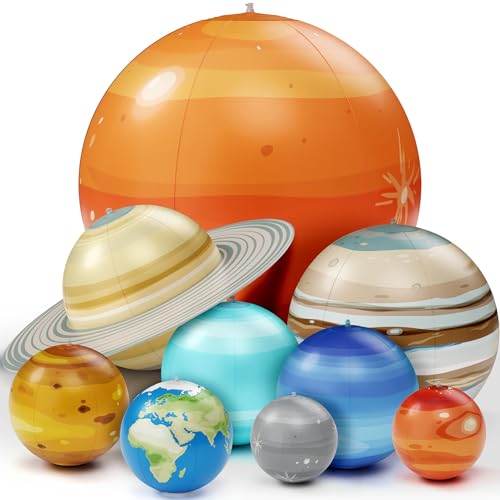
- Includes Sun and all eight planets
- Hanging strings and learning cards included
- Deflates for compact storage
Best For: Interactive classroom displays and introductory STEM lessons
Best DIY Display
35-Piece Foam Solar System Kit
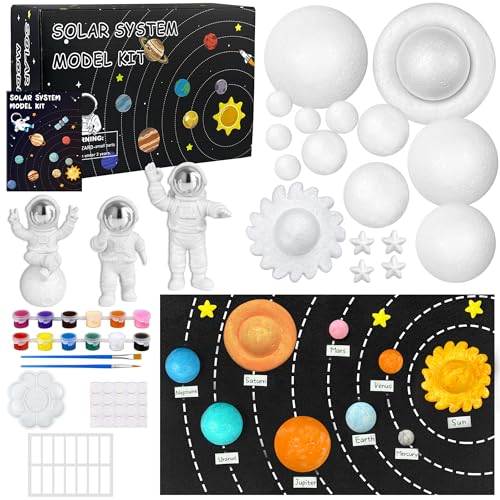
- Includes paints, brushes, and foam spheres
- Instructions cover orbital positions
- Wall display helps save space
Best For: Hands-on classroom projects for ages 8–10
Best Complete Project Kit

- Includes 64 project pieces and supplies
- Comes with 12 paint colors and instructions
- Designed for coloring and building
Best For: Ages 6–12 classroom science and art projects
Best Interactive Pick
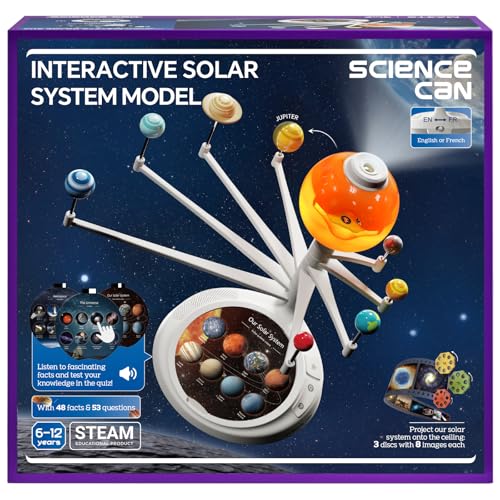
- 48 facts and 53 quiz questions
- English and French options
- Projects 24 colorful space images
Best For: Interactive bilingual STEM lessons for ages 6–12
Best Hands-On Project

- Includes wood model and puzzle
- Paints, brushes, and fact cards included
- Build time is about 1–2 hours
Best For: Ages 8+ classroom projects and science fairs
Best for Younger Learners

- English and Spanish learning modes
- Projects 24 HD space images
- Also works as a night light
Best For: Introductory astronomy for ages 5 and up
Best Magnetic Classroom Display – Giant Magnetic Solar System
For classrooms needing a tactile teaching aid, the Learning Resources Giant Magnetic Solar System is a practical choice among solar system models for classrooms. Its large magnetic pieces let teachers demonstrate planetary order and compare relative sizes on whiteboards, metal doors, and other magnetic surfaces.
Best For: Teachers working with children ages 4–10 who need a reusable, hands-on space lesson display.
Pros:
- Includes the Sun, Moon, planets, asteroid belt, and Pluto with realistic NASA satellite images.
- Large pieces, including a 10-inch-plus Sun, are easy to see during group instruction.
- Flexible magnetic material is designed for repeated classroom handling.
- Includes an educational guide with space facts.
Cons:
- Requires a magnetic surface for display.
- It is a flat magnetic set rather than a freestanding 3D model.
This is a strong classroom pick when visibility, quick setup, and interactive sequencing matter more than a rotating or illuminated display.
Best Build-and-Paint Project – Glow-in-the-Dark Solar System Model
The National Geographic kit offers a creative, project-based option among solar system models for classrooms. Students build and customize all eight planets and the Sun, then use movable arms to adjust the display and glow-in-the-dark accents to extend the activity beyond the lesson.
Best For: Classrooms or small groups working with learners ages 8 and up on construction, creativity, and introductory astronomy.
Pros:
- Includes planets, Sun, paints, glow paint, brush, palette, decals, and a fact poster.
- Movable arms allow students to rearrange the planetary display.
- Combines model building, painting, and space facts in one activity.
- Kid-friendly instructions support independent assembly.
Cons:
- Recommended for ages 8 and up, so it may not suit younger classrooms.
- Painting and assembly require preparation and supervision.
This model is especially useful when the goal is an engaging STEM craft that students can build, personalize, and display rather than a ready-to-use demonstration tool.
Best Projector Combination – Orbiting Solar System & Projector
Educational Insights combines a rotating 3D model with projected NASA and space images, making this a versatile choice among solar system models for classrooms. Students can observe the planets orbiting the Sun, examine the model up close, and project images of planets, constellations, and asteroids.
Best For: Indoor classroom demonstrations and astronomy exploration with children ages 5 and up.
Pros:
- Features eight planets on moving, orbiting arms.
- Includes 32 images across four projector discs, including NASA photos.
- Supports lessons on planetary orbits, constellations, asteroids, and space science.
- Comes with a guide containing fun facts.
Cons:
- Requires three AA batteries, which are not included.
- Its projector function is intended for indoor use.
- The combined unit is less compact than a simple static model.
Choose this option when you want one classroom resource to support both physical orbit demonstrations and more immersive projected visuals.
Best Gear-Driven Build – DIY Solar System Kit
The Smartivity DIY Solar System Kit gives students an assembly-focused way to explore planets and motion. As one of the more construction-oriented solar system models for classrooms, its gear-driven design lets learners build a rotating model while connecting hands-on making with basic ideas about orbits, day, and night.
Best For: Makerspace activities, STEM stations, and small-group projects for children ages 8–14.
Pros:
- Students assemble a rotating solar system model themselves.
- Gear-driven movement provides a concrete introduction to planetary motion.
- Combines construction, creativity, and basic astronomy concepts.
- Uses eco-friendly, child-safe MDF materials according to the supplied notes.
Cons:
- Recommended for ages 8 and up, limiting use with younger students.
- Assembly takes more time than a ready-made classroom model.
- The supplied components list identifies the box but does not detail additional included tools or paints.
This is a good fit for classrooms that value building and mechanical interaction, particularly when students can work through the assembly as part of a guided STEM activity.
Most Immersive – Inflatable Solar System Planets
For classrooms seeking solar system models for classrooms that students can see and touch, this inflatable set offers a highly visual approach. It includes the Sun, all eight planets, hanging strings, and galaxy learning cards for lessons, displays, or interactive exploration.
Best For: Teachers wanting reusable, tactile classroom decor and introductory STEM activities for children ages 5–8.
Pros:
- Includes the Sun and all eight planets in a large inflatable format.
- Built-in hanging loops and included strings support ceiling or room displays.
- Learning cards add planet facts and visual reinforcement.
- Deflates for compact storage and repeated use.
Cons:
- Inflatables may provide less detail for precise scale or orbital-position lessons.
- Designed for indoor use and requires setup space when displayed.
This is a strong choice when engagement and visibility matter most. Its tactile, room-sized presentation can make an introductory astronomy lesson feel more memorable than a small tabletop model.
Best DIY Display – 35-Piece Foam Solar System Kit
This foam-ball kit is a practical option for solar system models for classrooms when students should paint, assemble, and display their own project. It includes foam spheres in multiple sizes, paints, brushes, a palette, a felt background, instructions, hooks, stars, and astronaut ornaments.
Best For: Classroom or home projects for learners ages 8–10 who benefit from hands-on art and astronomy activities.
Pros:
- Includes 35 pieces with painting and display supplies.
- Instructions introduce orbital positions and support project-based learning.
- Wall-mountable design saves space in classrooms or smaller rooms.
- Combines astronomy learning with hand-eye coordination and color work.
Cons:
- Requires painting and assembly before it can be displayed.
- Foam construction may be less durable than a rigid finished model.
- The kit is recommended for ages 8–10 rather than very young learners.
Choose this set when the making process is part of the lesson. It is better suited to a guided project and finished wall display than to a ready-to-use teaching model.
Best Complete Project Kit – 64-Piece Solar System Model
For educators comparing solar system models for classrooms, this 64-piece project kit provides a broad set of materials for coloring and building. It includes foam discs and balls, stars, bamboo sticks, toothpick flags, 12 colors of paint, brushes, a palette, and instructions.
Best For: Group or individual school projects for children ages 6–12 learning basic planet identification and astronomy concepts.
Pros:
- Supplies a substantial 64-piece set for a complete student project.
- Includes paints, brushes, palette, construction pieces, and instructions.
- Foam surfaces are described as smooth and easy to color.
- Supports creativity, focus, hand-eye coordination, and science learning.
Cons:
- Students must paint and assemble the model, so it is not ready to use immediately.
- Foam components may require careful handling during classroom activities.
- Although marketed for younger children, the listed recommended age is 6–12.
This is a flexible choice for a classroom unit that combines art and science. Its larger component count gives students more materials to work with, while the included instructions help structure the activity.
Best Interactive Pick – Talking Solar System Model
The Science Can Talking Solar System Model is a strong option for classrooms seeking solar system models for classrooms with built-in audio, quiz activities, and visual projection. It teaches 48 space facts in English or French, includes 53 quiz questions, and projects 24 colorful space images.
Best For: Ages 6–12, bilingual STEM lessons, and interactive demonstrations about planets, orbits, and sunlight.
Pros:
- Combines talking knowledge cards with an interactive quiz mode.
- Offers English and French language options.
- Projects 24 full-color space images using three disks.
- Shows the sun lighting up to illustrate sunlight’s effect on planets.
Cons:
- Requires three AA batteries, which are not included.
- The plastic model is designed for children rather than detailed scale modeling.
Choose this model when participation and multimedia learning matter more than a craft-based project. Its no-assembly design also makes it convenient for quick classroom activities.
Best Hands-On Project – DIY Nine Planets Model
This DIY Nine Planets kit is a practical choice among solar system models for classrooms when students need to build, paint, and discuss the planets. The wood model, puzzle, fact cards, paints, and brushes support a structured activity that takes approximately one to two hours.
Best For: Ages 8 and up, classroom craft sessions, science fairs, and project-based lessons.
Pros:
- Includes a wood model, puzzle, fact cards, paints, and brushes.
- Gives students a hands-on way to learn about nine major planets.
- Can be displayed in a classroom or used for a science fair.
- Estimated build time of approximately one to two hours suits a planned activity.
Cons:
- Requires student assembly and painting rather than being ready to use.
- Recommended for ages 8–12, so it may not suit younger classes.
- The supplied notes do not indicate that paint or brushes are refillable for group use.
This is the better fit when the learning objective includes creativity, sequencing, and student ownership of a finished model. Teachers should plan time for construction and painting.
Best for Younger Learners – Bilingual Planetarium Model
The Science Can Talking Astronomy Model is designed for younger children and combines a physical eight-planet setup with projection, audio facts, and a night-light function. For classrooms comparing solar system models for classrooms, its English and Spanish support and simple snap-and-lock assembly add practical flexibility.
Best For: Ages 5 and up, introductory astronomy, bilingual classrooms, and visual demonstrations.
Pros:
- Provides English and Spanish astronomy facts.
- Projects 24 HD images of planets, spacecraft, astronauts, and space scenes.
- Functions as a solar-system projector, night light, and flashlight.
- Snap-and-lock assembly is designed for quick setup.
Cons:
- Requires three AA batteries, which are not included.
- Recommended for ages 3–12, with content geared toward introductory learning.
- Projection and night-light functions may require dimmer classroom conditions to be most effective.
This model works well when a class benefits from short visual activities and simple controls. It is particularly useful for introducing astronomy vocabulary in English- and Spanish-speaking learning environments.
How We Picked the Best Solar System Models for Classrooms
We focused on classroom usefulness rather than appearance alone. Each model was considered for age suitability, durability, assembly requirements, interactivity, clarity of planet identification, storage needs, and potential for group activities. We also included a mix of display models, construction kits, sensory learning tools, and technology-enhanced options so teachers can match a product to their curriculum and teaching environment.
Because a classroom model cannot accurately show both planetary size and distance at the same time, the most effective choices are those that clearly communicate a specific concept. A magnetic set may work well for sequencing and labeling, while a moving or projected model can help demonstrate orbit and rotation.
Quick Comparison
| Model type | Best classroom use | Ideal for |
|---|---|---|
| Magnetic display | Wall activities, labeling, and rearranging planets | Elementary classrooms |
| Glow-in-the-dark | Visual reinforcement and space-themed displays | Older children and science centers |
| Orbiting or projected | Demonstrating motion, rotation, and orbit | Teacher-led lessons |
| DIY construction kit | Project-based learning and assessment | Small groups or individual students |
| Inflatable planets | Large-group demonstrations and movement activities | Active classrooms |
| Talking or interactive model | Independent exploration and review | Learning stations |
Key Buying Factors for Solar System Models for Classrooms
Age and Curriculum Fit
Check the recommended age against your students’ abilities and the lesson goal. Younger learners often benefit from large, brightly colored, easy-to-handle pieces. Older students may get more value from construction, factual content, projection, or moving parts.
Durability and Classroom Handling
Look for sturdy components, secure connections, washable or replaceable parts, and packaging that supports storage. Small pieces can be useful for detailed projects but require supervision and an organized storage system.
Interactivity and Teaching Purpose
Decide whether students need to build, sort, label, observe, listen, or physically manipulate the planets. Interactive features are most valuable when they reinforce a learning objective rather than simply add decoration.
Space, Setup, and Visibility
Consider whether the model will sit on a desk, hang on a wall, operate in a darkened room, or be used across a large classroom. Inflatable planets need storage space, while compact kits are easier to distribute and pack away.
Accuracy and Expectations
Use the model as a teaching aid, not a fully scaled scientific representation. Confirm that planet names, order, colors, and included facts suit your curriculum, and explain where visual simplifications are necessary.
Who Should Buy Which Solar System Models for Classrooms?
Choose a magnetic model for flexible wall displays and quick whole-class activities. An orbiting or projector-based model is a stronger choice when demonstrating movement is central to the lesson. Glow-in-the-dark and inflatable sets suit visual, sensory, or themed learning spaces.
DIY foam, gear-driven, wood, and multi-piece kits are best for project-based learning, science stations, and group assignments. Talking models can support independent review, especially when students benefit from audio prompts and repeated practice. For most classrooms, the right choice is the model that matches the intended activity, available storage, student age, and level of teacher supervision.