
The best USB-C NAS enclosures make it easier to expand storage, consolidate multiple SATA drives, and move large files without building a complete network server. This roundup compares 10 multi-bay and single-drive options for home offices, media libraries, backups, and workstation storage.
Because these products vary widely in bay count, RAID support, speed, cooling, and operating style, the right choice depends on whether you want simple direct-attached storage or a more flexible multi-drive setup.
Best 10 USB C Nas Enclosures Picks for 2026
Top Pick

- Four SATA bays for flexible drive expansion
- 10Gbps USB-C and HDMI up to 4K/60Hz
- Aluminum shell with temperature-controlled cooling
Best For: Flexible high-capacity storage and workstation expansion
RAID Choice
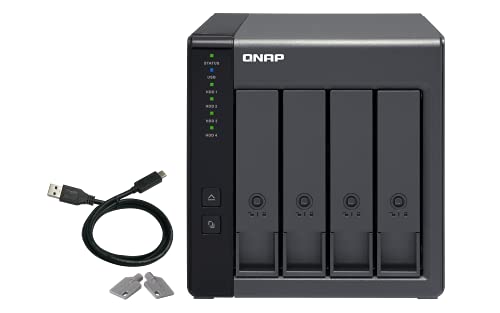
- Hardware RAID with five supported storage modes
- Four lockable 3.5-inch SATA bays
- Works with Windows, macOS, Linux, and compatible QNAP NAS devices
Best For: RAID-based direct-attached storage and NAS backups
RAID Flexibility

- Eight listed RAID and storage modes
- Up to 96TB across four 3.5-inch SATA drives
- Dual switch-controlled cooling fans
Best For: Large-capacity RAID storage for power users and professionals
Best High-Capacity Pick
SABRENT 5-Bay USB-C DAS Enclosure

- Five 3.5-inch bays support up to 100TB
- 10Gbps USB-C with independent bay controllers
- Quiet PWM cooling and tray-less hot-swap
Best For: High-capacity desktop DAS users who do not need RAID or network access
Best for Everyday Use
MAIWO 4-Bay USB-C RAID Enclosure

- Seven listed RAID and JBOD-style modes
- Accepts 2.5-inch and 3.5-inch SATA drives
- Dual fans and 78W external power supply
Best For: Users seeking configurable multi-drive RAID storage over USB-C
Best Four-Bay USB-C DAS
SABRENT 4-Bay USB-C DAS Enclosure
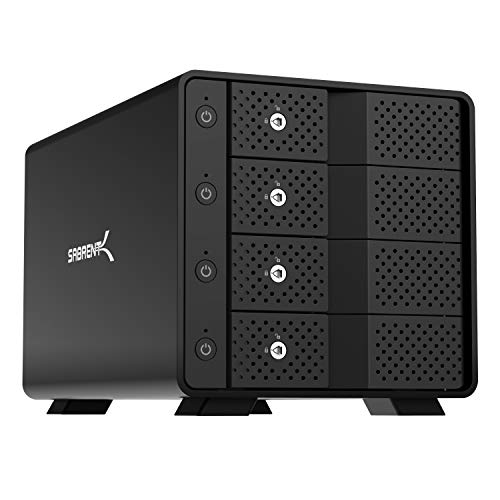
- Four 3.5-inch bays with up to 80TB listed capacity
- 10Gbps USB-C and independent bay controllers
- Tray-less hot-swap with active cooling
Best For: Desktop users wanting four independently accessed drives without RAID
Best for Expandable Professional Storage
ORICO 4-Bay 10Gbps DAS Enclosure

- Four independent 3.5-inch SATA drive bays
- Up to 88TB per unit and 264TB daisy-chained
- 150W power supply with aluminum cooling design
Best For: Video editors and large-file professionals
Best for Large Home Archives
ORICO 5-Bay USB-C DAS Enclosure

- Five bays support up to 110TB total
- Compatible with 2.5-inch and 3.5-inch SATA drives
- Plug-and-play design with 5Gbps transfers
Best For: Home data management and media storage
Top Pick – WAVLINK 4-Bay USB-C Enclosure
For shoppers comparing USB C NAS enclosures, the WAVLINK 4-Bay model combines four SATA bays with 10Gbps USB-C connectivity, active cooling, and additional display functionality. It supports both 3.5-inch and 2.5-inch drives, though 2.5-inch drives require separate mounting brackets.
Best For: Users who want flexible, high-capacity direct-attached storage with fast transfers and HDMI output.
Pros:
- Four bays support 3.5-inch and 2.5-inch SATA HDDs or SSDs.
- USB-C 3.2 provides transfer speeds up to 10Gbps.
- Aluminum construction and temperature-controlled dual fans help manage heat.
- Includes HDMI output up to 4K at 60Hz when the host USB-C port supports video output.
Cons:
- 2.5-inch drive mounting brackets are not included.
- HDMI functionality depends on compatible host video output and a USB-C-to-C connection.
- The supplied information describes independent bay power switches rather than hardware RAID.
This is a versatile expansion enclosure for large media libraries, backups, and workstation storage. Its combination of four bays, fast USB-C, cooling, and HDMI makes it especially practical for a busy desk setup.
RAID Choice – QNAP TR-004 4-Bay USB-C DAS
QNAP TR-004 4 Bay USB Type-C Direct Attached Storage (DAS) with hardware RAID (Diskless)
Check Price On AmazonThe QNAP TR-004 is a diskless four-bay DAS for shoppers evaluating USB C NAS enclosures with hardware RAID. It connects over USB Type-C to Windows, macOS, or Linux systems and can also expand compatible QNAP NAS storage, subject to QNAP’s stated compatibility limitations.
Best For: Users who need selectable RAID 0, 1, 5, JBOD, or individual-disk configurations in a metal four-bay enclosure.
Pros:
- Hardware RAID supports RAID 0, 1, 5, JBOD, and individual disks.
- Four lockable 3.5-inch SATA bays provide room for storage expansion.
- Works as direct-attached storage with Windows, macOS, and Linux.
- Can serve as external storage for NAS backups or compatible QNAP NAS expansion.
Cons:
- Ships diskless, so drives must be purchased separately.
- Its listed data transfer rate is up to 5Gbps, below 10Gbps USB-C enclosures.
- QNAP NAS compatibility and storage-pool limitations require careful checking before purchase.
The TR-004 is a strong fit when hardware RAID matters more than maximum USB speed. Buyers should review QNAP’s compatibility notes, particularly if they plan to connect it to an existing NAS.
Compact Pick – ORICO 2.5-Inch USB-C Enclosure
The ORICO DD25-C3 is a compact single-drive option among USB C NAS enclosures, designed for one 2.5-inch SATA HDD or SSD. Its aluminum housing, tool-free installation, and USB 3.2 Gen 2 cable make it convenient for portable storage, device upgrades, and everyday file transfers.
Best For: Users who need a simple, portable enclosure for a single 2.5-inch SATA drive.
Pros:
- Supports 2.5-inch SATA HDDs and SSDs in 7mm or 9.5mm thicknesses.
- USB 3.2 Gen 2 supports up to 10Gbps, with a USB-C-to-A/C cable included.
- Tool-free, plug-and-play installation with hot-swapping.
- Aluminum housing and built-in protection features support safer operation.
Cons:
- Holds only one drive.
- Maximum listed capacity is 6TB.
- Users should safely eject the drive before unplugging to help avoid data loss.
This enclosure is a practical choice for repurposing a 2.5-inch SATA drive or adding portable storage to a computer, tablet, PS5, TV, or phone. It is not intended for multi-drive capacity or RAID.
RAID Flexibility – MAIWO 4-Bay RAID Enclosure
The MAIWO four-bay enclosure is aimed at buyers seeking USB C NAS enclosures with extensive RAID options. It accepts four 3.5-inch SATA drives, supports up to 96TB using four 24TB drives, and connects through a USB A/C 3.1 interface at up to 5Gbps.
Best For: Professionals and power users who want multiple RAID layouts for backups, surveillance storage, or large media collections.
Pros:
- Offers eight listed modes, including Normal, RAID 0, 1, 3, 5, 1/10, Clone, and Large/JBOD.
- Supports four 3.5-inch SATA I/II/III drives and up to 96TB total capacity.
- Includes USB-A-to-C and USB-C-to-C cables.
- Dual switch-controlled cooling fans help manage drive temperatures.
Cons:
- USB transfer speeds are limited to up to 5Gbps.
- Designed for 3.5-inch drives rather than a mix of 2.5-inch and 3.5-inch drives.
- Its return and damage-reporting requirements should be reviewed before purchase.
The MAIWO stands out for configuration flexibility and high-capacity 3.5-inch storage. It is a good fit for users who value RAID choices and cooling, while buyers prioritizing faster transfers may prefer a 10Gbps model.
Best High-Capacity Pick – SABRENT 5-Bay USB-C DAS Enclosure
For shoppers comparing USB C NAS enclosures, the SABRENT DS-SC5B is a high-capacity five-bay option for direct-attached storage. It holds up to five 3.5-inch SATA drives and connects to a computer through USB-C at up to 10Gbps, but it is a DAS enclosure—not a network-attached storage device or hardware RAID system.
Best For: Users who need five independently mounted drives, tray-less hot-swapping, and quiet temperature-controlled cooling for Windows, macOS, or Linux.
Pros:
- Five empty 3.5-inch bays support up to 100TB total capacity.
- Dedicated controller for each bay provides independent drive access.
- 10Gbps USB-C connectivity, hot-swap design, and per-bay power switches.
- 120mm PWM fan adjusts cooling based on drive temperature.
Cons:
- Drives are not included.
- It does not provide RAID or network access; each drive mounts individually over USB.
- The larger five-bay enclosure weighs about 10 pounds.
The DS-SC5B is a strong choice when capacity and independently accessible drives matter more than built-in RAID or NAS features. Its cooling, locking features, and included USB-C cables make it well suited to a desktop DAS setup.
Best for Everyday Use – MAIWO 4-Bay USB-C RAID Enclosure
Among USB C NAS enclosures, the MAIWO four-bay enclosure stands out for its broad RAID-mode support. It accepts 2.5-inch and 3.5-inch SATA drives, offers RAID 0, 1/3/5/10, Clone, Normal, and Large/JBOD modes, and connects over USB-C, although it remains direct-attached storage rather than a true NAS.
Best For: Users who want configurable RAID storage, support for mixed drive sizes, and an enclosure that can also connect to compatible PCs, routers, phones with OTG, or TVs.
Pros:
- Supports seven listed RAID and drive-configuration modes.
- Four bays accept both 2.5-inch and 3.5-inch SATA HDDs or SSDs.
- Dual fans and a 78W external power supply support sustained operation.
- Includes USB-A-to-C and USB-C-to-C cables plus drive-installation hardware.
Cons:
- It is DAS, not a network-attached storage system.
- USB transfer speed is listed as up to 5Gbps, below the 10Gbps speed of some alternatives.
- Drive capacity specifications vary in the supplied listing, which cites both 72TB and 96TB.
The MAIWO is the more versatile choice for buyers prioritizing RAID configuration over maximum USB speed. Its cooling and power design suit multi-drive workloads, while the TV-oriented HDMI feature adds flexibility for compatible setups.
Best Four-Bay USB-C DAS – SABRENT 4-Bay USB-C DAS Enclosure
The SABRENT DS-SC4B is a practical four-bay option for shoppers evaluating USB C NAS enclosures for desktop storage. It provides up to 10Gbps USB-C connectivity for four 3.5-inch SATA drives, with tray-less hot-swapping and individual drive controls. Like the five-bay model, it is DAS rather than a NAS or hardware RAID enclosure.
Best For: Users who need a compact four-drive USB-C setup with independent bay access, active cooling, and compatibility with Windows, macOS, and Linux.
Pros:
- Four 3.5-inch bays support up to 80TB according to the product notes.
- Dedicated ASMedia controller per bay supports stable independent access.
- 10Gbps USB-C, tray-less hot-swap, per-bay switches, and activity LEDs.
- Aluminum-and-metal housing with a 92mm fan supports continuous operation.
Cons:
- Drives are not included.
- No hardware RAID or network access; it operates as JBOD-style DAS.
- Uses an external AC adapter.
This enclosure fits buyers who want four independently managed drives without paying for built-in RAID features. Its 10Gbps connection, sturdy housing, and hot-swap design make it a capable desktop expansion dock for compatible computers.
Best for Expandable Professional Storage – ORICO 4-Bay 10Gbps DAS Enclosure
For shoppers comparing USB C NAS enclosures, the ORICO 9948C3 is a high-capacity four-bay DAS option with USB 3.2 Gen 2 connectivity. It supports four independent 3.5-inch SATA drives, delivers up to 10Gbps transfer speeds, and can be daisy-chained with additional units for large storage setups.
Best For: Video editors, professionals, and users managing large files who want expandable desktop storage.
Pros:
- Supports up to 88TB across four drives, with daisy-chain expansion up to 264TB using three devices.
- Independent disk slots allow single-drive replacement or upgrades.
- Aluminum construction, an 80mm fan, and front and rear vents support cooling.
- Built-in 150W power supply helps support simultaneous multi-drive use.
Cons:
- Designed for 3.5-inch SATA HDDs rather than offering stated native 2.5-inch drive support.
- Its four-bay desktop design may be more capacity than casual users need.
The 9948C3 stands out when capacity and expansion matter more than a compact footprint. Its 10Gbps USB-C connection, replaceable drives, and strong cooling make it a practical choice for demanding storage workflows.
Best for Large Home Archives – ORICO 5-Bay USB-C DAS Enclosure
Among USB C NAS enclosures, the ORICO 9758C3 emphasizes straightforward, high-capacity desktop storage. Its five-bay design supports 2.5-inch and 3.5-inch SATA drives, includes a USB/Type-C data cable, and offers plug-and-play operation for centralized file management.
Best For: Home users who want a large personal database for backups, media, documents, and general file organization.
Pros:
- Five bays provide up to 110TB using drives rated up to 22TB each.
- Supports both 2.5-inch and 3.5-inch SATA hard drives.
- 12V/10A power supply supports reading and writing across multiple drives.
- Quiet 80mm fan helps with cooling during extended use.
Cons:
- USB 3.2 Gen 1 connectivity is rated at up to 5Gbps, below the 10Gbps class of some alternatives.
- The listed product details contain inconsistent capacity and supported-device fields, so buyers should verify specifications before ordering.
This enclosure is a sensible capacity-first choice for a home archive or personal storage hub. It offers more bays than the other options here, though users prioritizing the fastest USB performance may prefer a 10Gbps model.
Best for Storage and Display Expansion – WAVLINK 4-Bay USB-C Dock
The WAVLINK four-bay model is a versatile alternative for shoppers considering USB C NAS enclosures with workstation features. Along with four SATA bays and 10Gbps USB-C connectivity, it adds HDMI output up to 4K at 60Hz, an extra USB-C port, independent bay switches, and temperature-controlled fans.
Best For: Desktop users who want expandable storage combined with display and peripheral connectivity.
Pros:
- Supports four 3.5-inch or 2.5-inch SATA HDDs or SSDs, up to 88TB total.
- USB 3.2 Type-C provides transfer speeds up to 10Gbps.
- HDMI supports up to 4K at 60Hz when the host USB-C port supports video output.
- Dual fans automatically activate at 48°C, and each bay has an independent power switch.
Cons:
- 2.5-inch drives require separate 2.5-inch-to-3.5-inch mounting brackets.
- HDMI output depends on a compatible host USB-C port and a USB-C-to-C cable.
- Its added docking features may be unnecessary if storage is the only requirement.
The WAVLINK is the most feature-rich choice in this group for a mixed storage-and-desk setup. It is particularly appealing for users who can take advantage of its video output and extra connectivity, provided their host system supports the required USB-C video functionality.
How We Picked the Best USB C Nas Enclosures
We focused on enclosures that offer practical ways to connect SATA hard drives or SSDs over USB-C, with attention to drive capacity, bay count, transfer bandwidth, RAID support, cooling, power delivery, and compatibility. The selection includes compact single-drive models as well as four- and five-bay direct-attached storage units.
We also considered how easily each enclosure fits common workflows. Some are designed for straightforward plug-and-play expansion, while others are better suited to users who want hardware RAID, redundancy, or a larger desktop storage pool. Product claims such as maximum capacity can depend on drive sizes, formatting, RAID mode, and firmware.
Quick Comparison
| Best For | What to Look For |
|---|---|
| Simple portable expansion | Single-drive enclosure, USB 3.2, broad macOS and Windows support |
| Large media libraries | Four or five bays, high capacity, active cooling, strong power supply |
| Drive redundancy | Hardware RAID or several supported RAID modes |
| Fast project storage | 10Gbps USB-C and SSD-compatible bays |
| Budget desktop storage | Plug-and-play DAS operation and included cables |
Key Buying Factors for USB-C NAS Enclosures
Bay Count and Drive Compatibility
Choose the number of bays based on both current needs and likely expansion. Two- and four-bay designs are suitable for most home users, while five-bay models provide more room for backups and media collections. Check whether the enclosure accepts 3.5-inch drives, 2.5-inch drives, or both, and confirm the maximum supported capacity.
USB Speed and Host Connections
A 10Gbps USB-C connection can reduce transfer times when paired with a compatible computer, cable, and SSD. Mechanical hard drives may not reach that ceiling, but the faster interface can still help when multiple drives are used. Verify whether the package includes USB-C-to-C, USB-C-to-A, or both cable types.
RAID, Cooling, and Reliability
RAID can improve redundancy or performance, but it is not a substitute for an independent backup. Hardware RAID is convenient for users who want enclosure-managed storage, whereas independent disks offer simpler recovery and flexibility. For multi-drive systems, temperature-controlled fans, ventilation, and a reliable power adapter are important for sustained workloads.
DAS Versus a True Network NAS
Most products here are direct-attached storage devices, not full network NAS servers. They connect directly to a computer through USB and generally do not provide built-in network services, remote access, apps, or independent NAS operating systems. If you need shared access across many devices without a host computer, a dedicated network NAS may be more appropriate.
Who Should Buy Which USB C Nas Enclosures?
Choose a single-drive ORICO enclosure if you need a compact, affordable way to reuse one SATA drive. Four-bay models from WAVLINK, QNAP, MAIWO, SABRENT, and ORICO are better for expandable desktop storage, backup rotation, and organized media libraries. Look to five-bay SABRENT or ORICO options when maximum local capacity matters most. For users who want built-in storage management and redundancy, the QNAP or RAID-capable MAIWO models are the strongest starting points.