
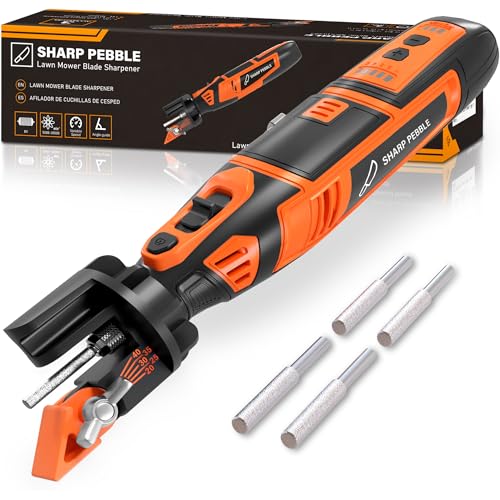
Sharp Pebble Cordless Lawn Mower Blade Sharpener is built for one job: keeping standard residential mower blades in shape without turning blade maintenance into a weekend project.
If you want a faster way to refresh a dull edge between full services, this Sharp Pebble Cordless Lawn Mower Blade Sharpener review should help you judge whether it fits your mower and your workflow.
Cordless Blade Sharpener Review Summary
The Sharp Pebble Cordless Lawn Mower Blade Sharpener makes sense for homeowners who want to maintain a cutting edge regularly instead of waiting until the blade is badly worn.
Its strongest appeal is convenience: the listing says blade removal is optional for many standard residential blades, and the cordless format removes one more layer of setup.
Best fit: routine maintenance on ordinary homeowner mower blades.
Less suitable: damaged, chipped, or commercial blades that need heavier grinding or more robust equipment.
As a category tool, it is trying to save time, reduce friction, and extend blade life, not replace a full shop grinder.
Review Scorecard
| Category | Score | Why it matters |
|---|---|---|
| Convenience | 9/10 | Cordless use and optional on-mower sharpening make quick touch-ups easier to start. |
| Angle Control | 8/10 | The 20° to 40° guide helps match different blade geometries. |
| Maintenance Value | 8/10 | It is positioned as a way to maintain rather than replace blades. |
| Portability | 9/10 | Lightweight cordless design suits garage, driveway, or shed use. |
| Power for Routine Work | 7/10 | The variable-speed rotary approach looks well matched to touch-ups, not heavy material removal. |
| Durability Fit | 6/10 | Good for standard residential blades, but not the answer for deep damage or commercial use. |
| Safety/Control | 7/10 | The adjustable guide and ergonomic grip should help, but blade work still demands care. |
Key Features and Specifications of Cordless Blade Sharpener
The listing centers on standard residential mower maintenance.
It is a cordless rotary sharpener with a replaceable wheel bit setup and a rechargeable battery, designed around quick edge touch-ups rather than full blade rebuilding.
| Spec | What the listing says |
|---|---|
| Product type | Cordless lawn mower blade sharpener / rotary tool kit |
| Angle range | Adjustable guide from 20° to 40° |
| Operation | Cordless, lightweight, handheld |
| Speed range | Variable speed from 5,000 to 30,000 RPM |
| Blade workflow | Blade removal is optional for many standard residential blades |
| Battery note | One full charge is said to sharpen 1 to 2 standard residential blades |
| Included use case | Routine edge maintenance for homeowner mower blades |
| Important limitation | Not intended for zero-turn or heavy-duty commercial blades |
Several listing claims are worth reading carefully.
First, the tool is explicitly described as a sharpener, not a grinder.
That matters because buyers often confuse the two and expect a sharpener to repair chips, dents, or missing metal.
Second, the adjustable angle guide is a practical feature only if you actually take a moment to align it consistently; angle control is a strength only when you use it consistently.
The battery claim is also directional rather than absolute.
The listing suggests a full charge is enough for 1 to 2 standard residential blades, which sounds appropriate for occasional maintenance sessions, but not for large fleets or repeated deep rework.
That makes it more of a homeowner convenience tool than a high-volume workshop tool.
Pros and Cons of Cordless Blade Sharpener
Pros
- Fast setup for routine use. Cordless operation reduces the friction of dragging out cords and power placement.
- Optional blade removal. For many standard residential blades, the listing says sharpening can be done without taking the blade off the mower.
- Adjustable angle guide. The 20° to 40° range is useful for matching different edge profiles.
- Portable and lightweight. Easy to carry to the mower instead of bringing the mower to a workstation.
- Maintenance-focused value. The product is aimed at extending blade life, which is the right goal for regular homeowners.
Cons
- Not a damage-repair tool. Deep dents, chips, and missing metal are outside its scope.
- Not for heavy-duty commercial use. The listing says it is not compatible with zero-turn or commercial blades that need higher torque.
- Depends on user consistency. The angle guide helps, but only if the user holds position and checks alignment.
- Battery ceiling is modest. The advertised output is enough for a small session, not a long day of sharpening.
Who Should Buy Cordless Blade Sharpener?
Buy this if you own a standard residential mower and want to keep the blade sharp on a regular schedule.
It is especially useful if you prefer a compact tool that can be taken to the mower, used quickly, and stored without much setup.
This is also a good fit if you already understand basic mower maintenance and want a practical middle ground between doing nothing and paying for service.
The listing’s emphasis on optional blade removal and routine touch-ups points to a buyer who values speed and convenience.
Skip it if your blade is visibly damaged, badly chipped, or built for a heavy-duty commercial setup.
In that case, the listing itself says you need a grinder first, and this tool is not meant to perform that job.
It is also a poor match if you want one tool to handle every blade condition, because its strength is maintenance, not rescue work.
How the Sharp Pebble System Works in Practice
Angle Guide and Edge Matching
The 20° to 40° adjustable guide is the most important technical detail here because blade sharpening is mostly about consistency.
If the guide holds steady, it should help you preserve the edge geometry instead of grinding randomly and weakening the blade profile.
Cordless Convenience and Session Size
The cordless format is the reason this product exists for many buyers.
It is meant for quick maintenance sessions where getting started matters more than long runtime, and the listed battery capacity supports that use case.
What It Can and Cannot Fix
This is where buyer expectations need to stay realistic.
It is built for dull edges, not damaged metal.
If the blade has chips, dents, or missing sections, the listing says that condition calls for a grinder rather than this sharpener.
Fit for Residential Mowers
The product language keeps returning to standard residential blades, and that is the correct frame for evaluation.
If your mower falls into that category, the tool sounds well matched.
If your equipment is bigger, tougher, or more specialized, the fit gets weaker fast.
Alternatives to Cordless Blade Sharpener
If you want a different approach, compare it with these options:
- Work Sharp blade sharpening solutions
- Dremel sharpening attachments
- Lawn mower blade sharpening kits
- Bench grinder options
Work Sharp-style systems make sense if you want a more established sharpening workflow.
Dremel-based options are worth comparing if you already own a compatible rotary tool.
A generic mower blade sharpening kit can be a lower-complexity choice if you want basic maintenance without a specialized cordless package.
A bench grinder is the better alternative when you need more aggressive metal removal or have damaged edges to rebuild.
Is Cordless Blade Sharpener Worth It?
Yes, if your goal is fast, regular maintenance on standard residential mower blades and you value cordless convenience over workshop-grade power.
The Sharp Pebble Cordless Lawn Mower Blade Sharpener looks most compelling as a practical homeowner tool for keeping blades serviceable through the season.
It is worth it for routine upkeep and not worth it for damaged blades or commercial workloads.
If that is the right boundary for your needs, this looks like a sensible buy.